

Consultation Planning
Prepare for a clinician conversation that separates your goals, the proposed procedure order and the travel arrangements that follow.
This guide helps you organize that conversation, understand the alternatives and translate a clinician's recommendation into travel planning without treating an advertised combination as personal approval.
Define the procedures before discussing their order
Start by clarifying both the procedures and the meaning of “sequence.” Order within a combined operation is different from deciding which procedure happens first when operations are separated. Ask the clinician to address the question you actually mean.
Breast augmentation also needs a precise description. VIDA Wellness and Beauty's breast augmentation page describes augmentation with implants or fat transfer and distinguishes adding breast volume from a breast lift. That distinction matters: a discussion about implants is not automatically a discussion about breast fat transfer or an additional lift.
Prepare a private note about the changes you want and which goal matters most. Use it during the clinician consultation rather than selecting a technique yourself. Have the clinician name the proposed breast procedure and the proposed BBL plan, including any associated procedures. You can then discuss the order of a defined plan instead of an ambiguous bundle.
Compare combined, staged and narrower plans together
Discuss a combined operation only if the treating clinician considers both procedures and their combination appropriate for you. Staging, pursuing only one procedure or postponing a decision should remain available alternatives, not evidence that your original goals were wrong.
Mommy Makeover Tijuana's BBL page discusses incorporating BBL into a broader surgical plan and makes candidacy part of that discussion. Its description is not an assessment of you, and it does not establish that another provider offers the same combination.
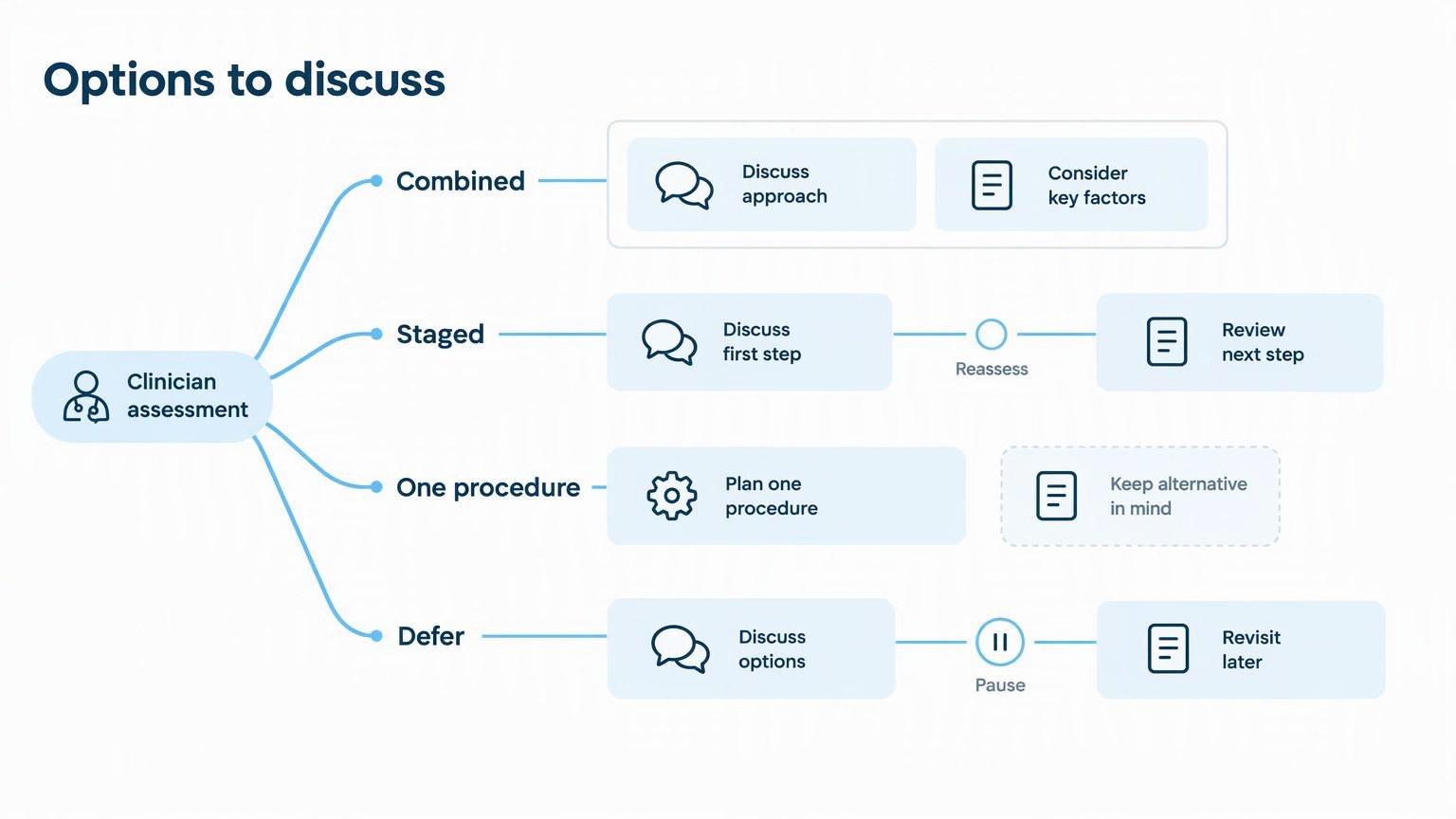
The comparison below is for structuring a consultation, not selecting your treatment. A combined route may appeal because it could consolidate travel, but one trip does not establish compatible aftercare. A staged route separates the operations, but you still need an explanation of what determines readiness for the later procedure. Choose the next planning step from the clinician's reasoning, not the number of reservations.
| Route | When to discuss it | Reason | Trade-off |
|---|---|---|---|
| Combined operation | The clinician supports each procedure and their combination. | It may consolidate the surgical travel plan. | Combined aftercare and individual suitability still need explanation. |
| Staged procedures | The clinician recommends separate operations. | It allows reassessment before the later procedure. | It involves separate planning and potentially another trip. |
| One procedure only | One goal has priority and that procedure is independently appropriate. | It narrows the current decision. | The other goal still requires a separate decision. |
| Defer the decision | Assessment or essential care arrangements remain incomplete. | It avoids committing to an undefined plan. | Your preferred schedule may need to change. |
Ask for the reasoning behind suitability and sequence
A useful recommendation explains why the plan fits you and why its order was chosen. “We usually do it this way” does not, by itself, explain your individual suitability or the proposed combination.
Use this compact checklist in the clinician consultation:
- Individual assessment: What findings support or rule out each procedure for me?
- Combination: How does evaluating both together change your recommendation about risks, anesthesia and aftercare?
- Order: Why this sequence rather than the alternatives?
- Daily care: What instructions would apply to sleeping, sitting, movement and assistance, and can they be followed together?
- Reassessment: What would cause you to change, separate or defer the plan?
- Responsibility: Who makes the clinical decisions and manages follow-up concerns?
Do not use the checklist to design your own recovery routine. Its purpose is to obtain a coherent explanation from the treating team. For staged procedures, request readiness criteria for the later operation rather than treating a calendar interval as automatic approval.
Use your priorities without letting the calendar choose surgery
A limited travel window should shape the discussion, not determine clinical suitability. If the recommended care cannot fit your available time, the useful alternatives are to change the travel window, narrow the proposed plan or postpone it.
Say you want both procedures, but breast augmentation is your main priority. Your time away from work is fixed, and the clinician has not yet explained the follow-up requirements for a combined operation.
Combining procedures would match your preference for a single trip, but without defined follow-up requirements, you cannot yet judge whether that trip works. Staging would allow you to discuss the priority procedure separately, although it would leave another clinical decision and potentially another trip later. Deferring both preserves time to clarify the full recommendation.
The reasoned next step is to ask whether the priority procedure is independently appropriate and what care it would require. If it is, compare that defined plan with waiting for the broader assessment. Do not assume either operation has a shorter recovery or that moving one first solves the scheduling problem.
Build the travel plan from clinical milestones
Once a clinician has proposed a plan, arrange travel around the required assessments, follow-up and individual clearance to fly. A published recovery estimate or a reserved flight is not your personal departure approval.
First, obtain the treating team's review milestones and instructions for travel decisions. Next, compare lodging and transport arrangements against those requirements, including any assistance the care plan specifies. Then decide whether the reservations accommodate the plan or need different terms. Arrange the clinical follow-up handoff before departure so you know who handles concerns that still need attention afterward.
Keep medical requirements and booking consequences separate. If the clinician directs a longer stay, an additional hotel night remains a travel charge. That instruction does not establish who pays, whether the night is included or what cancellation terms apply. Those answers come from the applicable supplier agreement. Insurance coverage and claim conditions are separate from the supplier's change or refund obligations.
For staged procedures, repeat this process after the later operation is clinically approved. Do not turn a tentative second procedure into a fixed travel commitment prematurely.

Review Hospitality Cancun's role before making an inquiry
Hospitality Cancun publishes travel and consultation-planning education for adults considering care in Cancun or the Mexican Caribbean. Use that scope to judge its relevance to your travel-planning interests; procedure suitability, sequence and recovery instructions belong with your qualified treating clinician.
When considering a clinician, distinguish the named professional from the website or intermediary presenting them. Obtain the clinician's identity, relevant credentials and proposed treating facility, then seek confirmation from the issuing authority or facility. A combined-procedure page does not establish those details for your own care.
Before submitting any information through the Hospitality Cancun contact section, clarify the recipient and purpose. A first submission allows only your name and email, with an optional contact-method preference. Travel details may be discussed later with the confirmed travel contact. Diagnoses, scans and clinical records belong only in a named provider-confirmed secure channel, not a general form.
Keep permission to reply to your inquiry, optional marketing and referral to a specifically named provider separate. Permission for a requested reply is not marketing consent.
Frequently Asked Questions
Does a “mommy makeover” label identify the exact procedures?
No. Treat the label as a starting description, not a complete surgical plan. Ask the treating clinician to name every proposed procedure and distinguish what is recommended from what was merely discussed. Your sequence conversation should refer to those specific procedures, not the package name.
Should I decide on implant size before the consultation?
You can prepare your preferences, but leave the recommendation to the clinician's assessment. VIDA's breast augmentation page describes consultation as including anatomical requirements and aesthetic concerns. Explain the change you want rather than treating a selected size as a condition that every proposed plan must meet.
What if two clinicians recommend different sequences?
Compare the reasons and assumptions behind each recommendation, not just the order. Check whether they evaluated the same procedures and had the same relevant clinical information. Ask each to explain the alternative. If the difference remains important, consider an independent clinical opinion before making surgical or travel commitments.
Does discussing both procedures commit me to both?
No. You can state both goals while asking for an assessment of each separately. Make clear which goal matters most and request an explanation of alternatives. A consultation should help you understand the recommendation; a discussion of combined planning is not itself your decision to proceed with both.
Can before-and-after photographs tell me which procedure should come first?
No. Photographs can help you describe aesthetic preferences, but they do not show the clinical reasoning needed for your sequence decision. Use them as conversation aids, not evidence that another person's plan applies to you. Ask the clinician to connect the recommendation to your assessment and proposed care.