

Consultation Planning
Match your questions to the people responsible for clinical decisions, follow-up and travel arrangements before relying on a package description.
An all-inclusive plastic surgery package may describe purchases without explaining the care team's responsibilities. Before relying on it, establish who makes each decision, how you can reach that person and where questions outside their role go. Use those answers to evaluate the proposed team, separately from package contents.
Compare responsibility, not reassuring package language
A useful answer identifies a person or defined role, explains their responsibility and tells you how to reach them. Continue evaluating when those details are clear; pause when reassurance replaces accountability.
In your provider consultation, ask: “Who is responsible for each part of my care, and which questions can I discuss directly with them?” Distinguish the proposed surgeon, anesthesia clinician, follow-up clinician and administrative contact. These are responsibilities to clarify, not a promise that every proposal uses identical staffing.
One contact can relay messages without being qualified to interpret a clinical concern. Several contacts can also work well when their roles and handoffs are explicit. Judge whether your question reaches someone qualified to answer it, not how many people are involved.
The comparison below connects team answers to your next step. Clear responsibilities support further evaluation; they do not establish treatment suitability or guarantee an outcome.
Check the exact clinician and facility named
Investigate the proposed clinician and facility separately. A surgeon's credential does not establish a facility's status, or vice versa.
Start with the clinician's full professional name and exact credential claimed. Search the name alongside the credential issuer, then use the issuer's verification resource where available. Match identifiers and specialty rather than accepting a similar name or a screenshot without context.
If the search does not establish the claim, seek clarification from the issuer. A logo or membership description cannot replace evidence of what was issued, to whom and whether it is current.
For the procedure location, establish its exact name and address. Investigate any claimed authorization or accreditation independently of the surgeon's credentials. Keep findings in your private comparison notes. An inconclusive search is not proof of misconduct, but the claim still needs support before you rely on it. Separate what you have established from what remains to be checked.
| Answer you receive | Next step | Reason |
|---|---|---|
| Named roles, direct clinical discussion and an explained follow-up pathway | Continue evaluating the proposed team | You can investigate qualifications and address questions to the responsible person. |
| A friendly shared contact, but no identified clinical responsibility | Pause the care decision and resolve the missing roles | Message access does not establish who makes clinical decisions. |
| An all-inclusive label used instead of answers about the team | Separate package contents from clinical accountability | A list of purchases does not identify who assesses, treats or follows up. |

Take surgery and anesthesia questions to the clinical team
The qualified treating clinician should explain your eligibility, treatment suitability and individualized surgical recommendation. A planning contact can explain communication arrangements, but cannot replace that clinical discussion.
Ask the proposed surgeon why the approach fits your goals, what alternatives deserve consideration and which limitations or risks matter to your decision. If implants are proposed, ask about the implant and the reasons for recommending it. Seek clinical reasoning, not simply a product name.
For anesthesia, establish who will assess you, who will provide care and how you can raise anesthesia-specific questions. Let that clinician explain the assessment and plan rather than treating an administrative description as individualized advice.
A useful consultation leaves you able to explain the recommendation in your own words, including what remains undecided. Take conflicting clinical answers back to the responsible clinicians. A coordinator should not choose between medical recommendations or interpret which applies to you.
Trace the follow-up handoff beyond your stay
Identify who reviews you during your stay, receives concerns between visits and provides clinical follow-up after you return home. An inbox alone does not explain who assesses messages or decides what happens next.
Imagine comparing proposals before returning to the United States. One says, “Message our team anytime.” Another names the follow-up clinician and explains how messages reach clinical review, including when that clinician is unavailable.
The second answer gives you an actionable pathway, not proof of better outcomes. With the first, pause the follow-up decision until responsibility and escalation are explained. With the second, continue evaluating credentials and the care plan.
Establish which reviews the treating team expects to provide and what arrangements may be needed at home. Do not assume an unnamed local clinician will accept the handoff. Before departure, understand how to obtain care documentation and the treating team's instructions for concerns requiring urgent attention.
Use the clinical plan to guide travel, not the reverse
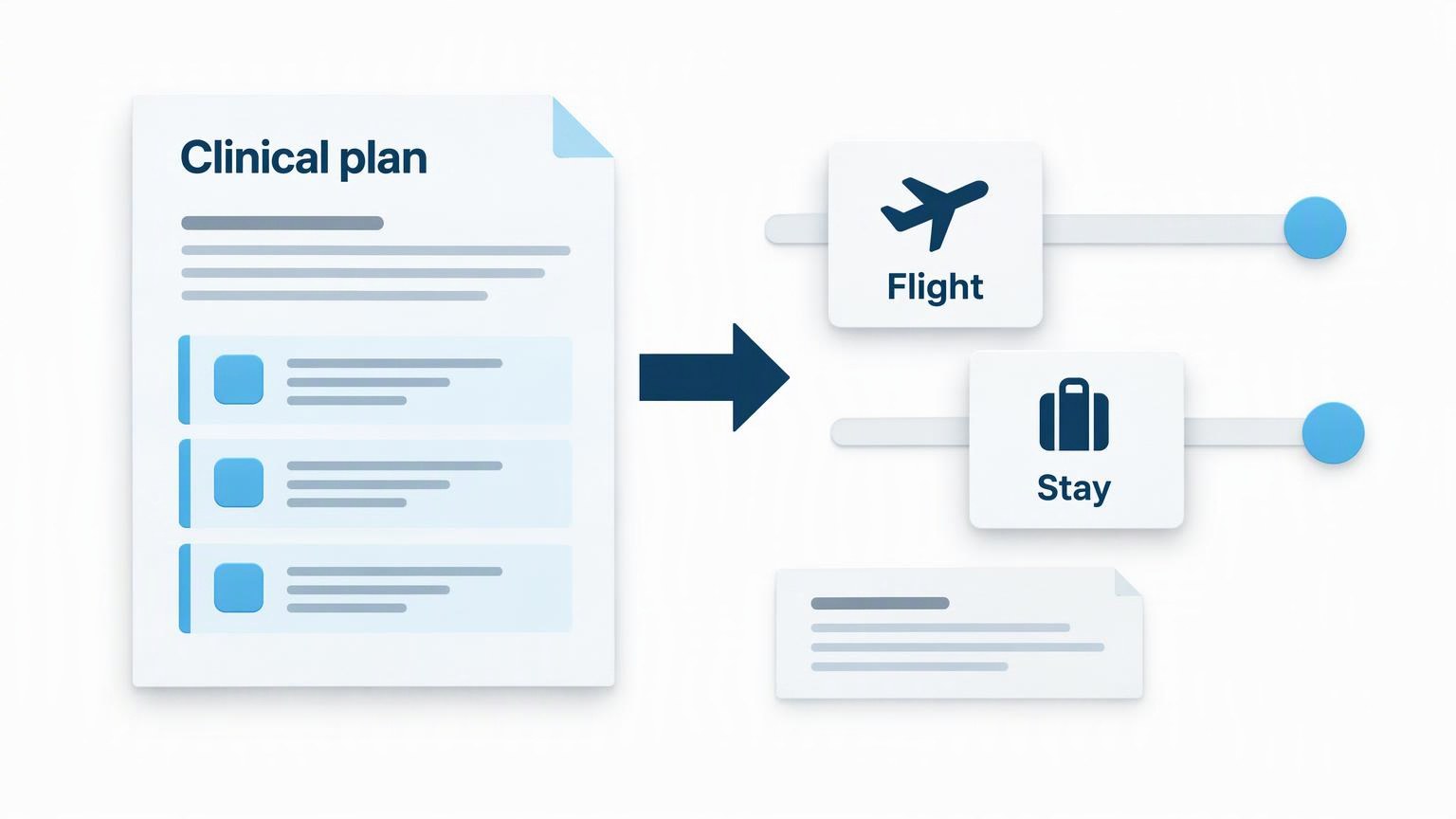
Flight timing and length of stay depend on the treating clinician's advice and follow-up plan. Package lodging is not individual clearance to fly; a return ticket should not determine the clinical schedule.
First establish when assessments require your presence and what support the clinician says you need. Then compare reservation flexibility and arrange travel around that plan.
If a clinical review changes your departure, the clinician explains the medical decision; the airline or lodging supplier explains reservation consequences. An extra hotel night remains a travel service even when clinically recommended. That cause establishes neither who pays nor whether the night is included.
Supplier cancellation, refund and change terms govern contractual consequences. Insurance coverage depends separately on the policy and claim conditions; neither the medical recommendation nor supplier terms establish coverage.
A changed flight or room booking does not itself require additional clinical support. That requirement comes from the care plan, while reservation changes remain a logistics task.
Review Hospitality Cancun's role before beginning contact
Hospitality Cancun publishes travel and consultation-planning guidance for adults considering care in Cancun or the Mexican Caribbean. Consider that educational scope separately from breast augmentation suitability, which belongs with a qualified treating clinician.
Before submitting information through the contact section, clarify the recipient and collection purpose. If either is unclear, wait. The first submission allows only name and email, with optional contact-method preference, not trip details, narratives, health information or attachments.
Keep permission to answer your inquiry, optional marketing and referral to a specifically named provider separate. A requested reply is not marketing consent.
Discuss ordinary travel details later with the confirmed travel contact once recipient and purpose are clear. Diagnoses, scans and clinical records belong only in a named provider-confirmed secure channel. Payment details and insurance identifiers are not clinical records and do not belong in a general inquiry.
Frequently Asked Questions
Does an English-speaking coordinator mean the clinical consultation will be in English?
Not necessarily. Establish how you will communicate with the treating clinicians and how interpretation will work if needed. A coordinator's language skills do not establish the consultation language. You need to be able to discuss your questions and understand the clinician's answers.
Can before-and-after photos replace questions about qualifications?
No. Photos establish neither the proposed clinician's credentials nor your suitability or follow-up arrangements. Use images in a clinical discussion to clarify your goals and the limits of comparison. Keep identity and credential verification separate from evaluating whether an image reflects your preferences.
What if the proposed surgeon changes before the procedure?
Revisit the decision with the newly proposed surgeon. Check their identity and credential claims, discuss the recommendation directly and clarify changed responsibilities. Do not treat the original consultation as interchangeable: administrative continuity does not answer your clinical questions about a different treating clinician.
Can my companion make clinical decisions for me?
A companion can organize questions and help you remember explanations, but should not replace your clinical discussion. Ask how participation and your permission will be handled. Traveling together does not establish authority to receive clinical information or make decisions on your behalf.
Are breast augmentation consultations always free?
No invitation to inquire establishes a free consultation. Ask the provider about the charge and applicable terms before agreeing. Distinguish a planning conversation from a clinical consultation: their purposes differ, and an inquiry invitation does not establish the price of either service.