

Consultation Planning
Use your consultation to turn a general recovery description into clear daily instructions, follow-up arrangements, and travel decisions.
A consultation should help you picture what happens after discharge, not just understand the operation. For a traveler, an answer such as “follow-up is available” leaves practical questions unanswered: where the review happens, who performs it, and what happens once you are home. Use the questions below in a discussion with the qualified treating care team. Hospitality Cancun publishes travel and consultation-planning guidance; individual treatment and recovery decisions belong to your clinician.
What should your postoperative instructions explain?
Your instructions should explain what you personally need to do, what to avoid, and when the care team should reassess you. A general description of recovery is useful background, but it is not a substitute for directions tailored to your procedure.
Dr Jeremy Hunt’s consultation guide identifies incision care, support garments, discomfort management, activity, and follow-up as topics for the surgeon discussion. Use those categories to organize your questions, not to borrow another patient’s routine.
- Incisions and dressings: What should I do about cleaning, bathing, and dressing changes?
- Medication: What is prescribed, how should I take it, and whom do I contact about problems?
- Garments: Is a particular garment required, and how will I know it fits correctly?
- Activity: What limits apply to lifting, reaching, driving, exercise, and everyday tasks?
- Assistance: Which tasks will require help, and how will those needs be reassessed?
Ask the team to explain unfamiliar terms and have you describe the instructions back. This reveals misunderstandings before you are managing care away from the facility.
Which follow-up arrangements fit your trip?
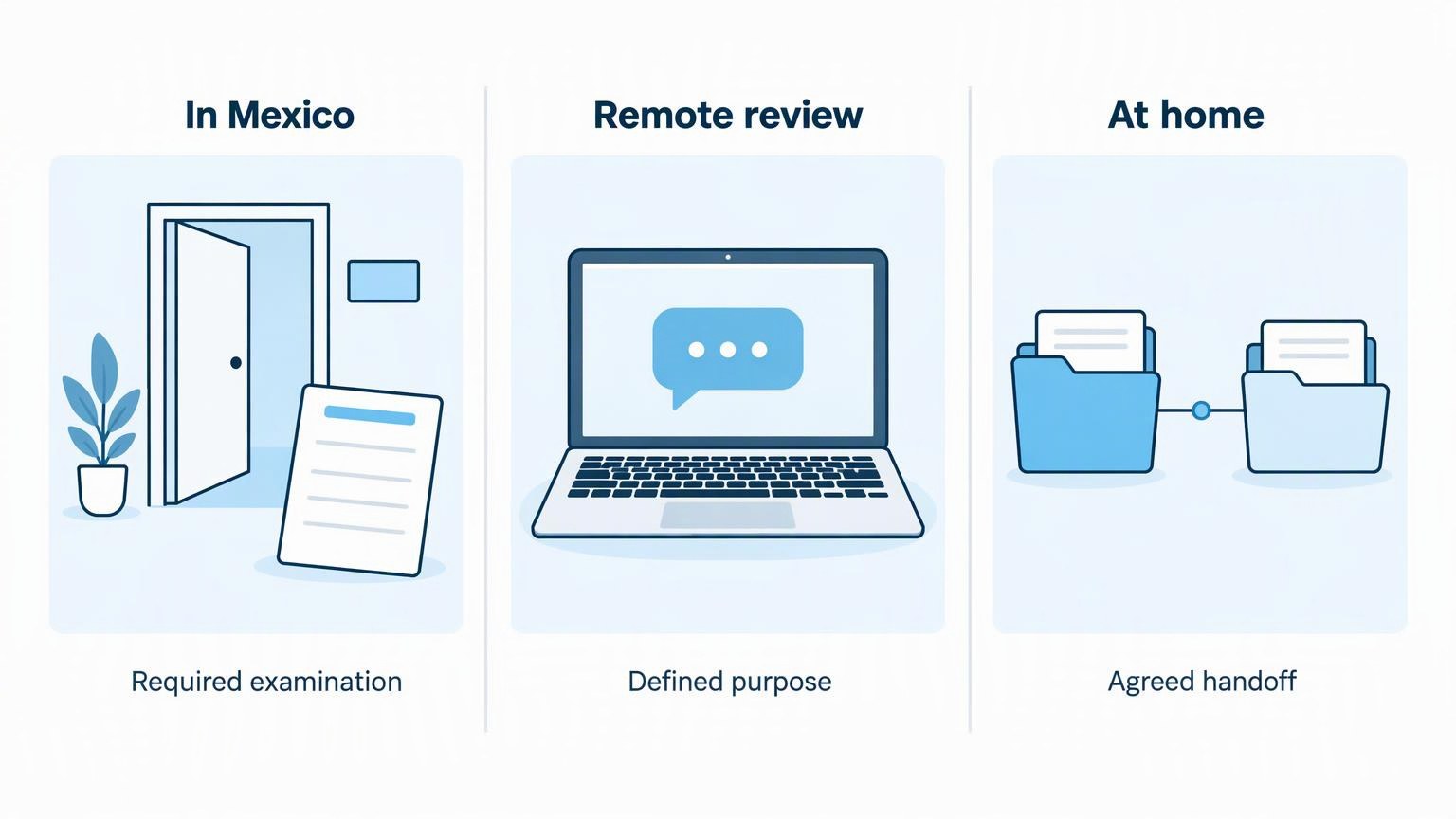
Choose a plan whose review arrangements match the treating clinician’s requirements and your ability to attend them. In-person reviews, remote contact, and care from a clinician at home can serve different purposes; none should be assumed to replace another.
Start by identifying who performs each review and what it is meant to assess. Then establish where it happens, how it is scheduled, and whether it requires an examination. A messaging channel alone does not explain the scope of follow-up.
Compare the formats below with the treating team. These are planning options, not claims that a particular provider offers them. A workable plan may combine formats, provided responsibilities are clear.
If returning to Mexico for a later review would be difficult, raise that before choosing an option. The answer may change the provider you select, the travel commitment you accept, or whether you postpone the decision. Do not assume a clinician at home has agreed to take over simply because you already have a primary care appointment.
| Format | Suitable when | Trade-off |
|---|---|---|
| In-person reviews in Mexico | The treating clinician requires an examination before departure. | Your stay must accommodate the review and its findings. |
| Remote follow-up after returning home | The treating clinician considers remote review appropriate for a specified purpose. | Clarify what cannot be assessed remotely and where to go if an examination is needed. |
| Follow-up with an agreed clinician at home | A receiving clinician has accepted the role and the treating team has explained the handoff. | Records, responsibilities, appointment arrangements, and charges need separate agreement. |
What happens if you need help between reviews?
You need a clinician-defined escalation plan that distinguishes routine questions from concerns requiring prompt assessment or emergency care. Ask for that plan before committing, rather than relying only on a promise that you can send a message.
Have the treating team explain which symptoms or changes should trigger each action and which contact to use outside scheduled reviews. Ask what to do when the usual contact is unavailable, and where an in-person assessment would occur if needed. Obtain instructions for both your stay in Mexico and your return home.
The useful distinction is between communicating a concern and receiving an assessment. An acknowledgment of a message is not necessarily a clinical evaluation. Ask who reviews postoperative concerns and how they decide whether you need to be seen.
For an emergency, seek emergency care rather than waiting for a routine planning reply. A hotel, travel contact, or website inquiry is not a substitute for the treating team’s urgent-care instructions. This article cannot supply your individual warning-sign list or diagnose a postoperative change.
How should aftercare shape your return travel?
Build your return itinerary around the clinician’s review and travel-assessment requirements. A hotel checkout date or a package’s advertised stay does not establish that you are ready to fly.
Say you are considering a fixed return flight, but the surgeon explains that departure depends on an in-person postoperative review. You can buy the fixed ticket now, choose a ticket with suitable change terms, or delay committing while the review plan is clarified.
The fixed ticket may suit you if the clinical plan is sufficiently clear and you accept its contractual consequences. A changeable itinerary may suit you better while departure remains dependent on an assessment, but “changeable” does not necessarily mean changes are free. If the provider cannot explain the required review, delaying the booking avoids treating an unanswered medical question as a settled travel date.
Once the clinical plan is clear, compare flight and lodging terms against it. Arrange transport and assistance according to the actual care instructions. Extra lodging flexibility is a logistics choice; it does not, by itself, establish a need for clinical support or permission to travel.

What aftercare costs and change terms need clarification?
Separate the clinical services included in the proposal from travel purchases and possible additional charges. “Aftercare included” is not enough to determine the scope of care or your financial exposure.
During the provider discussion, establish whether scheduled reviews, additional examinations, prescribed supplies, and care for complications are included or separately charged. Ask which organization supplies and bills each service. Do not assume that a revision or another procedure is covered by a follow-up provision.
Suppose the clinician recommends staying for another review and you need an extra hotel night. The reason for the change is clinical, but the hotel night remains a travel charge. That fact does not establish who pays, whether the night is included, or whether the original reservation can be changed or refunded.
The hotel’s terms govern its booking consequences; airline terms govern the flight change. Insurance is a separate question involving the actual policy’s coverage, exclusions, and claim conditions. Before payment, resolve those obligations with the relevant supplier or insurer. A medically recommended change does not automatically create a refund right or insurance benefit.
What should support your care after returning home?
Arrange the information handoff and any receiving clinician before assuming follow-up will continue at home. The goal is to let the next clinician understand what was done, what instructions apply, and what still needs review.
Ask the treating provider what discharge summary, procedure information, medication instructions, and implant identification information you will receive. Establish how to obtain copies later and how a clinician at home can communicate with the treating team. Ask whether understandable English instructions are available, rather than assuming translation is included.
Dr Jeremy Hunt’s guide also states that breast implants are not lifetime devices. That makes the longer-term monitoring discussion distinct from early incision care. Ask your clinician what monitoring applies to your implant and situation, and who will oversee it after the immediate postoperative period.
Keep clinical records in a named provider-confirmed secure channel. Possessing a discharge summary is useful, but it does not mean another clinician has accepted responsibility for your care. Confirm that arrangement directly.
Frequently Asked Questions
Should I buy recovery supplies before the consultation?
Wait for the treating team’s specific supply instructions before buying specialized garments, dressings, or care products. Ask which items are necessary, which are supplied, and which you would purchase separately. A shopping list from another patient may not match your procedure or the instructions your clinician gives you.
Can I plan to work remotely during the stay?
Discuss the demands of your actual job with the treating clinician rather than treating remote work as automatic permission to resume working. Prepare the relevant tasks privately, including computer use, meetings, lifting, or prolonged activity. Use the clinician’s advice to decide whether to arrange leave or adjust duties.
Does bringing a companion replace postoperative support?
No. A companion can help with agreed everyday tasks, but that does not make them a clinical caregiver. Ask the treating team what assistance your plan requires and whether any tasks need qualified personnel. Decide whether your companion can realistically provide the nonclinical help before relying on that arrangement.
What if online advice conflicts with my discharge instructions?
Ask the treating team to clarify the conflict before changing your care routine. Identify the specific instruction you do not understand and request an explanation of what applies to you. General consultation articles can help you prepare questions, but they cannot replace individualized postoperative directions or authorize medication changes.
What belongs in a first Hospitality Cancun inquiry?
Clarify the recipient and purpose before submitting any information. The first submission allows only name, email, and optional contact-method preference. Discuss travel details later with the confirmed travel contact. Permission for an inquiry reply, optional marketing, and referral to a specifically named provider are separate choices. Keep clinical records, payment details, insurance identifiers, and attachments out of the general form.