

Consultation Planning
Turn your preferences into a focused consultation about implant features, the clinician's reasoning, and care after your visit.
You do not need to arrive at a consultation with a brand or model already chosen. You need language for what matters to you and a way to understand the clinician's explanation. This guide keeps the focus on that conversation, rather than country-wide price comparisons or a list of clinics.
Describe your goals before naming an implant
Start with the change you want to see and the characteristics you want to avoid. Size, feel and appearance are useful discussion categories, but they are not interchangeable. You may want more fullness without wanting a strongly projected look, or care more about overall proportion than a particular bra label.
In its breast augmentation consultation description, Nashielli Plastic Surgery describes discussing these preferences alongside a physical examination and medical-history review. That sequence matters: your preference opens the conversation; the clinical assessment informs which options can be discussed for you.
Prepare private notes separating your main goal, secondary preferences and unanswered questions. A reference photograph can help you explain an aesthetic preference, but ask the clinician to identify which features you are noticing rather than treating the picture as an order.
A useful consultation prompt is: “I want more fullness, but proportion matters more to me than reaching a named cup size. How would you translate that into options for my anatomy?”
Compare fill and design as separate choices
Ask the clinician to compare saline and silicone fill alongside the proposed implant's dimensions and design. Fill identifies what is inside the implant; it does not explain the entire recommendation.
The Nashielli Plastic Surgery page describes saline implants as silicone shells containing sterile salt water and silicone implants as silicone shells containing silicone gel. Neither description, by itself, tells you which is suitable for you. The comparison table gives you a starting point for discussing both without assuming a winner.
Then separate volume, width and projection in the explanation. Ask what the proposed profile means for that manufacturer's product and how it relates to the width being considered. Have shape and surface explained separately, too. PlacidWay's implant overview lists fill, shape, profile, surface and size as distinct comparison categories; it is not a substitute for product-specific information from your clinician.
For each option, ask what changes and what stays the same. That makes the conversation more informative than comparing labels such as “silicone” and “high profile,” which describe different features.
| Alternative | What it contains | When to discuss it | Trade-off to have explained |
|---|---|---|---|
| Saline-filled implant | Sterile salt water inside a silicone shell | When saline is among the options the clinician considers suitable | How the proposed design addresses your feel and appearance preferences, and how rupture would be managed |
| Silicone gel-filled implant | Silicone gel inside a silicone shell | When silicone is among the options the clinician considers suitable | How the proposed design addresses your preferences, and what device-specific monitoring and rupture assessment involve |
Work through competing preferences with the clinician
When your preferences conflict, ask for a comparison tied to your examination rather than choosing the most appealing product description. The useful outcome may be a clearer priority, not an immediate implant selection.
Say you like the visible fullness in a reference photograph but also want a result that does not feel overly prominent on your frame. You have found an implant volume mentioned online and are tempted to request it directly. You still need to understand whether that product's dimensions and the pictured appearance fit your own anatomy.
You could insist on the online specification, but that would leave the fit question unanswered. A more useful route is to ask the clinician to compare suitable alternatives and explain how each addresses fullness, width and projection. Ask which parts of the photograph are relevant to your goals and which cannot be used to predict your result.
If the explanation reveals a trade-off between your priorities, decide which preference matters more before proceeding. If the answer remains unclear, leave the product undecided. That is a reasoned consultation outcome, not a failure to prepare.

Request a product-specific explanation, not a reassuring label
A proposed implant should be discussed as an identifiable device with an explained rationale, not simply as “premium” or “natural.” Ask for the manufacturer, model and relevant patient information so you can connect the recommendation to the actual product.
Have the clinician explain why that option is being proposed over the alternatives discussed. The answer should connect your preferences with the clinical assessment and explain the limits of what can be predicted. Implant placement and incision are separate parts of the surgical plan; ask how they relate to the device choice rather than assuming the implant determines them.
Use the informed-consent discussion to request plain-language explanations of surgical risks, device-specific risks, rupture, surface-related concerns and possible future procedures. These are topics for the qualified clinician, not conclusions to draw from marketing language. Ask which current manufacturer and regulator materials apply to the exact device proposed for use in Mexico.
If you hear “approved,” clarify the regulator, product and use being described. A broad label is not enough to understand the recommendation or verify the treating provider.
Connect follow-up to life after the trip
Discuss follow-up before organizing travel around surgery. The treating clinician should explain the review plan and individual travel clearance; a fixed number of recovery days in an article is not permission to fly.
Separate immediate postoperative review from longer-term implant care. Ask what monitoring applies to the proposed device, who interprets any tests, and how care would continue once you are home. A return flight ends a visit, not necessarily the care plan.
Keep this compact checklist for the clinical consultation:
- Which reviews need to happen in person, and who provides them?
- What device-specific monitoring is recommended, and where can it be arranged?
- Which symptoms require clinical contact, and what instructions will you receive?
- What implant identification and clinical records will you receive for future care?
- How will the clinician decide when travel is appropriate?
Use the resulting care plan to evaluate lodging and flight arrangements. Clinical review requirements and ordinary booking changes are different tasks. Do not assume that a travel contact can provide medical follow-up, or that a clinician's advice establishes an airline's change terms.
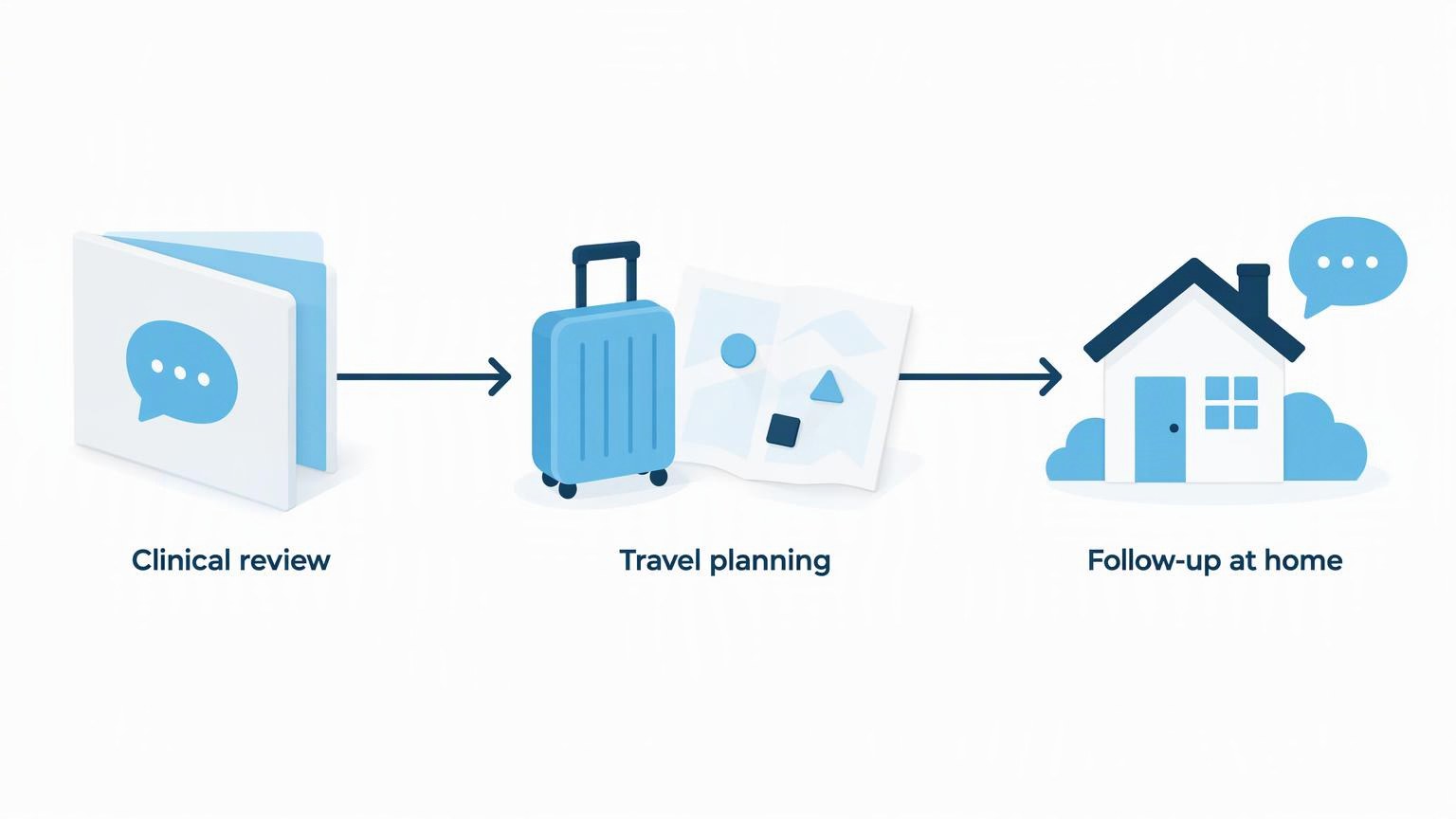
Keep travel planning separate from implant selection
Implant suitability, selection and recovery advice belong with the qualified treating clinician. At Hospitality Cancun, we publish travel and consultation-planning guidance for adults considering care in Cancun or the Mexican Caribbean; this article is not a clinical recommendation.
If you decide to inquire through Hospitality Cancun's contact section, clarify the recipient and purpose before submitting any information. The first submission is limited to name and email, with an optional contact-method preference. It does not include travel details, a planning narrative or attachments. Ordinary travel details may be discussed later with the confirmed travel contact once the recipient and purpose are clear.
Permission to answer your requested inquiry, optional marketing permission and permission for referral to a specifically named provider are separate choices. A requested reply is not marketing consent. Diagnoses, scans and clinical records belong only in a named treating-provider-confirmed secure channel. Payment details and insurance identifiers do not belong in the general inquiry.
Frequently Asked Questions
Can I ask for time to think after the consultation?
Yes, you can make clear that you want time to review the explanation before deciding. Ask which decisions remain open and whether another clinical discussion is needed. If you are considering paying a deposit, review the applicable written terms rather than assuming that taking more time has no contractual consequences.
What if different clinicians recommend different implants?
Compare their reasoning, not just their product names. Identify whether they understood the same priorities and what examination findings each used. Different recommendations give you a reason to clarify the trade-offs. If you cannot explain why either option was proposed, seek clarification before making your choice.
Should an advertised package determine my implant choice?
No. A package description is not an individualized clinical assessment. If an advertisement names an implant, ask the treating clinician whether that exact product is suitable for you and what alternatives can be discussed. Separately review the package's written inclusions; a listed product does not establish follow-up or travel services.
What if I need the consultation explained in English?
Establish how you will understand the clinical discussion and consent documents before proceeding. Ask the provider about English-language communication or interpretation arrangements. During the consultation, repeat the recommendation in your own words and ask the clinician to correct misunderstandings. Do not accept unfamiliar terminology as an adequate explanation.
Can I leave the consultation deciding not to have implants?
Yes. The purpose of the conversation is to understand suitability, options and trade-offs, not to produce a purchase. You can decide against implants, postpone the decision or ask the clinician whether another approach merits discussion. Those choices should follow your priorities and the clinical explanation, not travel-booking pressure.