
Hospital and Travel Information
Learn how to turn destination-level medical information into a practical understanding of hospital access during your holiday.
A holiday visitor may want a hospital contingency plan without intending to travel for treatment. That is a different task from comparing hospitals or arranging a procedure. The useful result is knowing which information you can act on, which belongs to a clinician, and which remains an assumption. Start with the location named on the page, then follow the information to the organization responsible for the answer.
What does Hospitality Cancun's Cozumel information tell you?
Use Hospitality Cancun's Cozumel information as a starting point for your review, not confirmation of the arrangements for a hospital visit. The key distinction is whether each statement applies to the Cozumel facility. If a page describes a wider region, do not treat that description as a service roster for one hospital.
The same distinction applies to specialties. If a page lists specialties across a hospital group, those headings can help you identify the kind of information to seek. They do not establish that a particular clinician or service is available in Cozumel when you need it. Likewise, an appointment action on a website is not an appointment confirmation.
Use the information to organize your questions by topic: local hospital access, the relevant department and the practical implications for your holiday. Leave decisions about diagnosis, treatment suitability and recovery with the qualified treating clinician. This keeps destination information useful without asking it to answer questions that require an individual assessment.
How do you find information that applies to Costamed Cozumel?
Search for the facility first, then narrow the search to the service. A useful starting query is “Costamed Cozumel official hospital.” Open the result and establish who publishes it before relying on its contact details. The page should identify the Cozumel location, rather than leaving you on a general group description.
Next, search the facility name with the department or service you are researching. Read the location wording inside the page, not only its title. If the service description never identifies Cozumel, retain it as background and continue to local information. For example, a group-wide specialty page explains a topic; it does not prove local staffing, equipment access or opening hours.
Finally, distinguish a published description from confirmation for a particular visit. Even a relevant facility page cannot establish your individual suitability for care. The comparison below shows how different information sources change the next step. Save the page title and date of any direct confirmation privately so that you can tell an old description from a current answer.
| Information | Useful for | What it does not establish | Next step |
|---|---|---|---|
| Regional medical-tourism overview | Understanding the destination and broad care topics | Cozumel-specific service access | Find a facility-specific page |
| Cozumel facility service page | Identifying the relevant local department | Individual suitability or availability for your visit | Obtain confirmation from the appropriate hospital contact |
| Insurer provider directory | Identifying a possible insurance connection | Direct billing or the benefits payable | Resolve policy conditions with the insurer and billing arrangements with the hospital |
| Clinician's individual care plan | Understanding required care and follow-up | Flight flexibility or hotel refund terms | Apply the clinical requirements to your actual travel contracts |
How should hospital information fit a fixed holiday itinerary?
A fixed departure makes the scope of the visit more important than the appointment time alone. You need to distinguish the consultation itself from any tests, results or follow-up that the clinician says are necessary. Do not turn a generic length-of-stay statement into personal clearance to fly.
Say you are spending a holiday in Cozumel and considering a nonurgent consultation before a booked departure. You find a page describing the relevant specialty, but it does not explain when results would be reviewed. Keeping the visit may be reasonable if the provider establishes a workable plan. Moving a discretionary consultation may make more sense if the clinical requirements are still unclear and your travel cannot change.
If the clinician instead recommends further care or delayed travel, that creates separate tasks. The clinician determines the care and follow-up requirements; you or your travel supplier handles flight and lodging changes. An available extra hotel night does not itself establish a need for clinical support.
For an urgent health concern, seek immediate medical assistance rather than waiting for a travel-planning inquiry. This guide is for preparation, not symptom assessment or emergency routing.

What do hospital payment and insurance statements actually mean?
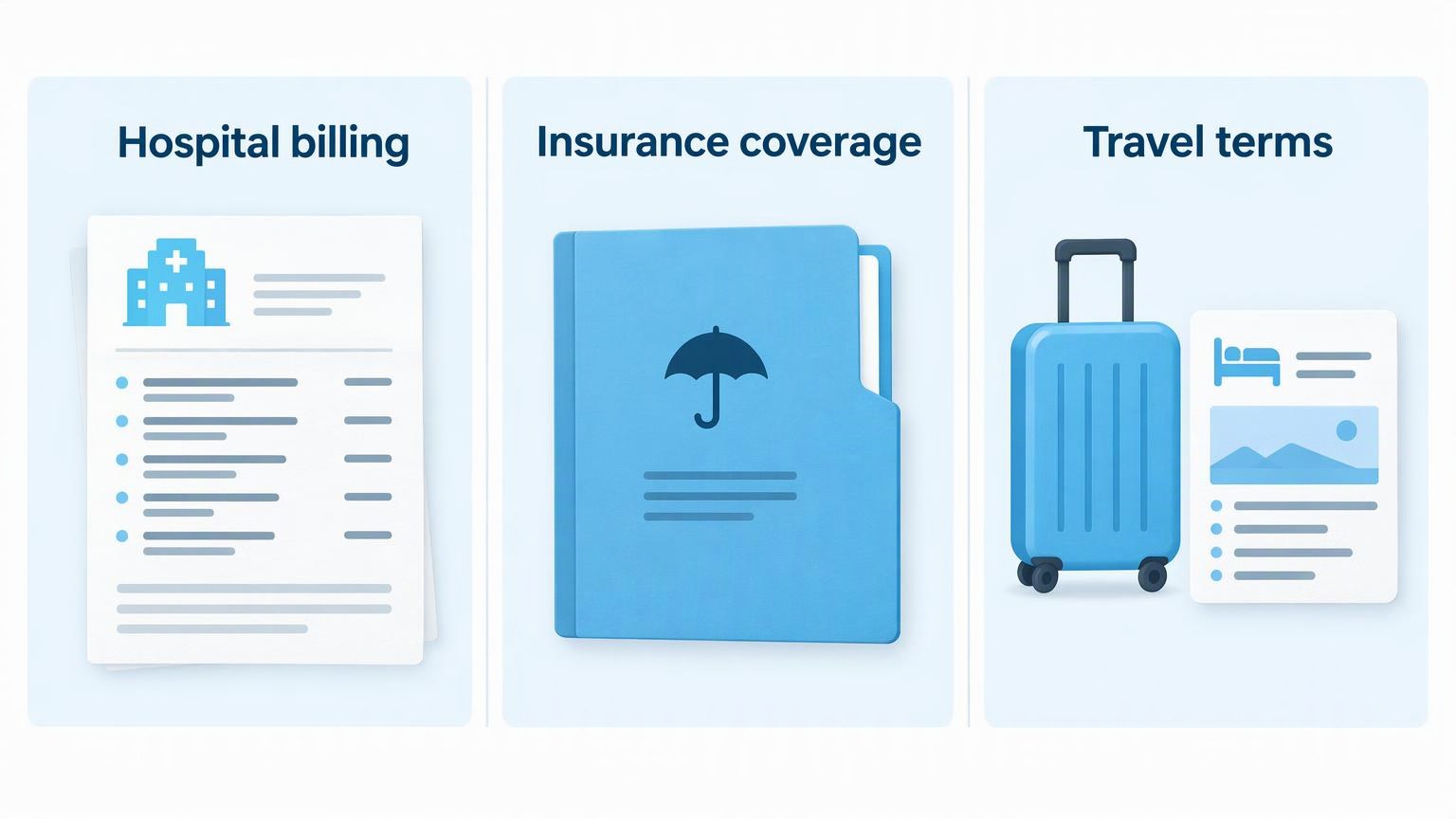
Hospital billing arrangements and insurance coverage answer different questions. The hospital explains its charges and payment process. Your insurer explains what your policy covers and the conditions for payment or reimbursement. A provider name appearing in an insurance directory does not by itself establish direct billing or eliminate an upfront payment requirement.
For a planned visit, examine an itemized estimate, if the hospital provides one, rather than assuming a single figure includes consultations, tests and later care. Establish the billing entity and payment timing directly through the appropriate confirmed contact. No price or payment policy should be inferred from another visitor's bill.
Travel costs remain separate. If a clinician recommends staying longer, the additional hotel night is still a lodging charge. That recommendation does not establish who pays, whether the night is included or whether insurance covers it. The hotel reservation terms govern changes and cancellation; the applicable insurance policy governs any claim. Neither substitutes for the other.
The practical outcome is a clear distinction between the service purchased, the event changing the plan and the party responsible under the actual terms.
Who should resolve the details you still need?
Take hospital access questions to the hospital, clinical questions to the treating clinician, coverage questions to the insurer and itinerary questions to the relevant travel contact. Hospitality Cancun publishes travel and consultation-planning guidance; reading that guidance does not establish a treating-provider relationship or a confirmed introduction.
Keep one short planning note privately:
- The facility and service identified by the page.
- The hospital details still needed for your visit.
- Any clinician-defined follow-up that affects departure.
- The billing, insurance or travel terms you still need to clarify.
That note is for your own preparation, not the initial contact form. Before submitting any information through Hospitality Cancun's general inquiry, clarify the recipient and purpose. If either is unknown, do not submit. The first submission is limited to name and email, with optional contact-method preference. Travel details may be discussed later with the confirmed travel contact.
Permission to reply to your inquiry, optional marketing and referral to a specifically named provider are separate choices. Clinical records belong only in a named provider-confirmed secure channel. Do not send records, insurance identifiers, payment details or attachments through the general form; that exclusion does not establish a later financial-information channel.
Frequently Asked Questions
Can I assume an English-speaking clinician will be available?
No. Establish the language arrangements for the particular service and visit, including how consent and written instructions would be explained. A general bilingual description does not identify the clinician who will see you. If you need interpretation, resolve that arrangement before relying on the consultation for important decisions.
Does a photograph of medical equipment prove that I can receive that test?
No. An image does not establish the equipment's location, current operation or availability for your visit. A test also requires the appropriate clinical decision. Use images for context only, and obtain service-specific information from the facility rather than treating promotional photography as a local diagnostic inventory.
Is a hospital listing enough to decide whether the destination is suitable for my holiday?
No. Hospital information does not answer destination safety, entry requirements or transport reliability. Review current official destination and entry guidance separately, then consider how your own itinerary would work. Do not interpret the presence of medical-tourism information as an assurance about travel conditions or access during a disruption.
Are hospital accreditation and a clinician's credentials the same thing?
No. They concern different entities. A facility claim does not establish an individual clinician's qualifications, and a clinician's credentials do not establish a facility's accreditation. Any credential you rely on should identify the exact person or facility, the issuing authority and its current status, rather than only displaying a badge.
Can I use another holiday visitor's bill to estimate my own costs?
Only as a reminder that billing deserves attention, not as a dependable estimate. The services, date, clinical circumstances and insurance arrangements may differ. For a planned visit, an itemized estimate from the relevant billing entity is more useful than an anecdotal total, although its scope and conditions still matter.