
Consultation Planning
Use the proposed follow-up plan to decide whether your visit, return travel and continuing care fit together.
A useful follow-up answer connects an action to a responsible person and a next step. “Contact us afterward” tells you less than “this clinician reviews the result through this channel.” Focus your provider conversation on those practical distinctions, rather than treating a broad promise of support as a complete plan.
Who handles follow-up and urgent concerns?
Identify the clinician responsible for your follow-up and the contact route for each type of concern. An administrative contact may help with scheduling, but that does not establish who interprets results or gives clinical advice.
In your consultation with the relevant provider, distinguish routine appointment questions, clinical questions, results still pending and concerns that cannot wait for a routine reply. For each, establish who receives the message and what happens if that person is unavailable.
A useful answer explains the next action. If a result arrives after you leave, for example, who reviews it, how are you notified, and who decides whether another appointment is needed? A statement that records will be emailed does not answer those clinical questions.
Have the treating clinician explain warning signs and the appropriate escalation route for your care. Do not treat a travel-planning inbox as an urgent-care channel. If responsibility remains unclear, resolve that point before relying on the proposed follow-up arrangement.
Where can your follow-up take place?
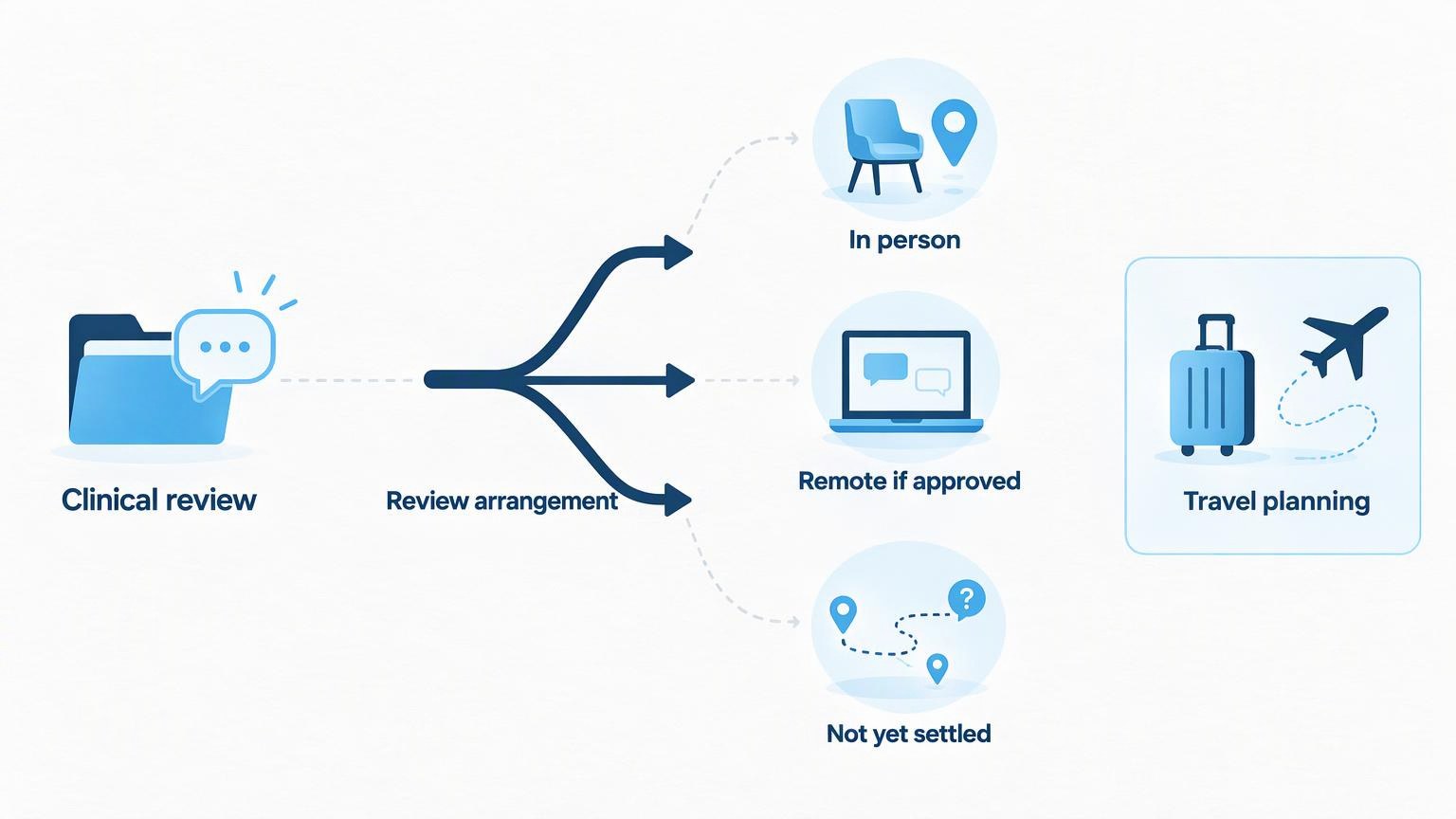
Follow-up in Cozumel, remote review and care with a clinician at home are different arrangements, not interchangeable conveniences. The treating clinician must determine which format fits the actual care plan; the receiving clinician must accept any proposed handoff.
Start with the purpose of the review. Is it a discussion of results, an examination or a procedure-related check? That purpose determines which alternatives are worth considering. Do not choose a remote appointment solely because it fits your flight schedule.
For a proposed remote review, establish whether the named provider offers it for your circumstances and what would trigger an in-person assessment. For care at home, establish who will accept responsibility and whether they need records before agreeing.
The comparison below is a way to evaluate a proposed plan, not a statement that Costamed Cozumel offers every option. An arrangement becomes usable only when the relevant clinicians confirm their roles and the necessary access is in place.
| Arrangement | Suitable when | Practical trade-off |
|---|---|---|
| In-person review in Cozumel | The treating clinician requires an examination or other in-person care. | Travel must accommodate the required review and individualized departure advice. |
| Provider-approved remote review | The named clinician offers and approves remote review for the specific follow-up task. | You still need a clear route for concerns requiring in-person assessment. |
| Accepted handoff to a clinician at home | A receiving clinician agrees to continue care and has the necessary information. | Records transfer and appointment acceptance must be arranged, not assumed. |
How should follow-up change your return-travel decision?
Base return travel on the clinician’s review and follow-up plan, not on a fixed stay length or an assumed recovery window. Separate the clinical decision about travel from the practical work of changing a reservation.
Say you are considering a visit to Costamed Cozumel and have selected a return flight, but a result may arrive after that departure. The clinician says the result must be reviewed before deciding the next step. The question is not how many bookings you have; it is whether that review requires your presence.
If the clinician requires an in-person review before departure, the original itinerary does not fit. If the clinician approves a remote review and explains the next-step arrangements, leaving may fit the plan, subject to individualized travel advice. If neither arrangement is settled, postponing the visit may be more workable than committing to travel around an unanswered question.
Keep a proposed return date separate from clinical clearance. A flexible ticket can make a later change easier to manage, but it cannot resolve whether you should travel.
What makes a records handoff complete?
A complete handoff includes relevant information, a confirmed recipient and a clear owner for unfinished work. Having copies yourself is useful, but it does not establish that another clinician has accepted follow-up.
Use this compact checklist with the treating and receiving clinicians to identify what applies:
- A visit or discharge summary explaining the care provided.
- Relevant test reports and images, where needed.
- Current medication instructions and changes.
- Written follow-up instructions and clinician-defined warning signs.
- Pending results, their expected availability and the person responsible for reviewing them.
Establish which documents will be available when you leave and which will follow later. For a delayed result, arrange both delivery and clinical review; sending a file alone is not the same as interpreting it.
Clinical records and scans belong only in a named provider-confirmed secure channel. Confirm the receiving clinician’s required format and whether they have received the material needed for the appointment. Ask about English-language instructions or translation needs rather than assuming every document will be available in English.

Which follow-up charges and change terms matter?
Separate the service being charged, the reason the plan changed and the party responsible for payment. A clinical recommendation does not, by itself, establish that a service is included or identify who pays.
When reviewing the relevant provider’s proposal, distinguish scheduled follow-up visits from additional consultations, tests or record-related services. Determine what the proposal actually includes and which additional services require a separate estimate. Do not infer free follow-up from a general statement about continuing support.
If the clinician recommends an extra lodging night, that night remains a travel charge. The recommendation does not establish its payer, inclusion or hotel change terms. Those questions depend on the applicable written arrangements.
Supplier cancellation, refund and change terms determine the contractual consequences of altered reservations. Insurance is separate: coverage and claim conditions determine whether an insurer may pay an eligible expense. Neither the provider’s recommendation nor an insurance category replaces the actual supplier terms or policy wording.
What belongs with the provider versus a travel contact?
Keep clinical follow-up decisions with the relevant treating provider. Travel dates, lodging and companion logistics can be discussed later with a confirmed travel contact once the clinical requirements are clear. A reservation change alone does not establish a need for clinical support.
Hospitality Cancun publishes travel and consultation-planning guidance. Verify Costamed Cozumel’s destination-specific services and follow-up arrangements directly with the relevant provider; do not treat a Hospitality Cancun inquiry as confirmation of a clinical appointment or referral.
Before submitting any information through Hospitality Cancun’s contact section, clarify the recipient and purpose. The first submission is limited to name and email, with an optional contact-method preference. It does not include travel details, narratives, records, attachments, payment details or insurance identifiers. Ordinary travel details may be discussed later with the confirmed travel contact.
Permission to reply to your requested inquiry, optional marketing and referral to a specifically named provider are separate choices. A requested reply is not marketing consent. Agreeing to a planning conversation does not itself authorize a provider introduction or transfer of clinical records.
Frequently Asked Questions
Can my companion help communicate with the provider?
Discuss your preference with the provider and establish what authorization is needed for your companion to receive information or help with communication. Separately, have the clinician explain any care-related assistance you need. A companion’s availability does not establish that they can provide the support required by your care plan.
Does a follow-up appointment mean all my results are final?
No. Treat the appointment and the status of each relevant result as separate items to establish with the provider. A review may occur while other information remains pending. Identify what is unfinished and who will review it, so the appointment does not become an assumed endpoint for continuing care.
What if different staff members give conflicting instructions?
Take the specific conflict to the treating clinician for clarification before acting on it. Distinguish a scheduling message from a clinical instruction, and identify which instruction is current. For travel implications, use the clarified clinical plan as the basis for reservations rather than choosing whichever message best fits the itinerary.
Will my usual doctor automatically take over follow-up?
Do not assume acceptance because you already have a doctor at home. Contact that practice through its established route to determine whether the clinician can take on the proposed follow-up and what information they need. An existing relationship and an accepted plan for continuing this particular care are different things.
Can I use this guide to decide whether treatment is suitable?
No. This guide helps organize follow-up and travel-planning decisions; it does not determine eligibility, diagnosis or treatment suitability. Those decisions belong with a qualified treating clinician. Clear logistics can make a proposed plan easier to evaluate, but they are not evidence of clinical appropriateness or a promised outcome.