
Consultation Planning
Build a focused question list that separates hospital information, individual clinical assessment and the practical commitments of traveling for care.
Your aim is not to settle every detail before speaking with anyone. It is to identify the answers that could change your decision to pursue a consultation. Keep the questions below as private preparation for a later conversation with the appropriate confirmed contact.
Before submitting any information through a general inquiry, clarify who receives it and why. The first submission remains limited to name, email and an optional contact-method preference. The question list is not a template to paste into that form.
Does the information you found apply to Cozumel?
Start by separating information about Costamed Cozumel from information about the wider brand. A shared name does not establish that a particular service, clinician or price applies at the location you intend to visit.
For example, PlacidWay's Costamed Medical Group listing identifies Playa del Carmen in its pricing heading. Its entries also distinguish inclusions and exclusions, with some separating laboratory or imaging services from the listed procedure. Neither feature establishes current Cozumel services or a personal estimate.
For a later discussion with the confirmed hospital contact, the useful question is: “Does this service take place at Costamed Cozumel, and which parts require separate appointments or another location?” The answer determines whether you can continue evaluating that location or need a different plan.
Keep the exact page and the claim that interested you in your private notes. This makes it easier to resolve a specific discrepancy instead of asking whether everything you saw online is accurate.
Who would assess you, and what would that assessment decide?
Ask for the identity and relevant qualifications of the clinician who would assess you, not simply confirmation that the hospital offers a category of care. Administrative availability and individual treatment suitability are different answers.
A focused question is: “Who would conduct the consultation, what are their relevant license and specialty credentials, and how can I verify those details?” Match the credentials to the named person and proposed service. A brand description alone does not do that work.
Then clarify the consultation's purpose: would it evaluate options, review existing information or determine whether further examination or testing is needed? Ask what remains undecided afterward. Eligibility, diagnosis, treatment suitability and recovery advice belong with the qualified treating clinician.
This distinction also helps you interpret a positive administrative reply. “We offer that service” is a reason to investigate further, not a personal recommendation to receive it. Pursue the consultation when its scope addresses your actual decision; do not commit to treatment on the strength of a general service description.
| Situation | Suitable next step | Reason | Trade-off |
|---|---|---|---|
| Only a general or other-location listing is available | Resolve Cozumel service applicability | A brand-level listing cannot establish the intended location's offer | Delay detailed travel planning |
| The service is confirmed, but suitability is unknown | Pursue a clearly scoped clinician consultation | Individual assessment is still needed | Further examination or testing may remain necessary |
| A proposed plan conflicts with a fixed return commitment | Change the visit window or defer commitment | The clinical schedule cannot be replaced by travel convenience | The preferred trip may not work |

Which cost questions make an estimate comparable?
A useful estimate identifies the service being charged, its scope and the terms attached to payment. A total without that context is not enough to compare care options.
In a later conversation with the confirmed billing contact, ask: “Is this for the consultation only or a proposed course of care, and what is excluded?” Separate clinician fees, testing, facility services, medications and follow-up where applicable. Keep lodging and transport outside the medical subtotal unless the actual proposal explicitly includes them.
Before paying, establish who issues the estimate, who collects each payment, when payment becomes due and what changes could require a revised estimate. An estimate is not evidence that your insurance will cover the service.
Supplier cancellation, refund and change terms determine the contractual consequences of canceling or moving a booking. Insurance coverage and claim conditions separately determine whether an insurer may reimburse an eligible expense. Ask each responsible party about its own terms; neither answer substitutes for the other. No particular refund, fee or coverage should be assumed.
Can the proposed care fit your travel limits?
Judge travel feasibility from the clinician's assessment and follow-up plan, not an assumed recovery period. Flight timing and length of stay depend on your individual care plan.
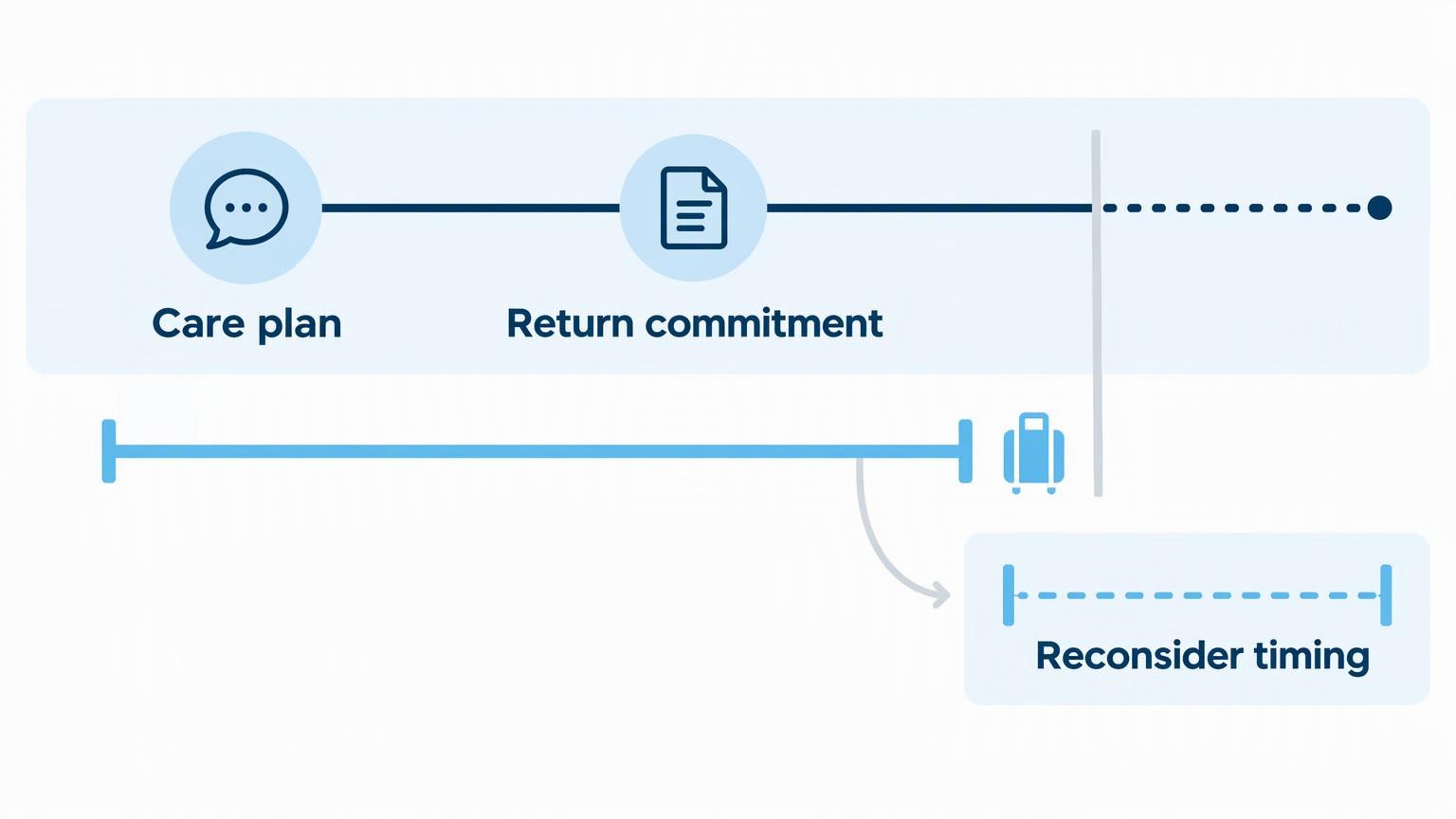
Say you are considering a consultation in Cozumel but have a return commitment you cannot move. You could book travel around an assumed short visit, or wait to learn whether assessment, results and any proposed follow-up fit your available window. Waiting is the better choice while those requirements are still unknown: a convenient return booking cannot establish medical clearance to fly.
The decisive later question is: “What must happen before departure, and what could change the recommended timing?” If the plan fits, compare suitable travel arrangements. If it does not, change the visit window, consider a consultation without a treatment commitment or postpone the trip.
If a clinician later recommends an extra hotel night, the lodging remains a travel charge. That recommendation alone does not establish who pays, whether the night is included, which hotel terms apply or whether insurance covers it. Those answers come from the relevant proposal, supplier contract and policy.
Who should answer questions as the inquiry develops?
Use the contact whose responsibility matches the question. The treating clinician handles clinical decisions; the hospital's confirmed administrative or billing contact handles its arrangements; ordinary travel matters belong with the confirmed travel contact.
Ask how English-language communication would work during the consultation, consent discussion and delivery of instructions. An English-language administrative reply does not establish that every clinical discussion will occur in English. Clarify whether interpretation is needed and how it would be arranged.
Also establish who explains results, how you receive a care summary and what handoff would be needed to continue care at home. Receiving a document and having a clinician responsible for interpreting it are not the same thing.
Hospitality Cancun publishes travel and consultation-planning guidance. Use that guidance to organize the practical questions, while keeping decisions about care with the treating clinician. If a provider introduction is proposed, identify the specific provider and make that referral permission a separate choice, rather than treating a planning conversation as automatic authorization.
What belongs in the first submission?
Only name, email and an optional contact-method preference belong in the first-contact submission through Hospitality Cancun's contact section. Clarify the recipient and purpose before submitting any information; an unclear route is a reason to wait, not to send a smaller message.
Keep your questions, travel timing and other planning notes private at this stage. Ordinary travel dates, destination, companion and room details may be discussed later with the confirmed travel contact after the recipient and purpose are clear. Do not put them or an open narrative in the first form.
Diagnoses, scans and clinical records belong only in a named provider-confirmed secure channel. Do not send insurance identifiers, payment details or attachments through a general inquiry. Financial information is not clinical information, and a clinical-records channel does not automatically provide its destination.
Keep three permissions distinct: a reply to your requested inquiry, optional marketing and referral to a specifically named provider. Requesting a reply is not marketing consent. Once the appropriate conversation is established, use your prepared questions in decision order: location, clinician, financial scope and travel feasibility.
Frequently Asked Questions
Can a consultation leave me with no treatment recommendation?
Keep that possibility open. Ask whether the consultation can conclude with a need for further assessment or no recommendation to proceed. Paying for an assessment should not be interpreted as a commitment to treatment. Clarify the consultation scope before making commitments that depend on a particular clinical answer.
What if the proposed clinician changes?
Revisit the identity and credential questions for the replacement clinician, and clarify whether the consultation scope or proposed plan changes. Information about the original clinician does not transfer automatically to another person. Decide whether to continue based on the revised arrangement, rather than the hospital name alone.
Should I arrange new tests before making an inquiry?
Do not use a general service listing as an instruction to obtain tests. Keep a private note of what you already have, then let the qualified assessing clinician determine what is relevant or needed. Existing clinical documents should be shared only through the named provider-confirmed secure channel.
Does a companion's availability determine how long I need to stay?
No. A companion's schedule is a practical limit, not a clinical assessment. Ask the treating clinician what support the actual care plan requires. If that support conflicts with your companion's availability, reconsider the arrangement. Changing room or flight bookings is a separate logistics task, not clinical advice.
How should I handle an answer that says “it depends”?
Identify what it depends on and who can resolve it. An answer awaiting clinical assessment is different from one awaiting administrative confirmation. Avoid firm commitments that depend on that answer. A useful reply should tell you the next decision-making step, even when it cannot yet provide a final treatment or travel answer.