

Care and Travel Planning
Compare what each proposal actually covers, who delivers it, and how the arrangements hold up when your schedule changes.
A polished package can combine very different purchases: professional care, facility services, lodging and transportation. Its total alone cannot tell you whether it meets your needs. Use this guide to separate those purchases and compare proposals on equal terms. Hospitality Cancun publishes travel and consultation-planning guidance; clinical decisions belong with the qualified treating clinician.
Find comparable care before comparing packages
Start your search with the relevant specialty or consultation type plus Cancun, then investigate the named clinician and exact treatment location. A broad medical-tourism search can introduce options, but it does not establish that their care is suitable for you.
Open the provider's own pages rather than comparing only advertisements. Separate results offering an initial assessment from proposals describing treatment after an assessment. Those are different purchases, even if both use the word package.
For each promising result, identify the clinician's full name, claimed qualifications, proposed facility and method for reviewing your needs. Seek confirmation of qualifications from the relevant issuing or regulatory body. A hotel relationship or travel coordinator's recommendation is not evidence of clinical credentials.
Next, establish whether you can discuss the proposed care, alternatives and follow-up directly with the treating clinician in language you understand. If a result cannot identify who would assess or treat you, set it aside rather than letting its hotel photographs or headline price determine your shortlist.

Choose the arrangement that fits what you already know
Compare medical-only arrangements with bundles when the clinical scope is sufficiently clear. Choose a consultation-first route when assessment may change whether treatment happens at all. None is automatically better because it contains more services.
Separate travel bookings can work well when you are comfortable managing reservations and the appointment schedule is settled. A bundle can be useful when its specific lodging and transport arrangements match your preferences and the care plan. Its value depends on those details, not merely having a single seller.
Do not compare an assessment fee with a treatment package total as though they buy the same thing. First establish the decision each offer supports; then compare equivalent scope within that category.
| Arrangement | Choose when | Reason | Trade-off |
|---|---|---|---|
| Medical-only with separate travel | Clinical scope is clear and you prefer managing travel | You can select lodging and transport independently | Separate contracts and change processes |
| Bundled care and travel | The specified travel arrangements fit the clinical plan | The offered combination matches your needs | Inclusions, the extra-night payer and change terms are unknown unless specified |
| Consultation first | Assessment may change treatment suitability or scope | Avoids treating an unassessed treatment offer as final | Treatment costs and timing may remain undecided |
Separate clinical scope, travel costs and payment recipients
Compare proposals line by line before comparing their totals. Mark each item as included, separately charged, excluded or not specified. An item that is not specified is not a free inclusion.
Use this compact checklist privately to organize the proposals:
- Clinical scope: assessment, proposed treatment, tests, professional and facility charges, medications and follow-up, as applicable.
- Travel scope: lodging dates, room type, transport journeys, companion arrangements and any separately purchased reservations.
- Coordination scope: the administrative tasks offered, their limits and the party responsible for each.
- Payment scope: named seller, currency, deposits, balance deadlines, exclusions and applicable change terms.
For example, a proposal covering a procedure but excluding tests is not equivalent to one including the required tests. Likewise, a hotel stay does not establish that nursing support is provided.
Map payments to recipients before paying. If a coordinator collects money for another supplier, establish whose contract governs that purchase and who handles a cancellation. Do not assume a combined total creates a single refund obligation.
Test the itinerary against an unsettled follow-up date
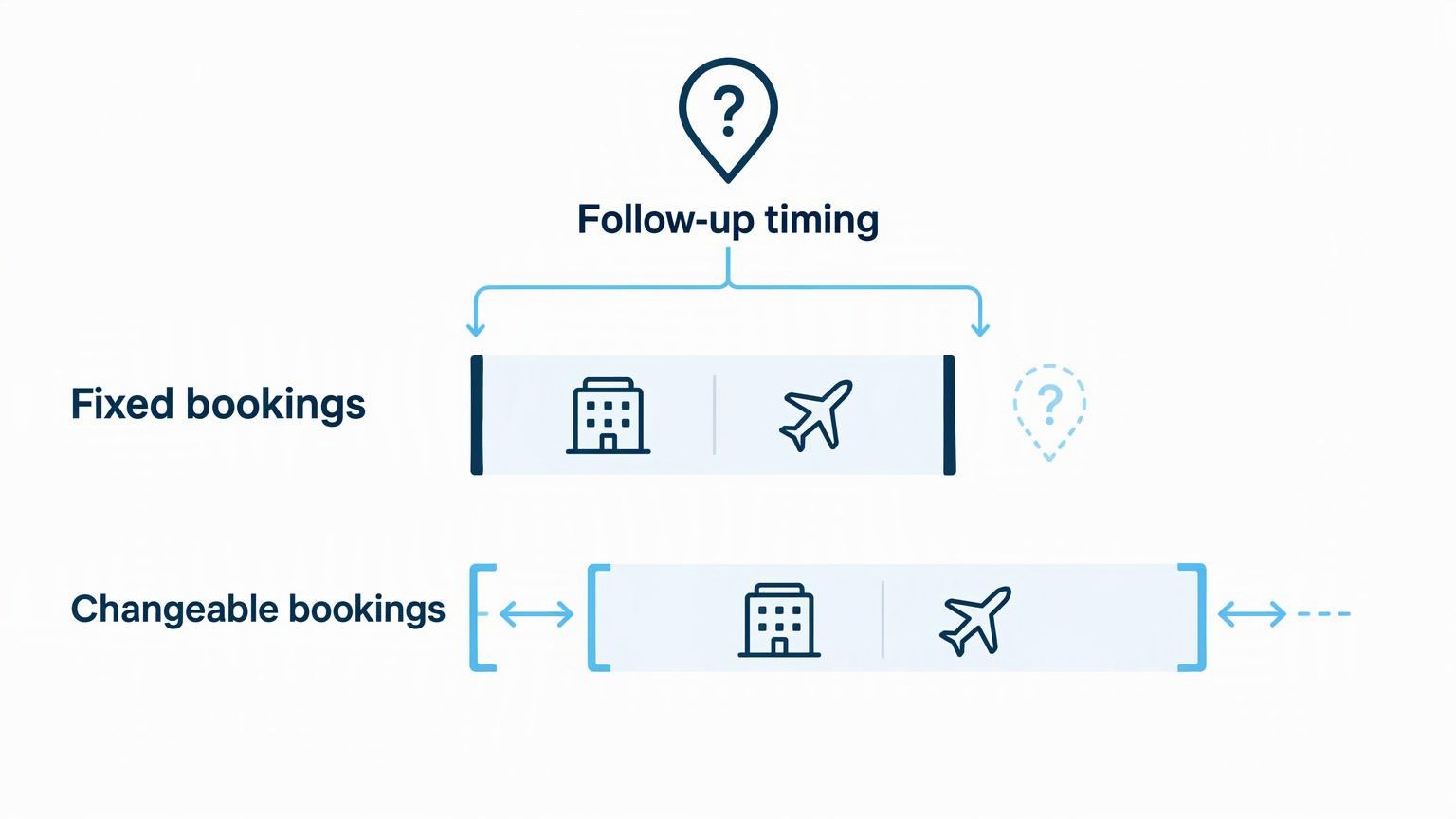
When the clinician's final review date is unsettled, favor arrangements that can accommodate that uncertainty rather than locking travel to an advertised package length. Booking flexibility does not itself provide clinical support or establish when you may fly.
Say you are comparing a fixed-date lodging bundle with a medical-only proposal and separately booked, changeable lodging. You prefer the bundled hotel's room, but the clinician has not finalized the follow-up schedule. The limiting factor is the review date, not the number of reservations.
If the bundle's written extension and flight-change arrangements remain unclear, the separate route may give you more control. If the bundle allows changes on acceptable terms and fits the eventual clinical schedule, it may still be preferable. Decide from the actual contracts, not the labels.
If the clinician later directs a longer stay, an extra hotel night remains a travel service charge. The clinical reason does not establish who pays, whether the night is included, which hotel terms apply or whether insurance covers it. Do not assign a payer or assume inclusion or coverage unless the relevant contracts and policy specify them.
Read supplier change terms separately from insurance
Supplier terms determine what happens to your purchase; insurance terms determine whether an insurer reimburses a covered loss. Neither replaces the other. Read both before committing funds.
Distinguish the events that could change the plan. If the provider cancels, its contract determines the consequences for the medical purchase. Separately booked flights and lodging have their own terms. If you cancel, different cancellation provisions may apply. An extension can create new charges rather than a refund issue.
For each purchase, locate the cancellation deadline, refundable portion, change conditions and process for claiming any contractual refund. If those terms are absent, you cannot calculate the financial exposure reliably.
UnitedHealthcare's Mexico insurance guide notes that private facilities often expect upfront payment. That general guidance does not establish any particular facility's payment policy or your coverage.
Ask your insurer specifically about the planned treatment, related complications, trip interruption and evacuation. Coverage categories alone are insufficient: exclusions, limits, authorization and claim-document requirements govern. A supplier refund and an insurance claim are separate processes, not interchangeable promises.
Arrange the follow-up handoff and the planning conversation
Before choosing a proposal, establish who handles clinical follow-up after you return home and who handles travel changes. A travel contact cannot replace the treating clinician's instructions or a receiving clinician's agreement to provide care.
The clinical handoff should identify the follow-up contact, how treatment records will be provided, and how questions or complications are escalated. Discuss ongoing care with your home clinician rather than assuming they will take over an unfamiliar treatment plan.
Before submitting any information through Hospitality Cancun's contact section, clarify the recipient and purpose. The first submission is limited to name and email, with an optional contact-method preference. It does not include trip details, narratives or attachments.
Later, ordinary travel details may be discussed with the confirmed travel contact. Diagnoses, scans and clinical records belong only in a named provider-confirmed secure channel. Payment details and insurance identifiers do not belong in the general inquiry form.
Keep permission to answer your requested inquiry separate from optional marketing and from referral to a specifically named provider. Agreeing to a reply is not marketing consent or blanket permission to share information.
Frequently Asked Questions
Can reviews establish that a clinician is qualified?
No. Reviews may describe someone's experience with communication or administration, but they do not verify professional qualifications or treatment suitability. Use them as supplementary context. Match credential evidence to the exact clinician and specialty, and discuss the proposed care directly with the clinician responsible for it.
Does an English-speaking coordinator mean my consultation will be in English?
Not necessarily. Administrative communication and clinical communication are separate. Establish who will explain the assessment, risks, alternatives and consent documents, and whether interpretation is available if needed. You should understand the clinical discussion itself, rather than relying on a coordinator's summary of what the clinician said.
Is a promotional package price enough to set my budget?
No. Treat it as an advertised starting point, not your final liability. Your budget should reflect an assessed clinical scope, separately priced travel, exclusions and potential change costs. Avoid assuming that an attractive headline total includes every test, follow-up visit or accommodation expense relevant to your plan.
Should I include a companion in my private planning comparison?
Yes, if someone may travel with you. Privately compare their lodging, transport and ability to change their return independently. A companion's presence does not establish that required clinical support is covered. Discuss any support requirements with the clinician, and reserve companion details for a later confirmed travel conversation.
What if competing clinicians recommend different treatments?
Resolve the clinical difference before ranking package value. Ask each clinician to explain the basis for the recommendation, alternatives and follow-up needs, and consider an independent clinical opinion. Comparing prices for different treatments will not tell you which treatment is appropriate, even when the travel arrangements look similar.