

Travel and Consultation Planning
Compare what each arrangement covers, how its clinical schedule fits your trip and what happens financially if your plans change.
A surgery proposal and a hotel reservation answer different questions. Putting them under a package label does not make them interchangeable. Use a side-by-side comparison that preserves those differences, so an attractive travel offer does not obscure the care plan you need to discuss with a qualified treating clinician.
Choose the arrangement structure, not the package label
Favor a bundled arrangement when its itemized services and contractual responsibilities suit your trip. Favor separate bookings when you can match travel reservations to the care plan and prefer control over individual suppliers. Neither structure establishes surgeon qualifications or medical suitability.
The useful distinction is who is responsible for each service. A bundle may name different parties for surgery, lodging and transport. Separate bookings may give you direct control over changes, but you will need to communicate those changes yourself. Compare that responsibility, not simply the number of reservations.
Keep clinical suitability as a separate decision. A clearly described hotel stay cannot compensate for an unidentified treating surgeon or unclear follow-up responsibility. Conversely, independently booked lodging is not a weakness if it meets the actual care plan.
The comparison below describes arrangement types, not offers from Hospitality Cancun or recommendations for particular suppliers.
Build a shortlist with comparable clinical scope
Start with identifiable surgeons and facilities, then compare provider-specific proposals for the same clinical question. Broad searches for rhinoplasty packages are useful for discovery, but a result title is not enough to establish what you would receive.
Search a candidate's full name alongside the claimed specialty and certification. Locate the relevant credential-issuing body's own records and match the person, specialty and current status. Check facility claims separately with the body said to have issued them. Association membership, surgeon certification and facility accreditation should not be treated as equivalent labels.
Next, have the treating clinician clarify the proposed scope. Are the proposals addressing the same goals, and do they describe comparable assessment and follow-up services? VIDA's rhinoplasty cost guide identifies complexity, surgical approach, revision surgery and surgeon fees as factors affecting its pricing. That explains why unlike proposals may carry different totals, not what your procedure will cost.
If the scope remains different, pause the price ranking. Resolve the clinical difference before treating either proposal as better value.
| Arrangement | Suitable when | Reason and trade-off |
|---|---|---|
| Itemized care-and-travel bundle | Named services, responsible parties and change terms fit the care schedule. | You can evaluate the combined offer, but must still distinguish each supplier's obligations. |
| Separate clinical and travel bookings | You can align reservations with the clinician's plan and manage supplier changes. | You retain individual booking control and handle the travel updates yourself. |
| Either structure before clinical scope is clear | Not ready for a final price comparison. | Clarify the proposed care first; lodging inclusions cannot resolve a clinical difference. |

Turn the care schedule into a usable itinerary
Let the treating clinician's assessment and follow-up plan establish the travel requirements. Then search flights, lodging and transport against those requirements. An advertised number of nights is not individual clearance to fly.
Begin with the sequence of consultation, any required assessment, the proposed procedure and follow-up. Distinguish confirmed appointments from timing that may still change. Search actual flight schedules for the resulting travel window and compare connections, arrival timing and return-change terms. If a flight conflicts with a required visit, it fails the comparison even if its fare is appealing.
For lodging, compare the specific property and room terms against the clinician's stated needs, your planned occupancy and the appointments you must attend. Use actual addresses to evaluate transport rather than assuming a destination label means convenient access.
Compare airport transport and appointment transport separately. Identify which journeys a proposal covers and which you would arrange independently. A pickup listing does not establish transport for every visit. Finish by checking whether the selected itinerary can be changed if an appointment that has not been confirmed moves.
Resolve a fixed return deadline before committing
If a fixed return deadline cannot accommodate the clinician's follow-up plan, postponing is more workable than building the trip around an assumed departure date. Flexible reservations help with logistics, but they cannot make an incompatible medical schedule suitable.
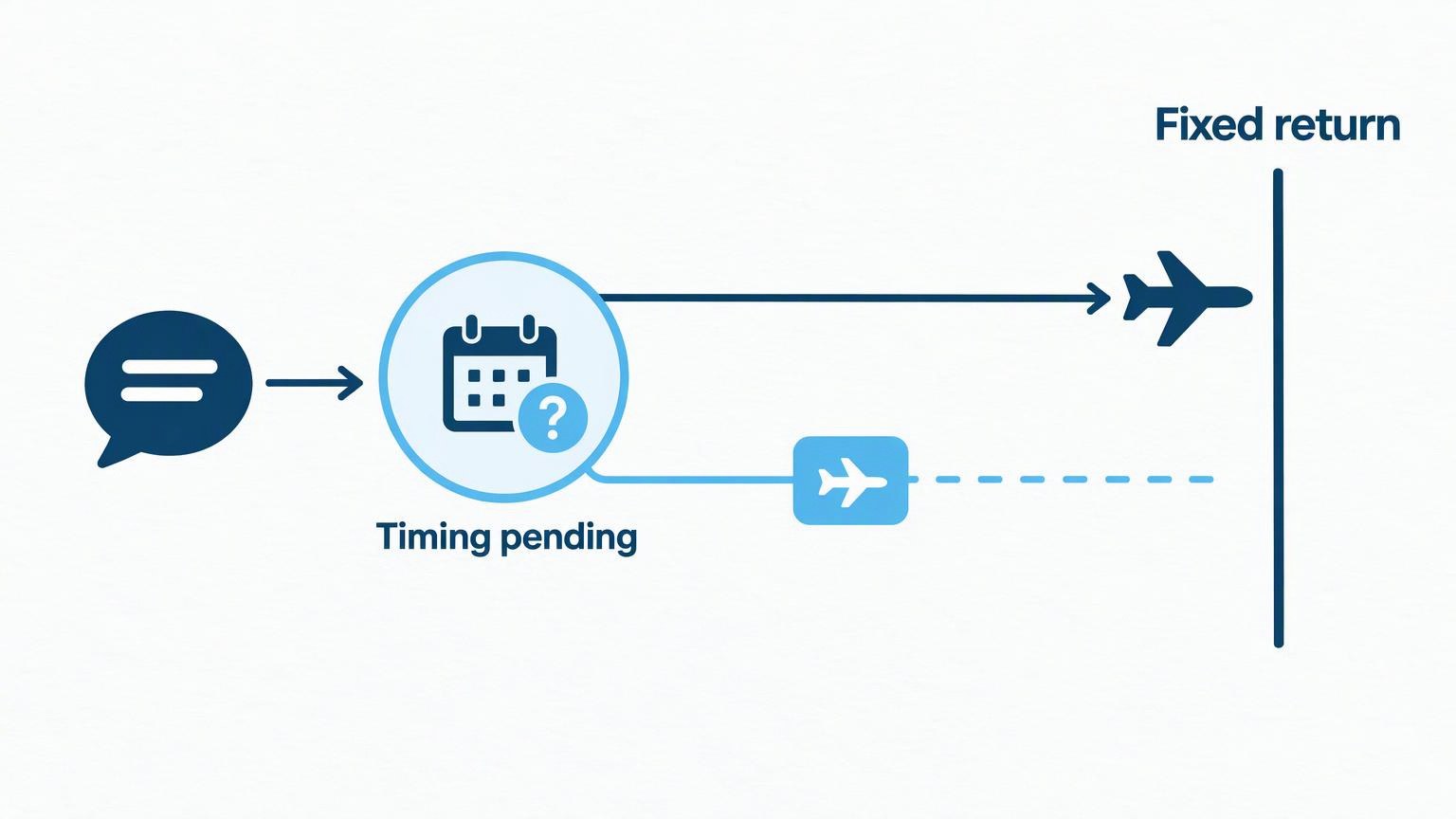
Say you need to be back at work on a fixed date. You are comparing an arrangement with a set checkout and return flight against separate reservations that allow changes. The treating clinician has not yet established when your predeparture review should occur.
The fixed itinerary offers a clear initial schedule, but you cannot yet tell whether it permits that review. The flexible itinerary leaves room to move bookings, but it does not solve your work deadline if the clinician requires a later departure.
The reasoned choice is to establish the clinical timing first. If it fits, compare the two arrangements on their terms and responsibilities. If it does not, change the work commitment or postpone the trip. This is a scheduling decision, not a prediction about recovery or an argument that everyone needs coordinated travel.
Compare total costs and the consequences of changes
Compare itemized totals and contractual consequences, not just the advertised surgical fee. Separate the service being purchased, the event that changes the plan and the party responsible for paying.
For example, if the clinician directs a longer stay, an extra hotel night remains a lodging charge. The clinical reason does not establish whether that night is included, who pays or which hotel terms apply. Without those terms, mark each answer as not yet established rather than assigning the cost to the clinician, coordinator or traveler.
Use one compact comparison checklist for each proposal:
- Clinical and travel services included, excluded or priced separately.
- Contracting party, payment recipient, deposit and remaining-payment sequence.
- Supplier cancellation, refund, rescheduling and unused-service terms.
- Additional-stay and replacement-transport responsibility.
- Insurance exclusions, claim conditions and applicable coverage.
Supplier terms determine the contractual consequences of canceling or changing a purchase. Insurance is a separate question: a cancellation, medical or evacuation policy may have its own exclusions and evidence requirements. Do not subtract an expected insurance reimbursement from your comparison unless the applicable coverage supports it.
Keep travel planning and clinical decisions with the right recipient
Use travel-planning information to organize the trip comparison; keep eligibility, surgical suitability, recovery instructions and clearance to travel with the qualified treating clinician. At Hospitality Cancun, we publish travel and consultation-planning guidance for adults considering care in Cancun or the Mexican Caribbean. Our guidance is not a clinical assessment.
Before submitting any information through Hospitality Cancun's contact section, establish who will receive it and for what purpose. Once those details are clear, the first submission is limited to your name, email and optional contact-method preference. Travel dates, destination, companions and room needs belong in a later discussion with the confirmed travel contact.
Permission to answer your requested inquiry, optional marketing and referral to a specifically named provider are separate choices. A requested reply does not grant marketing permission or authorize a provider introduction.
Diagnoses, scans and clinical records belong only in a named provider-confirmed secure channel. Do not put attachments, insurance identifiers or payment details in a general inquiry. Keep your comparison worksheet privately for the later planning conversation.
Frequently Asked Questions
Does “all-inclusive” mean complications or revision surgery are covered?
Do not infer that coverage from the label. Read the proposal's specific inclusions and exclusions for additional treatment, revision procedures and related travel. A description of routine follow-up is not the same as an agreement to pay for another procedure or a return trip.
Can I compare an open and closed rhinoplasty quote directly?
Only after a qualified treating clinician explains whether they address the same needs and why each approach is proposed. A technique name does not establish equivalent scope. Compare the assessment, proposed procedure and follow-up together, rather than selecting an approach because its advertised quote is lower.
What should I do if certification appears only on a booking listing?
Treat it as a claim to verify, not completed verification. Locate the issuing body's own records and match the surgeon's identity and claimed specialty. If you cannot resolve the match, keep that candidate unverified. A booking listing's reviews or package description do not answer the credential question.
Is a virtual consultation enough to commit to surgery and travel?
A virtual discussion can help clarify goals and planning, but the treating clinician must explain what it establishes and what still requires assessment. Distinguish a preliminary conversation from a final care plan. Make travel commitments according to the confirmed clinical requirements, not merely the existence of a video appointment.
How should I compare follow-up after returning to the United States?
Compare the named clinician responsible, the communication method, planned reviews and how an in-person assessment would be arranged if needed. Identify what is included and what would be separately arranged. Remote communication should not be assumed to replace every examination or to establish a local treating-provider relationship.