

Consultation Planning
Prepare consultation notes that explain what bothers you, what you want changed and what you want preserved.
You do not need to name an operation or explain your nasal anatomy. Bring a clear account of your experience and preferences; the clinician assesses those concerns and explains suitable options. This guide helps you prepare for that conversation, not determine whether surgery is appropriate.
Choose the Goal That Should Lead Your Consultation
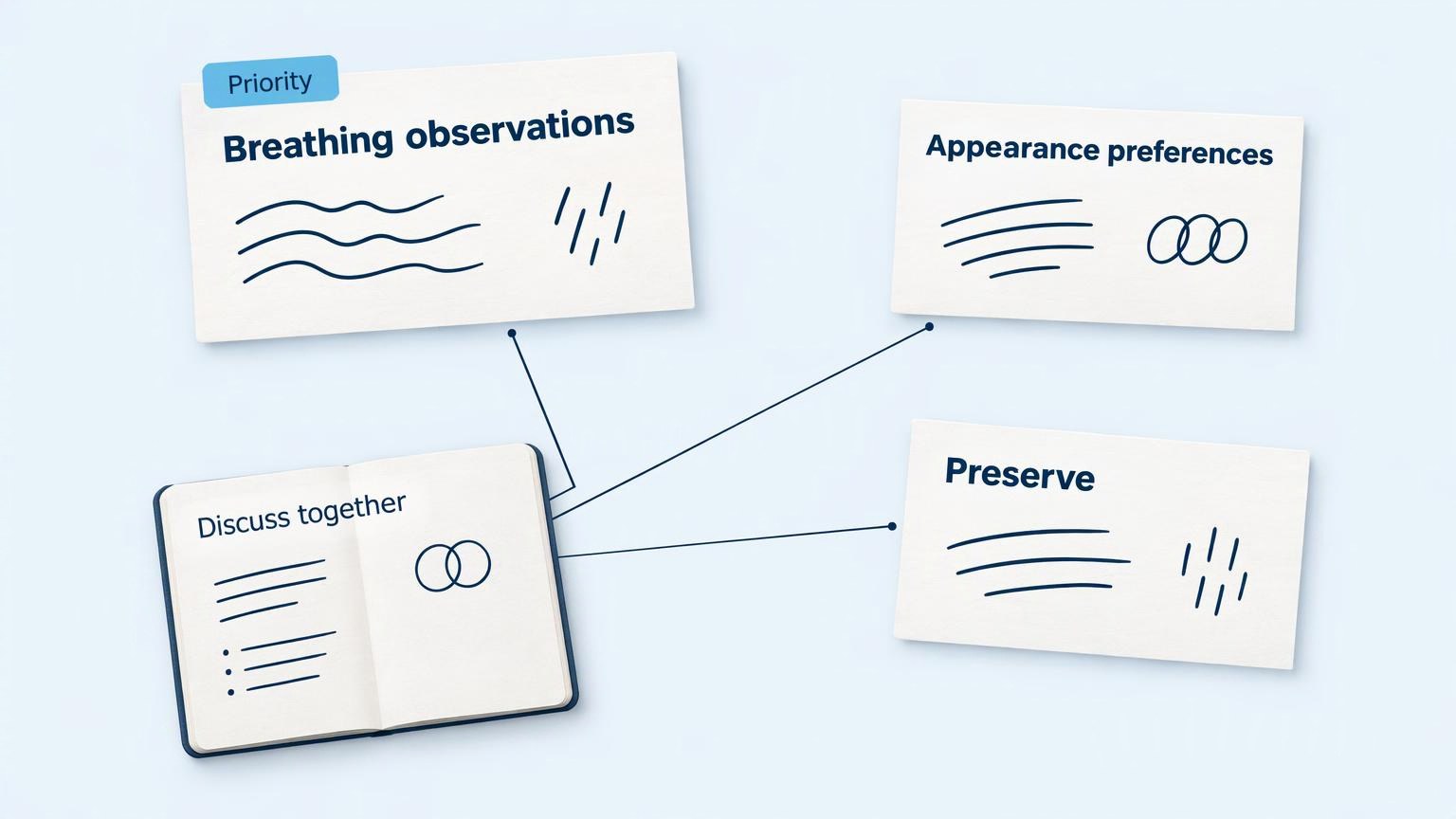
Lead with your most important concern and mention other goals early. Breathing difficulties call for functional assessment; appearance preferences call for discussion of desired changes. If both matter, neither should be an afterthought.
The Instituto de Cirugía Plástica's rhinoplasty page describes appearance, structure and function as goals that vary with the patient. This provides consultation vocabulary, not evidence that an operation will meet your goals.
Try: “My main concern is breathing, and I also want to discuss my profile,” or “I mainly want an appearance change, but want to understand the implications for function.” You are setting the assessment's focus, not prescribing treatment.
Use the comparison below to choose your opening. Discussing both concerns does not commit you to combined surgery.
Describe Breathing Concerns Without Diagnosing Yourself
Describe what you notice, when it happens and how it affects daily life. Leave diagnosis and treatment choice to the clinician. “Nasal breathing feels difficult during exercise” describes an experience; “I need a particular operation” assumes a conclusion.
For your private consultation notes, prepare:
- What the difficulty feels like.
- Whether you notice it on one side, both sides or cannot tell.
- When it happens and whether the pattern has changed.
- How it affects activities or comfort.
- Any previous assessment, nasal injury or treatment you can accurately describe.
Then ask: “This is the pattern I have noticed. What would you need to assess before explaining the cause and options?” Acknowledge uncertain details rather than overstating them.
Keep observation separate from interpretation: a visible shape concern does not diagnose breathing difficulty. These notes belong in the clinical consultation, not a general travel inquiry.
| Your Main Concern | Suitable Discussion | Reason | What It Does Not Establish |
|---|---|---|---|
| Breathing difficulty | Lead with functional assessment | Your symptom experience is the priority | The cause or need for surgery |
| Appearance preference | Lead with cosmetic goals and preservation boundaries | The clinician needs to understand your desired change | Feasibility or a promised result |
| Both breathing and appearance | Present both, with an explicit priority | Neither concern should be omitted from assessment | That one operation will address both |
Make Appearance Preferences Specific, Including What to Preserve
Identify the feature you want discussed, your preferred difference and what you want preserved. “I want a better nose” leaves the clinician guessing what better means.
Try: “The outline of my bridge in profile bothers me. I want to discuss a less prominent outline, but I like how my nose looks from the front.” This expresses a preference without claiming the change is feasible.
Explain labels such as “natural,” “balanced” or “subtle.” You might mean retaining a recognizable feature, avoiding dramatic change or preserving a connection to your family appearance. A broad label alone does not communicate those boundaries.
Rank your preferences: distinguish the most important change from those you would consider only after hearing the trade-offs. Ask the clinician about the limits of a proposal for you. The discussion may lead to a revised preference, a narrower goal or a decision against surgery.
Work Through Both Goals Without Assuming One Solution
When function and appearance both matter, state your priority and ask how the clinician would assess their relationship. Addressing one does not automatically resolve the other.
For example, suppose nasal breathing feels difficult during exercise and you dislike your profile, but want to preserve your front-view appearance. An appearance-only discussion leaves breathing unanswered; a function-only discussion omits your cosmetic preference. Presenting both gives the clinician the full question.
Try: “Breathing is my first priority. I also want to discuss my profile, but preserving my front-view appearance matters. What can you assess about each concern, and where might my preferences limit the options?”
If one concern needs further assessment, you have a partial answer and a next clinical step, not a complete surgery decision. If a proposal conflicts with a feature you want preserved, discuss that conflict before accepting it. Use your stated priority to judge whether the proposal fits, rather than treating every proposed change as equally important.
Use the Clinician's Response to Decide What Remains Open
A useful response connects your goals to the clinician's assessment and identifies uncertainty. Distinguish a finding, a proposed action and an expectation: they are not interchangeable.
Read the explanation back: “My understanding is that this part of the proposal concerns appearance, while my breathing concern still needs assessment. Is that correct?” This exposes misunderstandings without requiring technical terminology.
For each priority, note whether it has been assessed, has a proposed option or requires more information. Ask about that option's benefits, risks, alternatives and limits in relation to your priority. If a technique is mentioned, return to why it is proposed for your goals.
An unanswered question can be a useful consultation outcome if the clinician explains the next step. Mark it in your notes so it remains open. A recommendation against surgery, or an explanation that your preferred change is unsuitable, is also an answer to consider, not something to negotiate around.
Keep the Clinical Plan Separate From the Travel Handoff
Base travel timing on the treating clinician's care and follow-up plan. A general recovery estimate is not personal clearance to fly.
Clinical questions include further assessment, follow-up and who provides instructions if concerns arise. Travel arrangements are separate. Later, after the recipient and purpose are clear, discuss dates, destination, lodging and companions with the confirmed travel contact. Logistics cannot resolve treatment suitability.
Hospitality Cancun publishes travel and consultation-planning guidance; keep clinical decisions with the qualified treating clinician.
Before submitting any information through a general inquiry in Hospitality Cancun's contact section, clarify the recipient and purpose. The first submission allows only name and email, with an optional contact-method preference. Do not include clinical narratives, records, scans, insurance numbers, payment details or attachments. Clinical records belong only in a named provider-confirmed secure channel. Permission to reply, optional marketing and referral to a specifically named provider are separate choices; requesting a reply does not give marketing consent.

Frequently Asked Questions
Should I choose a named rhinoplasty technique before consulting?
You can ask about a technique, but explain your goals first. Ask the clinician why it would be relevant to you, what alternatives exist and which limitations matter. A technique preference does not establish suitability or replace assessment of your concerns.
Can I use someone else's nose photo to explain my preferences?
Use a reference image to explain a preference, not request an identical result. Identify the feature you like and what you want preserved in your appearance. Ask how the reference relates to your anatomy and preferences, without assuming it predicts your outcome.
How should I handle different opinions from two clinicians?
Compare whether both clinicians addressed the same observations and priorities. Identify differences in their assessments, options or explanations, then seek clarification. Do not choose solely because one answer sounds more appealing. Further assessment may be needed before you make a treatment decision.
How can I prepare for a consultation conducted in English?
Prepare plain-language notes and clarify communication arrangements beforehand. During the consultation, ask for unfamiliar terms to be explained and summarize your understanding aloud. Arrange any needed language support with the provider; an English-language website does not guarantee an English-language consultation or interpretation.
Does describing a functional goal mean I qualify for surgery?
No. Reporting breathing difficulty identifies what you want assessed; it does not establish a diagnosis, eligibility or need for surgery. Ask what evaluation is required and which options follow from the findings. Distinguish your reported experience from the clinician's assessment and recommendation.