

Care and Travel Planning
Learn how to identify the person responsible for each part of your care and travel plan before treating a package as a complete answer.
A search for a mommy makeover in Cancun can bring up procedure descriptions, clinic listings and travel packages together. Those pages answer different questions. A hotel description cannot establish clinical support, and a coordinator's availability does not identify who accepts responsibility for treatment.
The useful next step is to map responsibilities, not count package features. We publish travel and consultation-planning guidance at Hospitality Cancun; clinical assessment and care belong with your chosen treating provider.
Who should answer care questions and travel questions?
The treating clinician should answer questions requiring medical judgment. A travel supplier or confirmed coordination contact should answer reservation and transport questions within their agreed role. If both are involved, split the question rather than allowing a travel answer to stand in for clinical advice.
For example, whether you need an assessment before departure is a clinical question. Whether a room can be extended is a lodging question. A room extension does not itself establish that nursing, monitoring or other clinical support is necessary or available.
A clinic's administrative contact may relay instructions or manage scheduling, but establish whose instructions they are conveying. Likewise, an English-speaking contact can help communication without becoming the person responsible for diagnosis or recovery advice.
The comparison below describes roles to establish, not services promised by Hospitality Cancun or any particular provider. One person may assist with several tasks, but each task still needs a clear scope and accountable party.
How do you identify the provider responsible for care?
Start with the proposed treating clinician's full name and the exact facility where treatment would occur. Then verify the credentials being claimed through the relevant issuing bodies rather than treating a listing, photograph or package badge as proof.
Use a simple sequence: obtain the identity, identify who issued the claimed license or specialty credential, and search that body's records for the same person. Match identifiers where available, not just a similar name. A listing for another location or a different professional does not resolve your question.
If the record is unclear, seek clarification from the issuing body before relying on the claim. Membership, licensing and specialty credentials should be understood according to what each actually establishes; do not treat different labels as interchangeable.
Next, have the provider identify who handles assessment, treatment and follow-up. The person selling or explaining a package may not be the person performing care. If the proposed clinician changes, repeat the identity checks for the replacement.
| Question | Appropriate Lead | Boundary |
|---|---|---|
| Is the proposed treatment suitable for me? | Qualified treating clinician | Travel preferences cannot establish eligibility. |
| Can I change my room or transport booking? | Relevant supplier or agreed travel contact | Booking assistance does not include clinical judgment. |
| Can I leave before a planned review? | Treating clinician first; travel supplier afterward | Clinical clearance and reservation changes are separate decisions. |
| Does the offer include clinical support outside the facility? | Provider for the care scope; seller for contractual inclusion | Accommodation alone does not establish clinical support. |

What does a package description actually establish?
A package description can identify advertised components, but the label alone does not establish your clinical plan, exact inclusions or payment obligations. Evaluate the actual proposal and the terms attached to each supplier.
Published descriptions illustrate why. PlacidWay's Cancun plastic surgery package guide describes hotel accommodation as included. Its Mexico mommy makeover package page lists hotel stays outside hospital admission as excluded. These are different descriptions, not a reliable rule for your proposed Cancun care.
Separate three issues when reading an offer: what service is purchased, who performs it, and what happens if the plan changes. An advertised follow-up visit does not explain the response to an unexpected concern. A hotel booking does not establish medical supervision.
Supplier cancellation, refund and change terms govern the contractual consequences of changing a booking. Insurance coverage and claim conditions are separate. Neither a package label nor the clinical reason for a change establishes that a supplier must refund it or that insurance will pay.
What if your preferred return flight conflicts with follow-up?
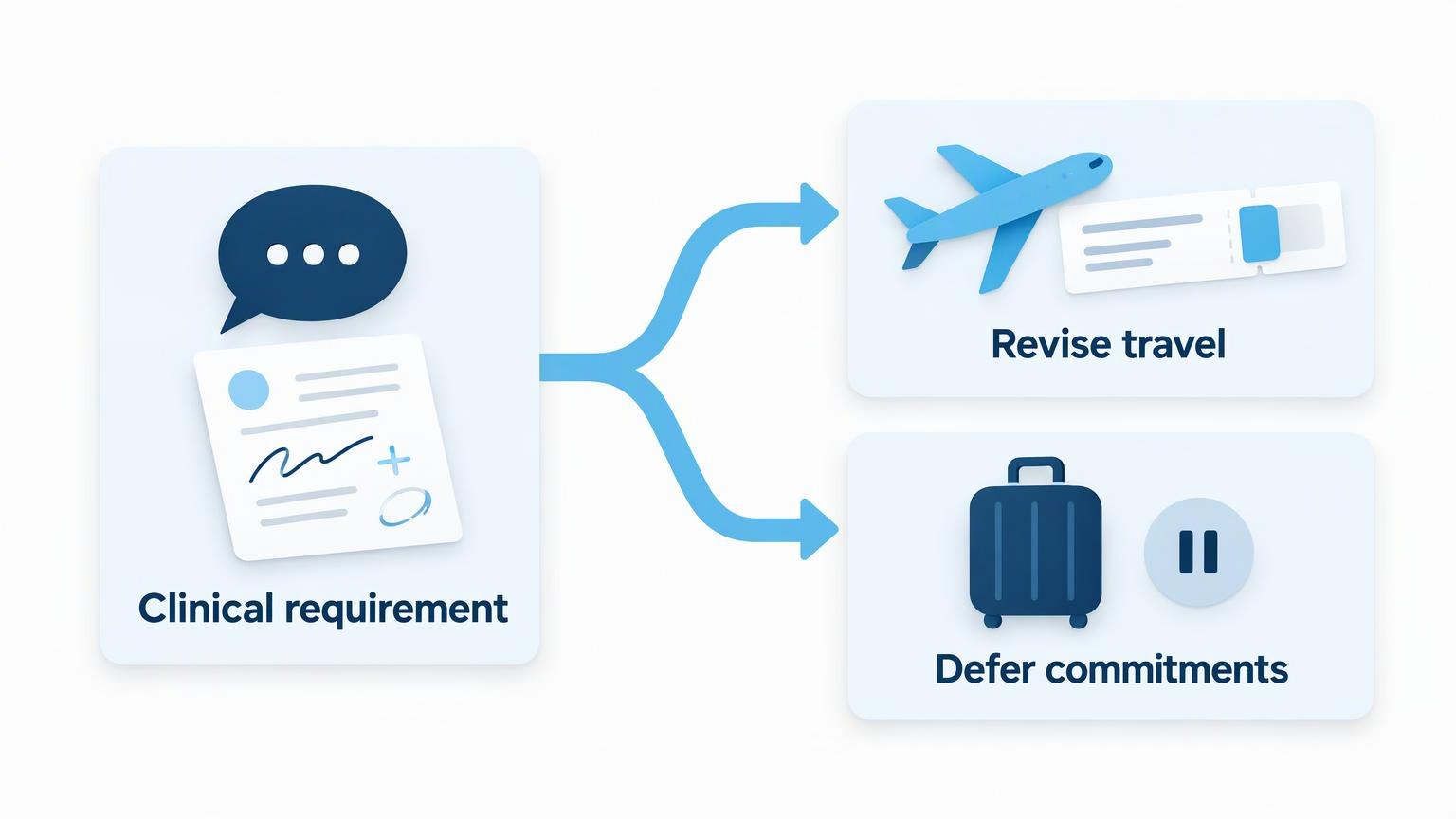
Resolve the clinical requirement before choosing the travel adjustment. Flight timing and length of stay depend on the treating clinician and follow-up plan, not a fixed recovery period copied from a package page.
Say you prefer to return home before a review the clinician has specified, while your companion plans to leave earlier. The immediate question is whether your proposed departure fits the care plan. The companion's departure alone does not establish a need for professional clinical support.
You could retain the preferred return only if the treating clinician determines that the resulting follow-up arrangement is appropriate. Otherwise, the alternatives are to revise the travel plan or defer commitments until the clinician establishes the follow-up timing. A convenient flight is not a reason to skip a required review.
If a longer stay is directed, extending the hotel remains a travel purchase. Who pays, whether the extension is included and what change terms apply depend on the written agreements. The clinician's instruction establishes the care requirement, not the financial allocation.
Who handles concerns after you leave Cancun?
Your follow-up plan should identify the clinical contact after departure and explain how to obtain care when a message is not enough. Returning home should not leave you relying on a travel contact to interpret a medical concern.
Distinguish routine reviews from unexpected concerns. For routine follow-up, establish who conducts the review, how it occurs and what information the clinician needs. For an unexpected concern, obtain the provider's instructions about contacting the clinical team and when to seek in-person or urgent care.
Also establish how care would continue at home if an examination or treatment is needed. A plan to send messages to the original clinic is not the same as arranging access to a local clinician. Do not assume another provider has accepted ongoing care without discussing it directly.
Travel assistance may still be useful for a changed reservation, but it cannot replace clinical assessment. Keep the clinical contact instructions accessible separately from hotel, transport and booking information.
How should you prepare the provider and travel handoffs?
Prepare a private role checklist, then keep the clinical conversation separate from later travel discussion. Your provider list can be short:
- Who assesses suitability and provides the treatment recommendation?
- Who is responsible for care at the proposed facility?
- Who gives recovery, follow-up and travel-clearance instructions?
- Who handles clinical concerns after departure?
For Hospitality Cancun's contact section, clarify the recipient and purpose before submitting any information. Once clear, the first submission is limited to name and email, with optional contact-method preference. Do not include travel details, a narrative, clinical records, financial details, insurance identifiers or attachments.
Ordinary travel details may be discussed later with the confirmed travel contact. Diagnoses, scans and clinical records belong only in a named provider-confirmed secure channel.
Permission to respond to your requested inquiry, optional marketing permission and referral permission to a specifically named provider are separate choices. A requested reply is not marketing consent.
Frequently Asked Questions
Does an English-speaking coordinator replace an interpreter?
Not necessarily. Establish what communication support is offered during the clinical consultation and consent discussion, not just during travel arrangements. If you do not understand an explanation, request clarification from the treating provider. Conversational assistance does not itself establish qualifications to interpret clinical information.
Can my companion make treatment decisions for me?
A companion can help you prepare questions or remember explanations, but their preferences should not be presented as yours. Discuss your own goals directly with the clinician. If someone would need authority to act on your behalf, clarify the applicable arrangements with the provider rather than assuming travel-companion status grants it.
Do before-and-after photos prove that a provider is qualified?
No. Photos do not verify the clinician's identity, credentials or responsibility for the proposed care. They also do not establish what outcome is achievable for you. Use them, if relevant, to explain a preference during consultation, while evaluating qualifications and the clinical recommendation separately.
Does the name mommy makeover identify my exact treatment?
Do not rely on the label as your treatment plan. Have the treating clinician explain the specific proposed procedures, their purpose, alternatives and relevant risks for you. A shared package name does not establish that different proposals involve the same treatment or that combining procedures is appropriate.
Should I choose the proposal with the most bundled features?
Not on feature count alone. A bundle is useful only when its components fit the care plan and the responsibilities are clear. Extra hospitality features do not resolve missing clinical accountability. Compare the proposed care first, then assess whether the travel components and supplier terms meet your practical needs.