

Personal Readiness and Consultation Planning
Use your reasons, responsibilities and unanswered questions to choose a next step without making a life milestone your surgery deadline.
A return to work, a change in family responsibilities or a relationship transition can prompt you to reconsider how you feel about your body. The useful question is not whether this is the moment to become a different person. It is what you want to understand before choosing care.
Keep personal readiness, medical suitability and travel feasibility separate. An answer in one area does not settle the others.
What do you want this change to mean in your life?
Start with what you would want for yourself even if no one else noticed. That helps distinguish a personal appearance preference from a decision shaped mainly by someone else's expectations.
Privately finish this sentence: I want to explore changing this aspect of my appearance because... Then write separately what you hope will change at work, at home or in a relationship. A specific appearance goal is something you can discuss with a clinician. Repairing a relationship, proving that you have moved on or feeling like your former self involves questions that a surgical recommendation cannot settle.
These motives can coexist. You do not need a perfectly uncomplicated reason to learn about your options. But if you would lose interest without another person's approval, that is a reason to give the decision more space.
A useful test is whether you could accept an outcome that changes your appearance without changing your circumstances. If not, spend more time understanding the broader need before making a financial commitment.
Choose between more reflection, a consultation and a pause
Choose a consultation when the unanswered questions are clinical. Choose further reflection when you are still identifying what you want. Choose a pause when pressure or practical demands make it difficult to consider the trade-offs freely.
A consultation is a way to gather information, not a promise to proceed. You can bring a clear preference and still conclude that you do not want the recommended approach. Equally, pausing does not mean ruling out care permanently.
Make the next step small enough to reconsider. Reading about an option, discussing your goals with a qualified clinician and paying a deposit are different levels of commitment. Do not let a package offer collapse them into a single decision.
The comparison below helps you match the action to the uncertainty. The point is not to score yourself as ready or unready. It is to identify what would make your next decision better informed.
| Situation | Suitable next step | Reason | Trade-off |
|---|---|---|---|
| Your appearance goal is clear; suitability is unknown. | Qualified clinical consultation | Clinical assessment can address the uncertainty. | The recommendation may differ from what you expected. |
| You know you want change but cannot describe what matters. | More personal reflection | Clarifying the goal makes later advice easier to evaluate. | You will not yet have a treatment recommendation. |
| Outside pressure or fixed responsibilities are driving urgency. | Pause commitments | Space preserves your ability to choose freely. | You may need to revisit the plan later. |
Personal readiness does not establish clinical timing
Your clinician must assess suitability and timing individually. Feeling ready, finishing a family milestone or having vacation time available does not provide medical clearance.
In an ASPS-hosted consultation article, plastic surgeon Scot Martin identifies future pregnancy plans, time since childbirth, breastfeeding and appearance goals as topics for discussion. These are consultation prompts, not a universal waiting rule or a recommendation for a particular provider.
Be honest about uncertainty. If you are undecided about future pregnancy, you do not need to invent a firm answer to keep a consultation moving. Explain that uncertainty to the treating clinician and ask how it affects the options under consideration.
Likewise, describe work and caregiving responsibilities rather than assuming a return date. Recovery advice, follow-up requirements, length of stay and flight timing belong with the qualified treating clinician. Use that guidance to build a travel plan afterward, rather than asking the care plan to fit a preselected departure.
Test your support plan against the care plan
A practical plan works only if your available support can accommodate the clinician's actual recommendations. General offers of help are not the same as coverage for specific responsibilities.
Say you are returning to work and have wanted to explore an appearance change for some time. A relative can handle childcare during your planned absence, but that help ends when your leave ends. You are comparing a Mexico travel package before a clinician has established follow-up needs or flight timing.
You could reserve around the relative's availability, continue consultation without travel commitments, or defer travel until support is less rigid. Reserving now would make an unconfirmed medical timetable depend on a fixed family deadline. Continuing consultation is the more useful next step: it reveals whether the proposed care can fit your support arrangements at all.
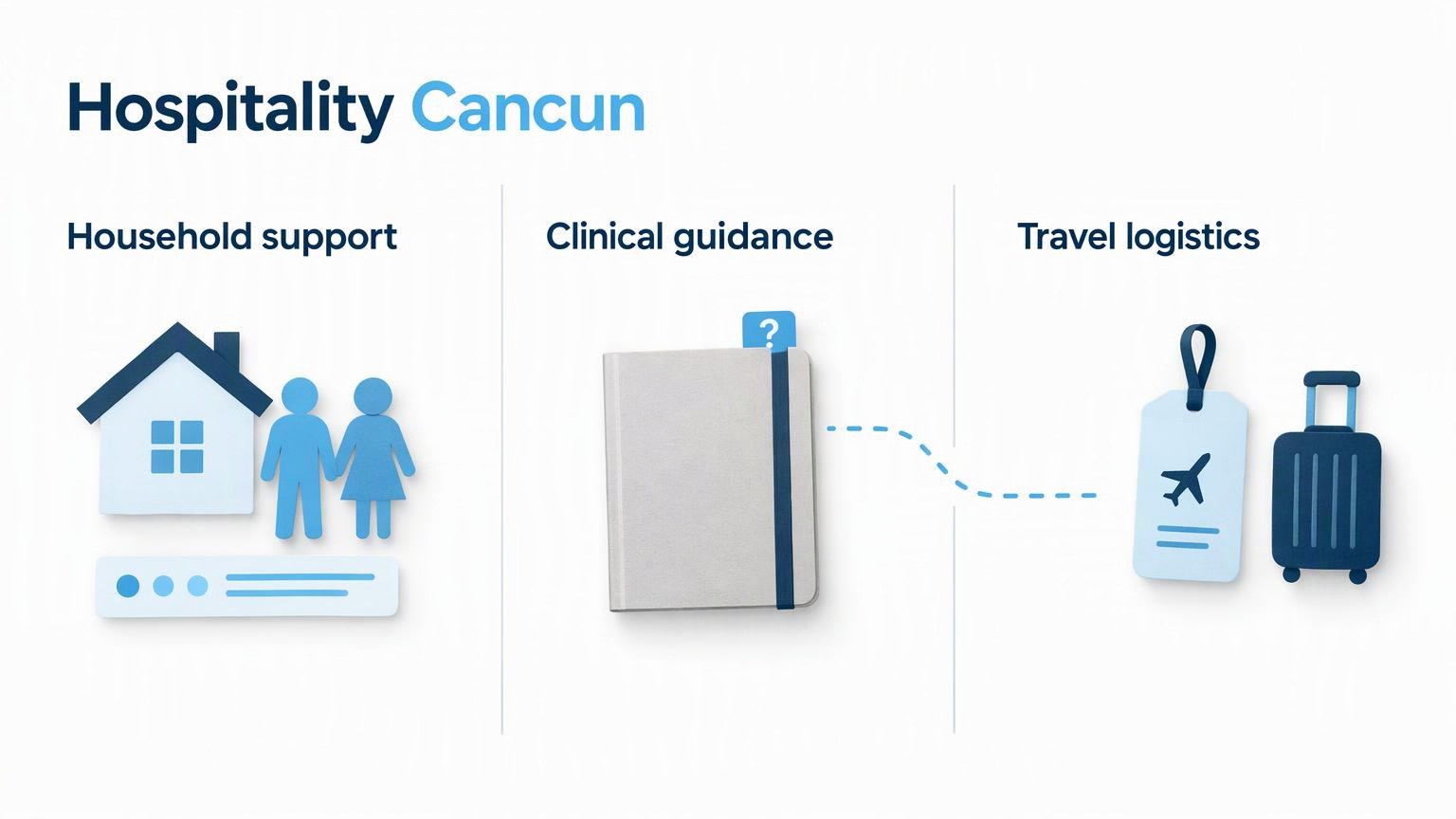
If it cannot, the answer may be different dates, additional help or a pause. A companion or relative does not automatically replace any clinical support required by the care plan. Keep household assistance, travel logistics and clinical care as separate responsibilities.
Research the provider before judging the package
Move from broad Mexico searches to a named provider and an identifiable care setting. A package description is not evidence that its procedures suit you or that the provider's credentials have been confirmed.
Start by identifying who would assess and treat you. Match the clinician's full name to the credentials claimed, then verify those claims with the relevant issuing authority. Treat a profile statement as a starting point for verification, not its conclusion. Identify the proposed facility separately from the travel company or intermediary.
Next, use the clinical consultation to understand the recommendation, material risks, alternatives and follow-up arrangements, including what happens after you return home. If those answers remain unclear, another qualified clinical opinion may be more useful than more package browsing.
Only then evaluate whether the travel offer supports that plan. An attractive price cannot resolve unclear clinical responsibilities. Hospitality Cancun publishes travel and consultation-planning guidance; that role is separate from the treating clinician's assessment and does not establish a relationship with a particular provider.

Write a private decision note before choosing care
Write down what you still need to understand, not just which option currently appeals to you. Keep this note for your own reflection and later appropriate conversations.
- Personal: The change you want, why it matters and what you do not expect surgery to solve.
- Clinical: Questions about suitability, timing, trade-offs and follow-up for a qualified clinician.
- Practical: Work, household support and financial limits that could change your decision.
- Decision boundary: What you need to understand before making a commitment.
Before submitting any information through Hospitality Cancun's contact section, clarify the recipient and purpose. The first submission permits only name, email and an optional contact-method preference. Your private note is not a first-form message. Travel details may be discussed later with the confirmed travel contact.
Permission for a requested reply, optional marketing and referral to a specifically named provider are separate choices. Diagnoses, scans and clinical records belong only in a named provider-confirmed secure channel. Do not send payment details, insurance numbers or attachments through a general inquiry.
Frequently Asked Questions
Does researching surgery mean I am unhappy with motherhood?
No. An appearance preference does not define how you feel about being a parent. You also do not need to frame surgery as a reward for motherhood. Consider the preference on its own terms, without requiring it to prove gratitude, confidence or commitment to your family.
What if I feel guilty about spending time or money on myself?
Separate the feeling from the practical calculation. Privately consider whether the commitment fits your responsibilities and financial limits, then consider whose expectations are influencing the guilt. You do not have to proceed to justify self-care, and you do not have to reject an appearance preference to demonstrate responsibility.
Can I reconsider after discussing options with a clinician?
Yes. Learning about risks or trade-offs may change what you want. Before paying or signing anything, understand the applicable supplier cancellation, refund and change terms. Your ability to reconsider personally does not establish a right to recover money already committed under a contract.
Should I use another person's photos to define my goal?
You can use images to explain a preference, but not as a promised outcome or evidence that the same approach suits you. Describe what attracts you to the image and what concerns you. Ask the clinician to explain the limits of that comparison rather than aiming to reproduce another person's body.
What if a package sounds affordable but leaves no financial flexibility?
Evaluate that as a financial limitation, not evidence that you should act quickly. Separate clinical charges from travel expenses and consider what a changed plan would mean for your budget. Supplier terms determine contractual costs; any insurance coverage depends separately on the actual policy and claim conditions.