

Medical Travel Decisions
Use an appealing trip as travel context, not as the deciding evidence about a surgeon or your care plan.
A review can describe a satisfying visit while leaving your most important decision unanswered. The useful question is not whether someone enjoyed Tijuana, but which parts of their account help you evaluate the care you are considering. This guide offers a reading method, not a provider ranking.
Separate holiday appeal from evidence about care
Give holiday details weight when choosing travel arrangements, not when deciding whether a provider is appropriate for you. You can value comfortable accommodation and courteous service without treating them as evidence of clinical qualifications.
Read each account in separate categories: travel experience, reported care experience and information requiring independent verification. A smooth hotel arrival belongs in the travel category. A description of how a clinician explained options belongs in the care-experience category. A claim about certification belongs in the verification category, even when the writer sounds confident.
This separation also prevents the reverse mistake. A disappointing room does not, by itself, establish poor surgical care. Identify who provided the service being criticized before carrying that criticism into another decision.
The comparison below shows what different accounts can support. None supplies a provider recommendation on its own. Use the most relevant account to guide your next research step, rather than awarding the entire trip a single score.
Search for the person and procedure, not just the destination
Start broad enough to identify a provider, then narrow the search to the exact clinician and procedure you are considering. A general Tijuana result is a starting point, not the end of the search.
Open the full account rather than relying on its preview. Establish whether it names the treating clinician, the facility, a travel organizer or only the destination. If it praises a facility but leaves the clinician unnamed, continue searching for the clinician instead of assigning the praise to someone by association.
Next, combine the clinician's full name with the procedure. Look for publication dates and any later updates. Search separately for follow-up experiences so that arrival-day impressions do not become your entire evidence base.
If results concern a different procedure or an earlier practice arrangement, retain only the limited information they actually offer. Broaden to another review source rather than forcing a weak match. Save the original page and note who posted it, what experience it describes and when. This makes later comparisons traceable.
| Account | Useful for | Limit and next step |
|---|---|---|
| Praise for accommodation and the welcome | Assessing the reported travel experience | Does not establish provider suitability; search for care-specific detail. |
| Named clinician, matching procedure and follow-up detail | Preparing focused consultation questions | Still one person's account; verify credentials separately. |
| A successful trip fitted into holiday dates | Understanding that person's itinerary | Does not establish your timetable; obtain individual clinical guidance. |
| A complaint naming a specific service and event | Identifying a concrete issue to investigate | Separate the reported event from an unverified explanation of its cause. |
Read the whole account before interpreting its verdict
Extract what the writer reports happened before adopting their conclusion. Words such as “amazing” or “terrible” express a judgment; the accompanying events tell you what that judgment rests on.
For example, an account posted shortly after a visit might describe communication, admission and the room. Read it as evidence about those reported experiences, not as a completed account of longer-term results. A later update adds another time point, but it still describes that person's experience rather than predicting yours.
Compare accounts using the same dimensions: the person named, the procedure described, the stage of care and the handling of follow-up. Several glowing accounts about unrelated services are not automatically more useful than a detailed account matching your question.
For a negative review, separate the reported problem from the writer's explanation of its cause. A provider response may add context, but it does not independently settle the dispute. Where accounts conflict, preserve the disagreement. Do not average it away into a reassuring overall impression or turn it into an unsupported accusation.
Move credential and personal care questions beyond reviews
Use reviews to identify questions, then use the appropriate authority to answer them. A reviewer cannot authenticate a credential or determine whether surgery is suitable for you.
For a credential claim, establish the clinician's full identity, the exact credential claimed and its issuing body. Match that information against the issuing authority's own records where available. A logo, biography or repeated testimonial is not a substitute for that match. If you cannot establish the match, treat the claim as unconfirmed rather than promoting repetition into confirmation.
Keep facility claims separate from clinician claims. A description of a clean room is an observation about the room, not confirmation of facility accreditation or the clinician's qualifications.
Your eligibility, procedure options, recovery advice and follow-up requirements belong with the qualified treating clinician. Flight timing and length of stay depend on that clinical plan. Another reviewer's return date is not your clearance to travel. Reviews can help you prepare for a consultation, but the consultation must address your circumstances rather than reproduce someone else's itinerary.

Test fixed holiday dates against the open care plan
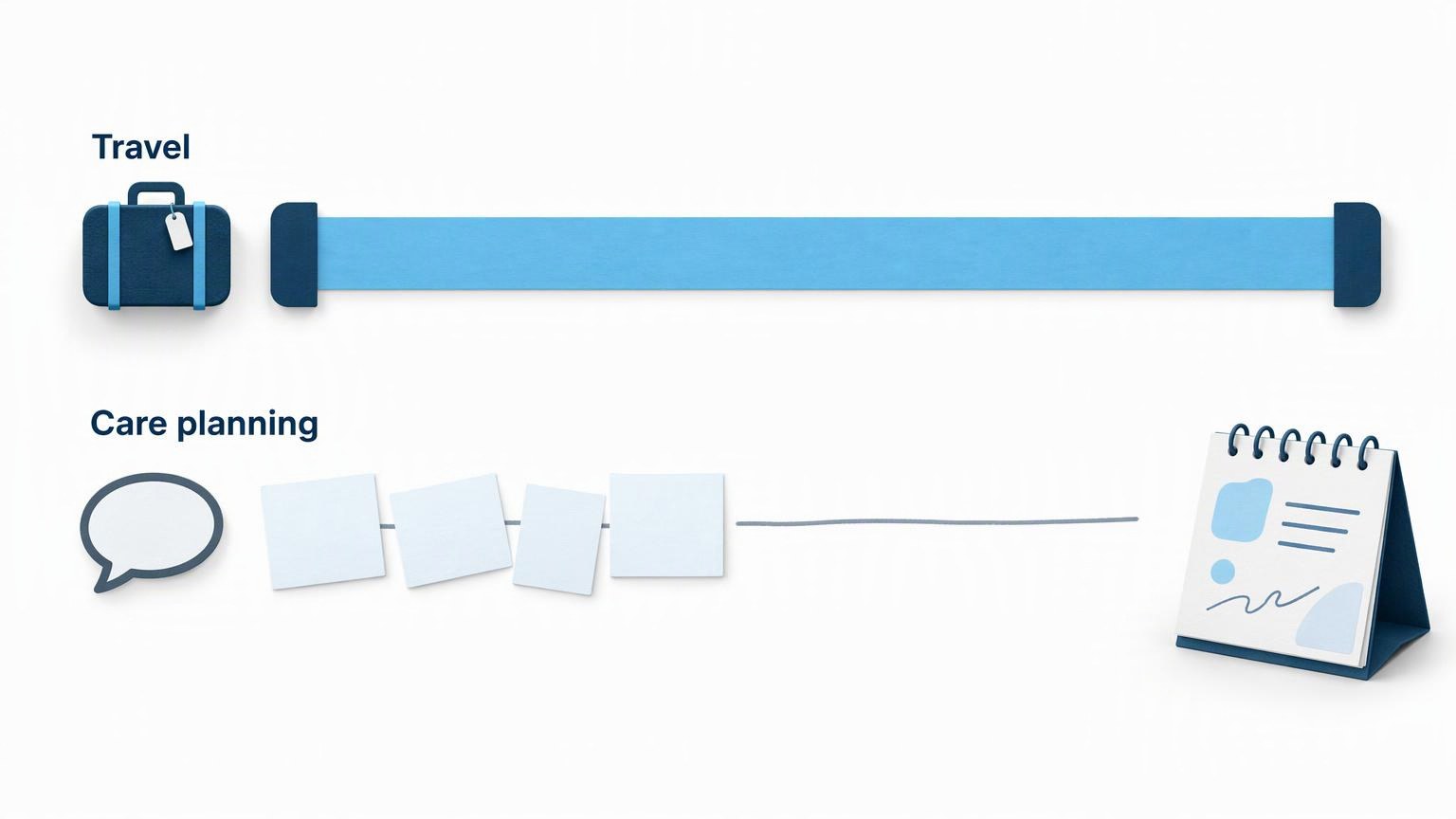
If your holiday dates are fixed but the clinical timetable is not, separate the holiday from the surgery decision. An available travel window does not establish a suitable care window.
Say you have approved leave, a companion with a fixed return date and an appealing accommodation option. The reviews you found praise the welcome and lodging, but you have not established the follow-up plan or individual return-travel advice.
You could keep the holiday and defer surgery consideration. You could change the trip after the clinical plan is established. Or you could commit now and assume the care will fit. The last choice rests on an unanswered clinical question, not on the strength of the holiday reviews. Keeping the trip separate is the reasoned option when changing dates is impractical.
If the clinician's plan later supports travel planning, assess the bookings on their own terms. Changing a flight or extending lodging is a logistics task; it does not itself define your clinical support needs. Likewise, a companion's convenient schedule does not establish whether their presence meets the actual care plan.
Choose the next step from the issue still open
End your review reading with a specific next action, not simply a larger collection of links. The next step depends on what you still need to establish.
Keep a short private decision record:
- What the accounts support: the relevant reported experiences, with their dates and sources.
- What you still need to establish: identity, credentials, a clinical question or an ordinary travel requirement.
- What would change your decision: the particular evidence or explanation needed before proceeding.
An identity mismatch calls for further verification. A question about suitability or follow-up calls for a clinician-led consultation. A settled care plan with an accommodation question calls for travel research. These are different jobs, not interchangeable reasons to seek a booking.
We publish travel and consultation-planning guidance at Hospitality Cancun. Our Cancun destination context is separate from your assessment of a Tijuana provider: it is not a recommendation, credential check or clinical endorsement. If Cancun is also part of your destination research, keep that comparison in the travel portion of your decision. Continue assessing provider reviews independently.
Frequently Asked Questions
Can before-and-after photos settle the decision?
No. Treat photos as material for a discussion, not a prediction of your result. Establish whose work is shown and what context accompanies the images. Even an accurately identified example does not answer your eligibility, explain the full care experience or establish the follow-up you would need.
Should an anonymous review be discarded?
Not automatically. You can use it to identify a question worth investigating, while recognizing that you may be unable to establish the writer's identity or experience. Avoid treating an anonymous allegation as a confirmed event, and avoid treating anonymous praise as an authenticated recommendation. Look for independently answerable details.
Does a large number of positive ratings make detailed reading unnecessary?
No. A rating total does not tell you which clinician, procedure or stage of care each account concerns. Read relevant accounts before drawing a conclusion. A collection dominated by travel praise may answer a hospitality question while leaving your provider question open, regardless of how favorable its overall score looks.
Should I post my medical history publicly to get more useful recommendations?
No. You can ask general questions about how to evaluate accounts without publishing diagnoses, scans or records. Personal clinical information belongs only in a named provider-confirmed secure channel. Public recommendations are not a substitute for an individual clinical assessment, and sharing more personal detail does not make them one.
What belongs in a first Hospitality Cancun inquiry?
Clarify the recipient and purpose before submitting anything. The first submission allows only name, email and optional contact-method preference. Travel details belong in later discussion with the confirmed travel contact. Permission for a requested reply, optional marketing and referral to a specifically named provider are separate choices. A reply is not marketing consent.