

Consultation and Travel Planning
Separate the consultation decision from the travel purchase so you can judge each Cancun option on its actual responsibilities.
A Cancun search can put a hospital, a surgeon’s practice and a travel facilitator beside one another as though they offer the same thing. They do not represent the same decision. Start by identifying who would assess you, who would provide care and who would sell any travel arrangements. Then move from browsing to consultation, proposal comparison and a workable itinerary.
Search by provider identity, then choose your contact route
Start with Cancun abdominoplasty listings, then separate treating providers from intermediaries before choosing whom to approach. A direct-provider route suits you when the clinician and facility are identifiable. A facilitator may be useful when its specific administrative responsibilities are clear; the label alone establishes no clinical authority.
The Health-Tourism Cancun directory presents entries labeled as a medical-tourism facilitator, a cosmetic surgery clinic and a private hospital. That distinction matters more than their order on the page: a listing can identify a potential contact without establishing who would perform your operation.
Open the provider’s own information next. Record the proposed surgeon, facility and consultation process privately. If the result identifies only an agency or package, the next decision is whether it can identify the actual treating provider, not whether its headline sounds attractive. If the surgeon or facility remains unnamed, keep that option out of your final comparison. The table distinguishes useful routes without endorsing a supplier.
Continue only when the consultation clarifies the clinical decision
A useful consultation establishes what the clinician still needs to assess, rather than treating your preferred procedure as already approved. Eligibility, the appropriate operation, risks and recovery advice belong with the qualified treating clinician.
Compare who conducts the discussion, whether an examination is still required and what could change the proposed procedure. A remote conversation, if offered, may help you understand the next assessment step. It should not be treated as equivalent to every examination or as a guarantee that surgery will proceed after arrival.
Match credential information to the individual who would operate. Obtain the surgeon’s full professional name and the details supporting any licensing or specialty-certification claim, then verify them with the issuing authority. A badge attached to a clinic brand is not a substitute for that match.
Also identify the proposed surgical facility separately from the consultation address. Before advancing, you should understand the clinician’s rationale, the limitations of the assessment so far and the arrangements for follow-up and urgent concerns. An advertisement cannot answer those individual clinical questions.
| Route | Choose When | Reason | Trade-off |
|---|---|---|---|
| Named provider directly | You can identify the clinician and proposed facility. | Clinical questions can be directed to the treating provider. | Travel arrangements remain separate unless expressly offered. |
| Facilitator with defined responsibilities | You want administrative help and know its scope. | You can evaluate the specific tasks it proposes to handle. | Its role does not establish surgeon credentials or clinical suitability. |
| Consultation before travel commitment | Suitability or the required stay has not yet been established. | Assessment can inform whether a surgery trip is feasible. | You defer firm travel purchases while the decision remains open. |

Compare equivalent services, not package headlines
Compare proposals only after they describe the same intended procedure and distinguish clinical services from travel purchases. A lower headline is not a lower total when it covers a different scope.
The PlacidWay Cancun tummy tuck listing describes surgical items while listing airfare and hotel accommodation as excluded. This illustrates why “package” does not mean the entire trip is included; your actual provider proposal must establish your arrangement.
Use one compact comparison checklist:
- Clinical scope: procedure, surgeon, anesthesia, facility, tests, medications, garments and specified follow-up.
- Travel scope: lodging, transportation, meals and companion expenses, with each inclusion or exclusion identified.
- Payment: contracting supplier, payee, currency, deposit, balance timing and which amounts or arrangements could still change.
- Changes: consequences if assessment changes the operation, surgery does not proceed or travel must move.
Read supplier cancellation, refund and change terms before paying. They determine the contractual consequences of those events. Insurance is a separate policy question: neither a medical reason for cancellation nor a package description establishes reimbursement.
Test your travel window against the care plan
Your available vacation window must fit the clinician’s plan, not determine it. Flight timing and length of stay depend on the treating clinician’s assessment and follow-up arrangements; a published recovery estimate is not personal clearance to fly.
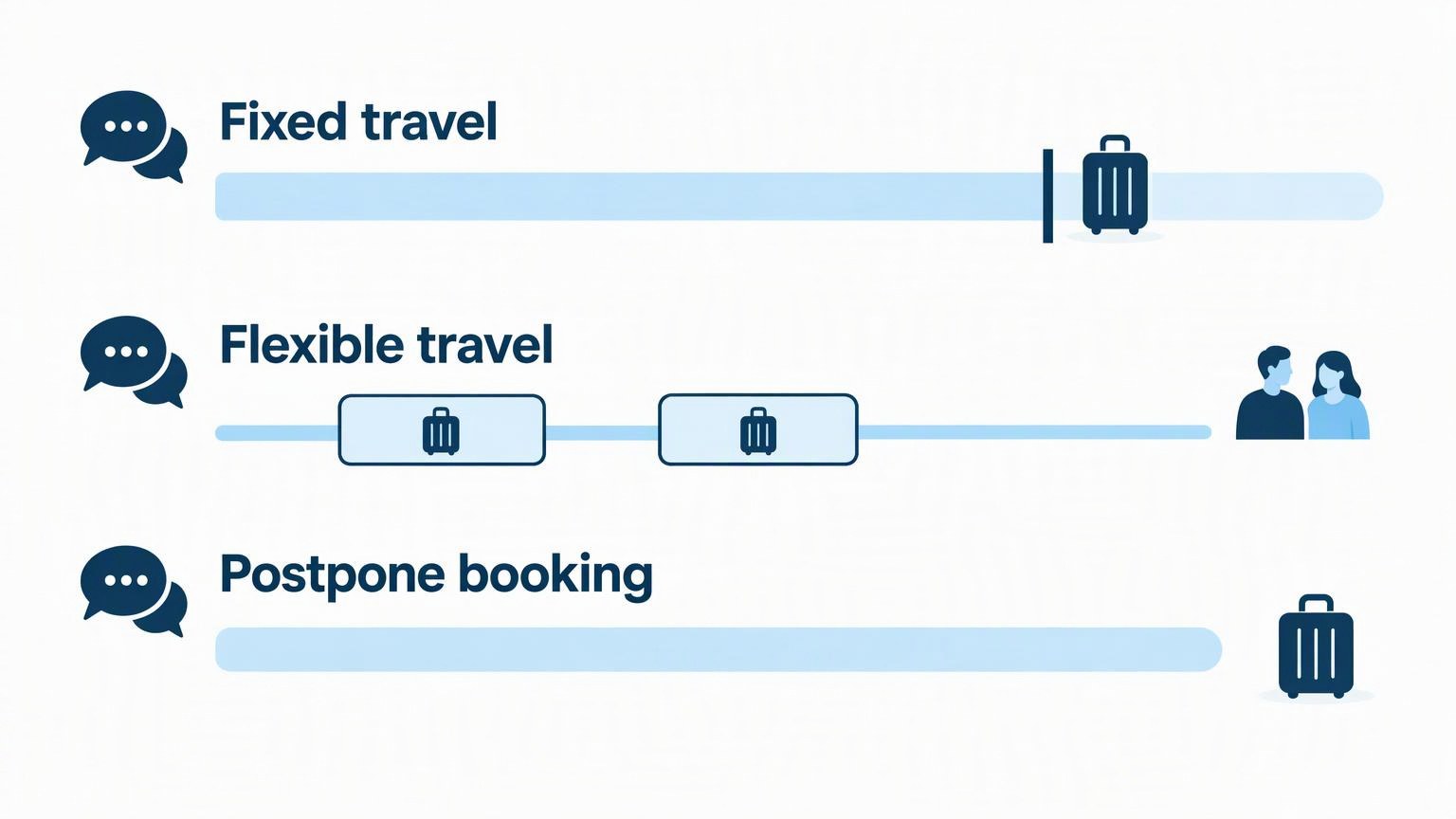
Say you must return to work on a fixed date, and your companion plans to leave before you. The proposed follow-up schedule has not yet established when you can depart. You could buy fixed travel now, retain flexible arrangements or postpone the surgery trip while continuing consultation.
Buying fixed travel creates a firm deadline before the clinician has determined when you can depart. Flexibility helps only if you can also extend time away and accommodation. If you cannot, postponement is the reasoned choice. Your companion’s departure separately requires checking whether you can meet any assistance requirements in the actual care plan.
If the clinician later directs an extra hotel night, that night is still a travel charge. The clinical reason does not establish who pays, whether it is included or which hotel terms apply. You need the relevant contracts to determine those obligations. Any insurance claim depends separately on policy coverage, exclusions and claim conditions.
Arrange travel and clinical handoffs as separate tasks
Build the travel itinerary around the care plan, while keeping booking responsibilities separate from clinical support. A driver, hotel reservation or companion is not automatically a substitute for care the clinician specifies.
First, establish the consultation and follow-up locations and the clinician’s scheduling requirements. Next, compare lodging for access features, room arrangements and extension terms that fit those requirements. Compare transportation for the actual journeys required, including who books each trip and what happens when an appointment changes. An airport transfer does not establish transport to follow-up visits.
Then identify the return-home handoff: who supplies the clinical summary, who handles follow-up questions and whether any local clinician has actually agreed to participate. Access to a phone number is not the same as an accepted follow-up arrangement.
You can prepare travel dates, companion availability and room preferences privately. Discuss them later with a confirmed travel contact after the recipient and purpose are clear. Diagnoses, scans and clinical records belong only in a named treating-provider-confirmed secure channel, not in ordinary travel correspondence.
Use Hospitality Cancun for the travel-planning next step
Hospitality Cancun publishes travel and consultation-planning guidance for adults considering care in Cancun. Use that guidance to organize the nonclinical decision; a planning inquiry is not a surgical assessment or confirmation that a procedure is offered.
Before submitting any information, establish who will receive it and for what purpose. If either is unclear, wait until it is clarified. Hospitality Cancun’s contact section by itself does not establish those details.
Keep three choices separate: permission to respond to your requested inquiry, optional marketing and referral to a specifically named provider. Agreeing to a reply is not marketing consent, and neither choice authorizes an unnamed referral. A later proposed introduction should identify the provider and purpose before you decide whether to permit it.
Once a planning recipient and purpose are clear, later discussion can address the travel arrangements around your consultation. Keep clinical suitability with the treating clinician and supplier obligations with the actual contracts. That division helps you pursue useful planning without assuming that an editorial site provides clinical care.
Frequently Asked Questions
Does a Cancun listing mean the procedure is available for me?
No. A listing describes an advertised service, not your eligibility or an accepted booking. Your assessment may lead to a different recommendation or no surgery. Treat availability, individual suitability and the final proposal as separate matters, each requiring an answer from the appropriate provider.
Should I compare a tummy tuck with liposuction?
Bring the question to the treating clinician rather than choosing between procedure names or advertised prices. The useful comparison is how each proposed approach relates to your goals, assessment, risks and follow-up needs. This travel guide cannot determine which operation, if any, is appropriate for you.
What belongs in the first Hospitality Cancun submission?
First establish the recipient and purpose; if either is unclear, do not submit information. Once clear, the first submission allows only name and email, with optional contact-method preference. It does not allow trip details, narratives, clinical records, insurance numbers, payment details or attachments. Travel discussion happens later.
Can before-and-after photographs settle my choice?
No. Photographs do not establish your likely result, the surgeon’s current credentials or the completeness of a travel arrangement. You can discuss images during a clinical consultation, but keep expectations individualized. Do not let appealing imagery replace assessment of the named clinician, facility and proposed care.
What if I decide against surgery after consultation?
Declining surgery and receiving a refund are different decisions. The consultation, deposit, procedure reservation, hotel and flight may each have separate terms. Review the relevant supplier agreement to determine what is retained, refunded or transferable. Do not assume that deciding against surgery automatically cancels every purchase without cost.