

Consultation and Travel Planning
Build a communication plan that identifies the sender, recipient, and next action for each kind of update.
An update might mean an appointment time, an answer about your care, or a message to someone waiting at home. Those messages serve different purposes. This guide helps you map communication responsibilities without prescribing recovery steps or assuming that a travel-planning contact speaks for your clinician.
Who should answer each kind of update?
Your named treating provider should be the source of clinical instructions. For appointment administration or travel arrangements, identify the person responsible for that specific task. A contact who forwards a message is not necessarily the person qualified or authorized to answer it.
Choose direct provider communication when you need a clinical explanation. A designated administrative contact can be useful for scheduling if the provider has confirmed that role. You can also manage straightforward travel changes yourself; having several reservations does not automatically create a need for coordination.
For each contact, distinguish relaying information from making a decision. If an administrative message changes an instruction you understood from your clinician, resolve that difference with the treating provider. Do not decide which version is medically appropriate yourself.
The comparison below describes roles to arrange, not services promised by Hospitality Cancun or any particular clinic.
How will you know when an update is due?
Agree on when routine updates happen and what counts as a completed response. An appointment confirmation, a message marked as read, and an answer from the clinician are different results.
Start with the provider's proposed communication process. Establish whether you initiate routine contact or someone contacts you, then record the arrangement privately:
- Owner: Who sends the update, and who answers questions?
- Channel: Which provider-confirmed method is used?
- Timing: What contact windows and local time apply?
- Completion: How will you recognize an answer or confirmed action?
- Backup: What provider-directed route applies if the usual contact is unavailable?
This gives an unanswered message a defined next step instead of leaving you to guess. Ask the treating provider to distinguish routine messaging from urgent communication and explain the urgent route. Do not assume an inbox is continuously monitored, or that an administrative reply means a clinician has reviewed your concern.
| Communication route | Suitable use | Reason | Boundary |
|---|---|---|---|
| Direct treating-provider contact | Clinical questions or clarification of instructions | Keeps clinical interpretation with the responsible clinician | Use the provider's agreed routine or urgent route |
| Provider-designated administrative contact | Appointment times and scheduling | Can handle an assigned administrative task | Forwarding a message does not establish clinical review |
| Self-managed travel or a confirmed travel contact | Implementing a lodging or transport change | Matches the task to whoever manages the reservation | A booking confirmation is not permission to fly |
| Your selected personal contact | Agreed updates to people at home | Gives personal communication a clear recipient | Does not replace clinical advice or provider authorization |
How should family or companion updates be arranged?
Choose who should receive updates and what you want shared, then clarify the treating provider's authorization process. Traveling with a companion does not, by itself, define that person's role in your clinical communication plan.
You might prefer to send a simple personal check-in yourself while keeping clinical discussions between you and the provider. Alternatively, you may want a selected person to receive agreed updates directly. These are different arrangements, so specify the recipient, sender, channel, and scope rather than relying on “keep my family informed.”
Separate receiving information from helping with travel tasks. Someone may need a revised appointment time without needing the medical explanation behind it. Ask how you can change or withdraw the sharing arrangement if your preference changes.
If several relatives want updates, choosing a single personal contact can reduce duplicated messages. That person can handle your agreed personal updates without replacing the provider's clinical contact or becoming responsible for interpreting instructions.

What happens when a care update changes the trip?
The clinician explains the care-related change; the person managing the affected reservation implements the travel response. Keep those actions separate so that a revised booking does not get mistaken for clinical clearance.
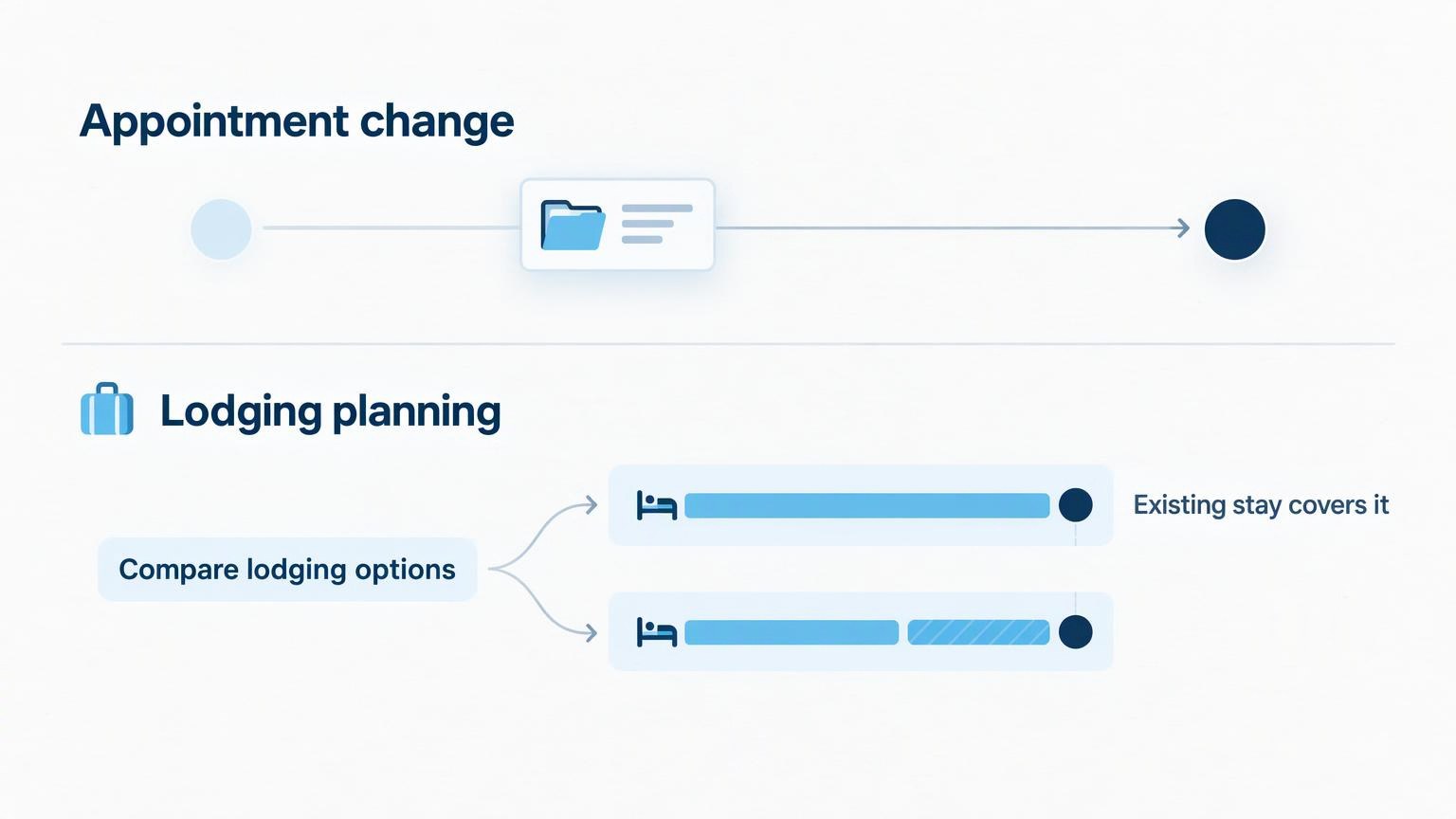
Say your treating provider moves a follow-up appointment to a later date. You are managing your hotel reservation, while a companion plans to leave earlier. First establish the appointment requirement with the provider. Then compare it with your existing stay.
If your reservation already covers the new appointment, you may only need to update your calendar and travel arrangements for attending it. If it does not, compare extending that reservation with another lodging option that meets any clinician-specified requirements. The changed appointment alone does not establish a need for a different level of clinical support.
Close both communication loops: obtain the provider's appointment confirmation and the lodging supplier's reservation confirmation. Tell your selected personal contact about the changed plan within your agreed sharing scope. Flight timing remains a separate matter for the clinician and follow-up plan.
Who answers questions after you return home?
Arrange post-trip communication with the treating provider before departure. A channel used during your Cancun stay does not establish how long follow-up continues, who reviews later messages, or what can be addressed remotely.
Clarify the planned follow-up format, its scope, and the route for questions outside that scope. Keep clinical instructions with the clinician rather than asking a travel contact to interpret them. If care at home is part of the plan, identify the receiving clinician and establish that clinician's agreement separately.
A proposed introduction is not the same as an accepted appointment or transfer of responsibility. Know who is arranging the handoff and how you will learn that it has been accepted.
For records needed by a receiving clinician, use the named providers' confirmed secure process. Keep the contact map accessible after the trip, including the treating provider's backup instructions. The useful outcome is a defined next contact, not simply possession of a message history.
Where does Hospitality Cancun fit in the communication plan?
We publish travel and consultation-planning guidance to help you identify logistics to clarify. Use that guidance alongside your provider discussion, not as clinical instructions or confirmation that we manage care updates.
Before submitting any information through a general inquiry, clarify the recipient and purpose. Once those are clear, the first submission is limited to name, email, and optional contact-method preference. It does not include trip details, a planning narrative, health information, or attachments.
Travel dates, destination, companion arrangements, and room needs may be discussed later with a confirmed travel contact. Diagnoses, scans, and clinical records belong only in a named treating-provider-confirmed secure channel. Do not send payment details, financial records, or insurance identifiers through the general inquiry; they are not clinical records.
Keep permission to reply to your requested inquiry, optional marketing, and referral to a specifically named provider as separate choices. Requesting a reply is not marketing consent, and a planning conversation does not establish permission for a provider referral.
Frequently Asked Questions
Does an all-inclusive package mean someone will update my family?
Do not infer family-update arrangements from a package label. Look for an explicit communication arrangement identifying the sender, authorized recipient, and information shared. If family updates matter to your decision, resolve that point with the treating provider rather than treating bundled travel services as evidence of clinical communication.
What if I cannot reliably make calls while traveling?
Tell the confirmed provider contact about that practical limitation when arranging communication. Establish an alternative the provider accepts and a backup for lost access. Keep the agreed contact information available offline. Do not assume a personal messaging app is an approved clinical channel because it is convenient for you.
Can I ask for communication in English?
Yes. Clarify who can communicate with you in English for the actual conversations you expect, including clinical explanations and backup contact. General statements about English-speaking assistance do not identify the person handling those tasks. If interpretation is needed, arrange it with the provider rather than assuming a companion can fill that role.
Should I forward screenshots of clinical messages to a travel contact?
Use the practical scheduling information needed for the travel task rather than forwarding an entire clinical conversation. For example, an appointment time may be enough to arrange transport. Clinical records and health details belong in the named provider-confirmed secure channel, not a general travel inquiry or an informal planning exchange.
What if different people give me conflicting appointment times?
Resolve the discrepancy with the provider's designated scheduling contact before acting on either version. Identify which appointment the confirmation concerns and retain the final agreed time. If the difference affects a clinical instruction rather than scheduling alone, take that part back to the treating clinician for clarification.