

Cost and Consultation Planning
Turn competing estimates into a comparable budget without confusing procedure fees, travel expenses and unconfirmed care.
A procedure price and a complete trip budget answer different questions. Your comparison needs both, plus a clear view of what could change before or after consultation. This guide focuses on the financial decision, not whether a tummy tuck is suitable for you. That assessment belongs with the qualified treating clinician.
Start with estimates for the same procedure
Start your search with the proposed procedure and intended location, then open the provider’s own pricing or consultation page. Use the result to identify what is being offered, not to declare a winner from the advertised amount.
For example, VIDA Wellness and Beauty’s cost page says final pricing is influenced by individual needs. Mommy Makeover Tijuana’s cost page describes combinations that can include a tummy tuck, breast procedures and liposuction. Those are different pricing subjects, not interchangeable tummy tuck estimates.
Record the procedure description, named provider and facility beside each result. Keep combined-procedure offers separate from tummy-tuck-only estimates. If descriptions differ, have the treating clinician clarify the proposed scope before ranking prices. An advertisement can help you identify a consultation candidate; it cannot establish your eligibility, the final operation or what your personal estimate will include.
Compare itemized estimates and packages on equal terms
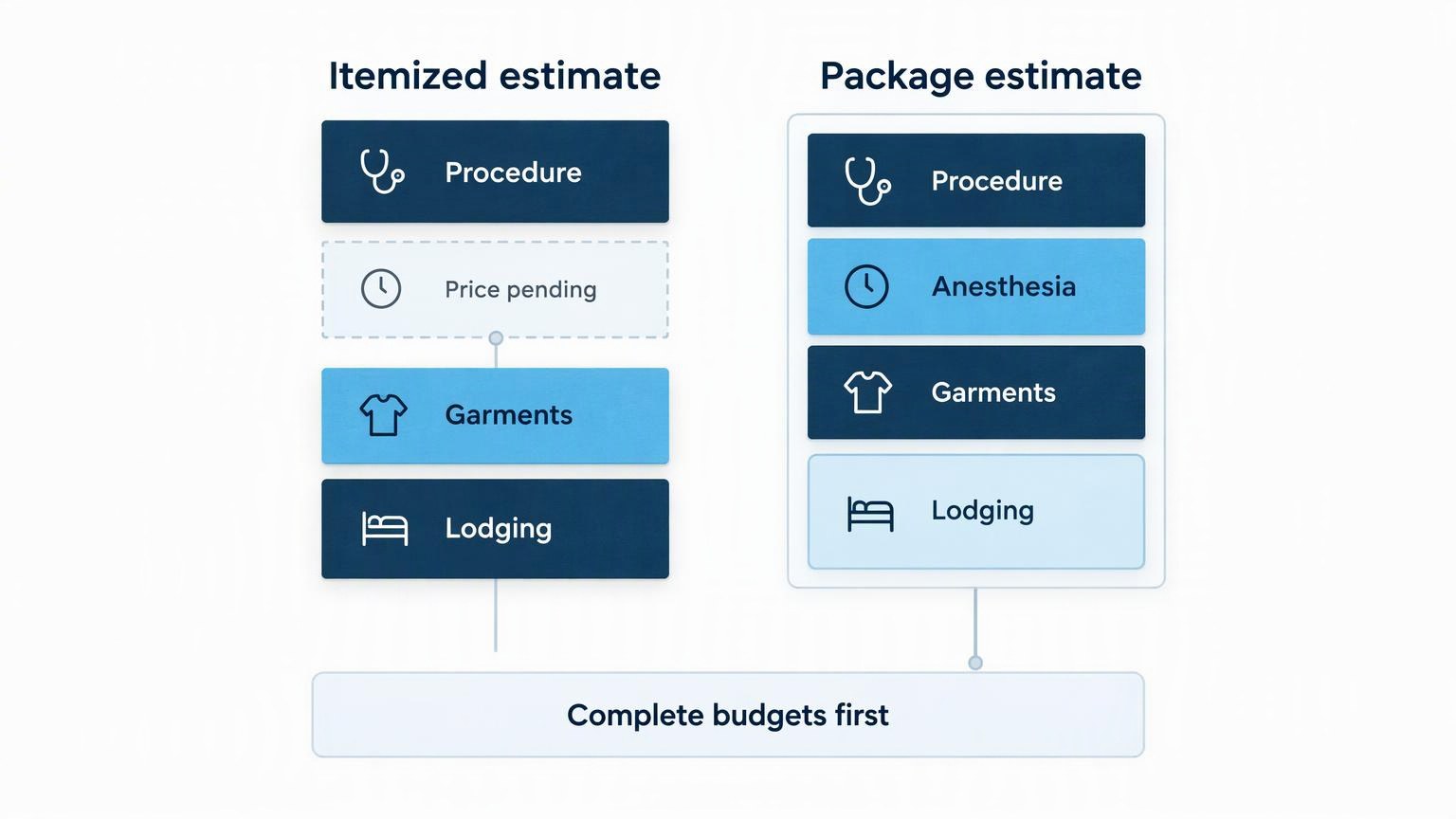
Neither an itemized estimate nor a bundled package is automatically better. An itemized option may suit you when you want independent travel choices. A package may suit you when its named services match your needs and its terms are acceptable. Both need a comparable total.
Build a private worksheet using the same categories for every proposal. Mark each item included, separately priced, not needed or awaiting confirmation. “Can arrange” does not mean included, and an unspecified service is not a zero-dollar expense.
- Procedure scope, surgeon fee, anesthesia and facility charges.
- Consultation, required testing, prescriptions, garments and defined follow-up.
- Lodging, transportation, meals and companion expenses where relevant.
- Currency, applicable taxes or payment charges, quote validity and exclusions.
Add separately priced required items to the quoted amount, counting bundled services only once. Keep amounts awaiting confirmation outside the confirmed subtotal but prominently visible. Also distinguish accommodation from clinical care: a room does not establish that nursing or other care is provided.
| Option | Choose when | Reason | Trade-off or detail to confirm |
|---|---|---|---|
| Itemized procedure estimate | Required clinical charges are priced and you prefer separate travel bookings. | You can compare individual charges and choose travel suppliers independently. | More contracts to review; unpriced required services prevent a complete total. |
| Defined clinical-and-travel package | Named inclusions match the clinician’s plan and your travel needs. | The stated total can cover several budget categories without double counting. | Less flexibility if unused services cannot be removed; change terms still matter. |
| Preliminary estimate with conditional services | You are assessing a consultation candidate, not committing to travel. | It identifies a possible starting scope for later assessment. | Final amount, extra-night inclusion, payer and applicable terms may still need confirmation. |
Work through a lower-price estimate before choosing
A lower procedure estimate wins on cost only if its completed budget remains lower for an equivalent plan. Missing amounts prevent that conclusion; they do not prove the estimate is expensive or inexpensive.
Say you have proposals for the same clinician-defined operation. One lists a lower procedure amount but excludes anesthesia, garments and lodging. The other has a higher stated total and explicitly includes those items. You prefer arranging your own accommodation, and both clinical proposals still need independent provider verification.
For the first option, add the separately quoted anesthesia and garments plus your chosen lodging. For the second, establish whether its included lodging matches your travel plan and whether declining it changes the price. Do not subtract an assumed hotel value from a package.
If the first completed budget is lower and its care arrangements meet the clinician’s plan, it may be the better financial fit. If anesthesia remains unpriced, neither proposal has yet earned a lower-cost ranking. Resolve that missing charge before deciding, rather than choosing the more complete-looking proposal by default.
Separate changed bookings from insurance coverage
When plans change, identify the service being charged, the event causing the change and who is responsible under the applicable agreement. Then evaluate insurance separately. The reason for a change does not determine its payer.
Suppose the treating clinician directs a longer stay. The additional hotel night remains a lodging charge. That direction alone does not establish whether the night is included, who pays, what extension rate applies or whether an insurer reimburses it. You cannot determine those points unless the relevant written terms answer them.
Review the clinic’s deposit and cancellation terms, the hotel’s amendment and refund terms, and the airline’s change conditions separately. A clinic cancellation does not, by itself, establish a refund from another supplier.
For insurance, examine whether the actual policy addresses your planned procedure, cancellation, medical expenses or evacuation, along with exclusions, authorization requirements and claim documentation. Potential reimbursement is not the same as a supplier waiver or guaranteed payment. Identify any expense you may need to fund while a claim is assessed.

Use the payment sequence to judge financial exposure
An estimate is ready for a deposit decision when its scope, remaining conditions, payment recipient and commitment terms are clear enough for you to accept. A polished total alone does not establish that readiness.
First distinguish a preliminary estimate from a proposal based on the clinician’s assessment. If consultation changes the planned procedure, compare the revised version rather than carrying the original amount forward. Establish what happens financially if the clinician does not recommend proceeding.
Next, match each charge to its billing entity. Identify the deposit, balance deadline, currency and any stated payment charges. A package should explain who owes you each included service and what happens if that service is unavailable or canceled. Do not assume separate suppliers share one refund policy.
Finally, compare the amount at risk before treatment with the total expected spend. A lower completed budget may still require a larger nonrefundable commitment. Time travel purchases around the confirmed consultation and follow-up plan rather than treating payment as clinical clearance.
Send remaining questions to the appropriate specialist
The treating clinician should resolve suitability, procedure scope, care requirements, follow-up and flight timing. Travel suppliers or a confirmed planning contact should address booking logistics and their own charges. Changing a flight is a logistics task; deciding whether you can fly is a clinical decision.
At Hospitality Cancun, we publish travel and consultation-planning guidance. Use that information to organize cost questions, not as a treatment recommendation or a provider-issued quote. Later planning discussion can address ordinary travel details once the recipient and purpose are clear.
Before submitting any information through Hospitality Cancun’s contact section, clarify who will receive it and why. The first submission is limited to name and email, with an optional contact-method preference. No trip narrative, quote request, records, attachments, payment details or insurance identifiers belong in that submission.
Permission to reply to your inquiry, optional marketing and referral to a specifically named provider are separate choices. A requested reply is not marketing consent. Clinical records belong only in a named treating-provider-confirmed secure channel.
Frequently Asked Questions
Can I use an advertised national average as my budget?
Use it as background, not as your spending limit. A national figure does not specify your proposed operation, provider, included services or travel plan. Your working budget should come from the applicable personal estimate and separate supplier prices, with required items awaiting a price still visible.
Does a higher price prove better care?
No. Price does not verify a clinician’s credentials, a facility’s status or the suitability of the operation. Evaluate those matters separately through the relevant credentialing bodies and treating provider. A higher estimate may cover more services, but that is a scope difference, not proof of clinical quality.
Should I add procedures to make a package better value?
Do not select additional surgery to improve the apparent value of a bundle. Ask the treating clinician to assess each proposed procedure and explain the care implications. Compare prices only after that scope is established. An unwanted inclusion is not automatically a benefit, even when advertised within a package.
How should I compare estimates in different currencies?
Keep the original quoted currency and use the same dated conversion basis for your comparison worksheet. Separately identify the supplier’s actual payment currency and any stated conversion or payment charges. A planning conversion is not a promise of the amount your bank or supplier will ultimately charge.
What if a quote mentions revision surgery?
Determine exactly what that wording covers: a surgeon’s fee, facility use, anesthesia, follow-up or something else. Also identify assessment conditions and any applicable time limits. Do not treat “revision included” as a guarantee of results or assume it pays for another trip. Clinical decisions remain with the treating clinician.