

Care and Travel Planning
Identify the clinical source behind your instructions, understand how clarification works and keep accommodation decisions separate from care responsibilities.
An instruction sheet, a coordinator's message and a lodging description can serve different purposes. The useful question is not just who handed you the information, but whose clinical direction it represents and how an unclear point reaches that person.
This guide helps you establish that communication process. It does not explain how to manage recovery, determine treatment suitability or decide when you can fly.
Identify the clinician behind the instructions and follow-up
Your instructions should have an identifiable clinical source. Ask the proposed treating provider who issues and approves your individualized instructions, who is authorized to explain them and who is responsible for follow-up. Do not assume these are all the same person.
Someone may deliver a document or relay a message without being responsible for its clinical content. A useful answer distinguishes those roles: who approves the plan, who communicates it and where a question goes when the person answering cannot resolve it.
Request the named follow-up clinician, the follow-up locations and the contact process after you return to the United States. An answer such as “contact the team” needs enough detail to explain how your concern reaches the responsible clinician.
Compare the answers with your consultation and discharge documents. Matching names and responsibilities make the process easier to understand; inconsistent answers need resolution. A named contact establishes responsibility to investigate further, not proof of qualifications. Verify credentials separately rather than treating responsive communication as evidence of clinical competence.
Clarify unclear wording with a specific question and read-back
Take the exact unclear wording to the provider's designated clinical contact rather than asking someone else to interpret it. The goal is an explanation of your instructions, not a general answer about what patients usually do.
Use this sequence during an established provider conversation:
- Identify the document, its date or version and the sentence you do not understand.
- Explain the specific ambiguity, such as which appointment an instruction refers to or when a stated restriction ends.
- Ask the authorized clinical contact to clarify what applies to you and whether the written instructions need updating.
- Restate your understanding and ask the clinician to correct it.
- Keep the confirmed explanation with the current instructions.
For example, “I understand this to mean I need that review before planning departure. Is that what you mean?” gives the clinician something concrete to confirm or correct.
If language is the barrier, request an explanation in language you understand and establish how interpretation or translation will be handled. Translation helps communicate wording; clinical clarification still needs an authorized source. Do not assume an English version or interpretation service is included.
| Arrangement | When It May Fit | What It Does Not Establish |
|---|---|---|
| Ordinary lodging with a companion | The clinician permits that setting and required professional care is arranged separately. | Companion availability does not replace required clinical support. |
| Residence advertising support services | Its actual services and responsible staff match the clinician's requirements. | A recovery label, meals or hosting do not prove clinical care. |
| Continued care in a clinical setting | The treating clinician directs that setting and the proposed care is established. | The setting alone does not identify the person approving instructions. |
Resolve conflicting messages before changing your travel plan
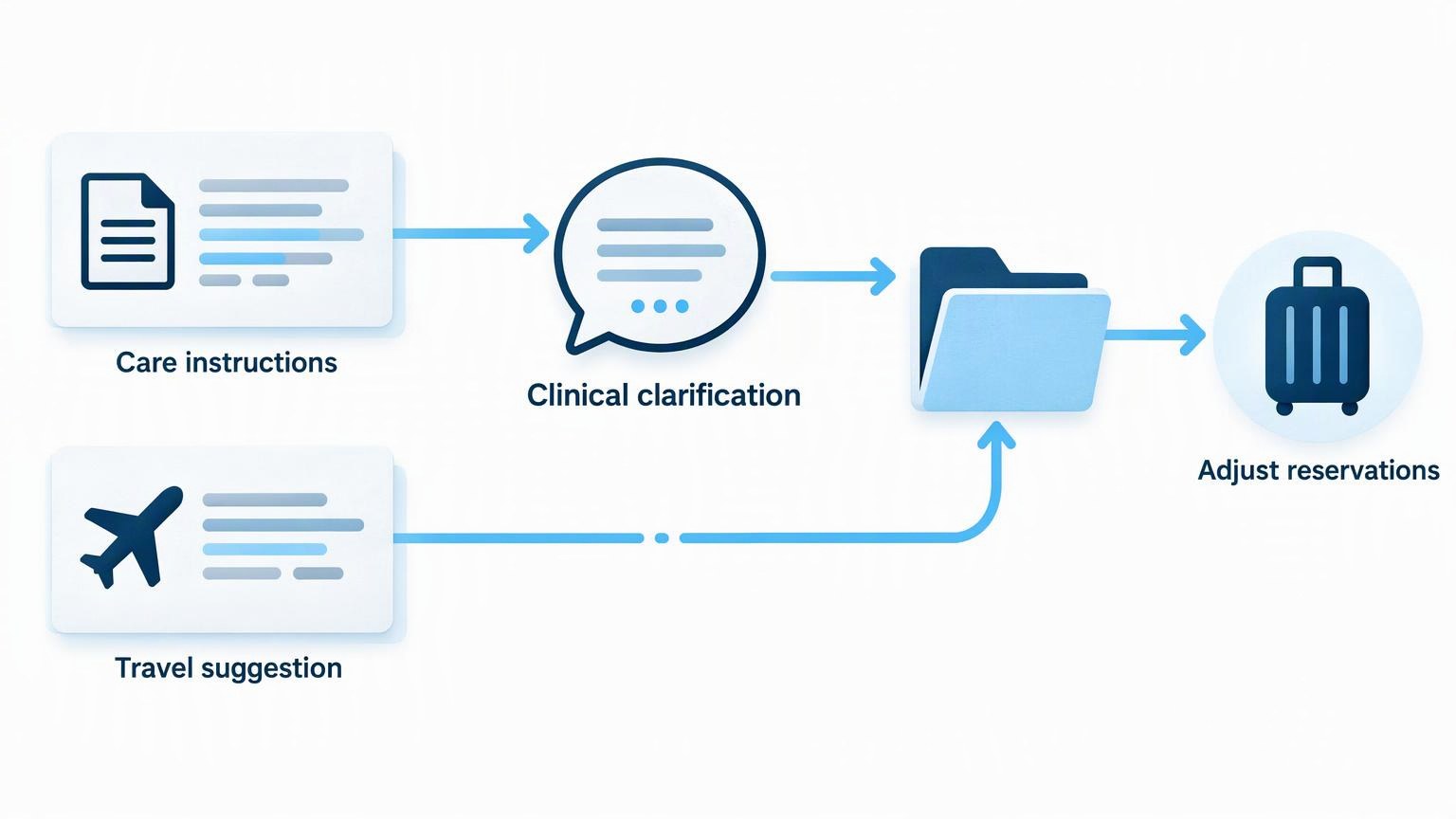
When two messages appear to disagree, separate the clinical instruction from the travel suggestion and ask the responsible clinician to resolve the clinical question. A newer message is not automatically an approved change to your care plan.
Say your written plan calls for a follow-up review before departure, but a travel message suggests a departure date that would come before that review. You have two options: treat the travel suggestion as permission to leave, or establish whether the clinician has changed the follow-up requirement. The second option addresses the actual uncertainty.
First, show the clinical contact the relevant wording through the provider-confirmed channel. Ask whether the review remains required and which instruction is current. The clinician resolves that question. Once the requirement is clear, you or your confirmed travel contact can adjust reservations around it.
If the clinician confirms the review, the suggested departure does not fit the plan. If the clinician revises the requirement, keep that clarification with your instructions before proceeding. Flight availability answers a booking question; it does not establish individual clearance to fly. For the wider handoff, see returning home after medical care in Mexico.
Separate accommodation support from professional care
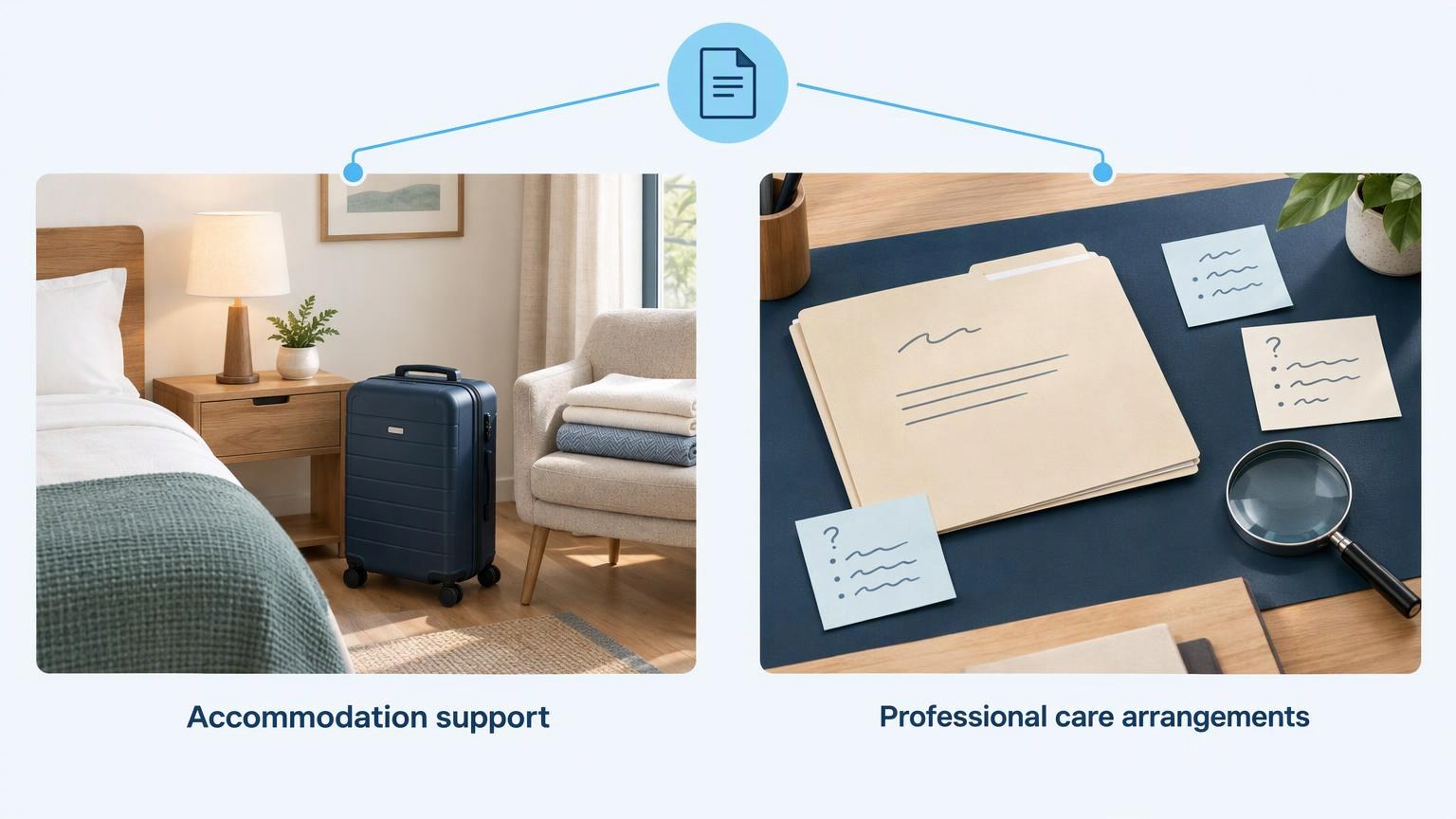
Lodging and companion help do not establish that required professional care will be available. Start with the support requirements in the clinician's plan, then compare what the proposed arrangement actually supplies.
A companion may help organize belongings or keep track of questions. That does not make the companion responsible for clinical assessment or authorized to change instructions. Similarly, hosting and meals describe accommodation services, not clinical staffing.
If a residence advertises support, identify the actual tasks, the people responsible and whether those services match the clinician's requirements. A recovery-related name alone cannot answer that question. If the clinician's plan permits ordinary lodging and separately establishes any necessary professional care, accommodation can be chosen for lodging preferences.
The comparison below helps distinguish arrangements without assuming that any particular supplier offers them. The decisive issue is a match between the care plan and actual services, not whether one setting sounds more specialized. For a broader look at locations and responsibilities, read understanding liposuction care settings in Mexico.
Keep a usable follow-up handoff after returning home
Before returning home, establish how you will obtain clarification and who remains responsible for follow-up. Do not assume a general inbox provides clinical follow-up or that a clinician in the United States has accepted your care.
Keep a compact private handoff record:
- The current instructions and any confirmed amendments.
- The named follow-up clinician and planned review arrangements.
- The provider-confirmed clinical contact channel and process for unanswered questions.
- The provider's urgent-care pathway and any accepted handoff to another clinician.
Ask the treating provider which questions can be handled remotely and which require an examination. Keep urgent-care directions separate from routine messaging; an inquiry awaiting a reply is not an emergency plan.
Clinical records belong only in a named provider-confirmed secure channel. For a website inquiry, clarify the recipient and purpose before submitting any information. The first submission is limited to name and email, with optional contact-method preference. Travel details can be discussed later with the confirmed travel contact. Permission for a requested reply, optional marketing and referral to a specifically named provider are separate choices.
Frequently Asked Questions
Does a clinician's credential establish who will answer my questions?
No. Credentials and communication responsibilities answer different questions. Verify the proposed clinician's qualifications, then separately establish who handles instruction questions and follow-up. Even when a clinician's identity is clear, you still need a usable contact process and an explanation of how questions reach the person authorized to answer.
Can a booking confirmation count as my care instructions?
A booking confirmation establishes reservation details, not an individualized clinical plan. Keep it separate from provider-approved instructions. If it contains a statement about departure or an appointment that appears inconsistent with the care plan, have the clinical requirement resolved before treating the reservation as an appropriate itinerary.
How should I organize updated instructions sent electronically?
Keep the original document and the provider-confirmed update together, with dates and the source visible. Ask which version is current rather than silently replacing one with another. Screenshots can preserve a message, but they do not establish the sender's authority or whether the message changes your clinical plan.
Can my companion take notes during an explanation?
You can ask the provider whether your companion may join the discussion with your permission. Notes may help you remember the explanation and identify remaining questions. They should support, not replace, the clinician's instructions. Before ending the discussion, confirm your own understanding rather than relying solely on your companion's interpretation.
Should I expect final instructions before the consultation?
Distinguish general preparation information from instructions individualized by the treating clinician. Ask what can be explained before consultation, what depends on assessment and when your applicable written instructions will be provided. Early information can help you research the process, but it should not be treated as a completed personal care plan.