

Consultation and Travel Planning
Separate what you want from an upcoming celebration from what an individual care plan can support.
A wedding, reunion or beach celebration can make a treatment decision feel time-sensitive. But “ready for the event” can mean looking a certain way, wearing a particular outfit, participating in activities or simply being present. Those are different goals. This guide helps you decide which commitments to protect before moving into procedure-specific planning.
Should the event or the care plan set your schedule?
Keep the plans separate if attending the event as planned matters more than pursuing surgery at that time. If you can change or miss the event, a clinician-led discussion can come first without requiring the treatment plan to deliver a deadline-dependent result.
This is not a choice between being organized and being cautious. It is a choice about which commitment can move. A celebration has a social schedule; a care plan must address your individual suitability and follow-up needs. A date that is convenient for travel does not answer those clinical questions.
The comparison below helps you select a planning route, not a procedure. Choosing consultation first also leaves room to decline treatment. You do not need to turn interest in combined care into a commitment to have both procedures, and postponing treatment does not require abandoning your longer-term goals.
What should the consultation resolve about event expectations?
The consultation should separate your appearance goals from suitability, procedure sequencing and permission for specific activities. Saying you want to be “event-ready” leaves too much open to interpretation.
Prepare a private note describing what matters to you: the desired change, the event activities and which expectations can move. Take those priorities into the clinician's consultation rather than treating a promotional image as a plan.
For example, Plastic Surgery Riviera's breast augmentation page states that implant placement, type and volume depend on patient preferences and anatomy. That supports an individualized discussion, not a conclusion about your suitability for combined surgery or your readiness for a celebration.
Ask the treating clinician to address each procedure and the combination, including whether staging or no treatment is appropriate. Appearance expectations, participation in event activities and clearance to travel need separate answers. For a more focused preparation step, read our guide to discussing BBL and breast augmentation sequencing.
| Situation | Suitable Route | Reason | Trade-off |
|---|---|---|---|
| Event attendance and participation are essential | Keep the event separate from treatment | Protects the fixed commitment without relying on unconfirmed clinical timing | Treatment goals wait |
| Event attendance can change | Discuss care first, then decide about the event | Allows individual assessment to shape the schedule | Attendance or participation may need to change |
| Suitability for either procedure has not yet been assessed | Consult before making treatment commitments | A calendar cannot establish eligibility or whether combining is appropriate | You cannot finalize a treatment itinerary yet |
How does a fixed wedding commitment change the decision?
A fixed event favors postponing treatment commitments when the care plan has not yet been established. The deciding factor is not how many reservations you would make, but whether the proposed care could require changes you are unwilling to accept.
Say you want both procedures before a wedding. You consider attendance essential, want to participate fully and have a companion who must return home after the celebration. No treating clinician has yet assessed a combined plan or established follow-up and support needs.
Booking treatment around the wedding would make unconfirmed assumptions about participation, departure and assistance. Separating the wedding from treatment protects the commitment you have already identified as essential.
If a clinician later proposes staged care, that is another option to evaluate, not an automatic way to meet the wedding deadline. Each stage needs its own rationale and planning requirements. If you instead decide the wedding is optional, you can consider care first and adjust event attendance to the resulting plan. The outcome changes because your priority changes, not because the same calendar suddenly proves suitability.

How do you translate the care plan into travel arrangements?
Start with the clinician's follow-up and support requirements, then compare lodging and transport against them. Flight timing and length of stay depend on that plan; a published recovery estimate is not individual clearance to fly.
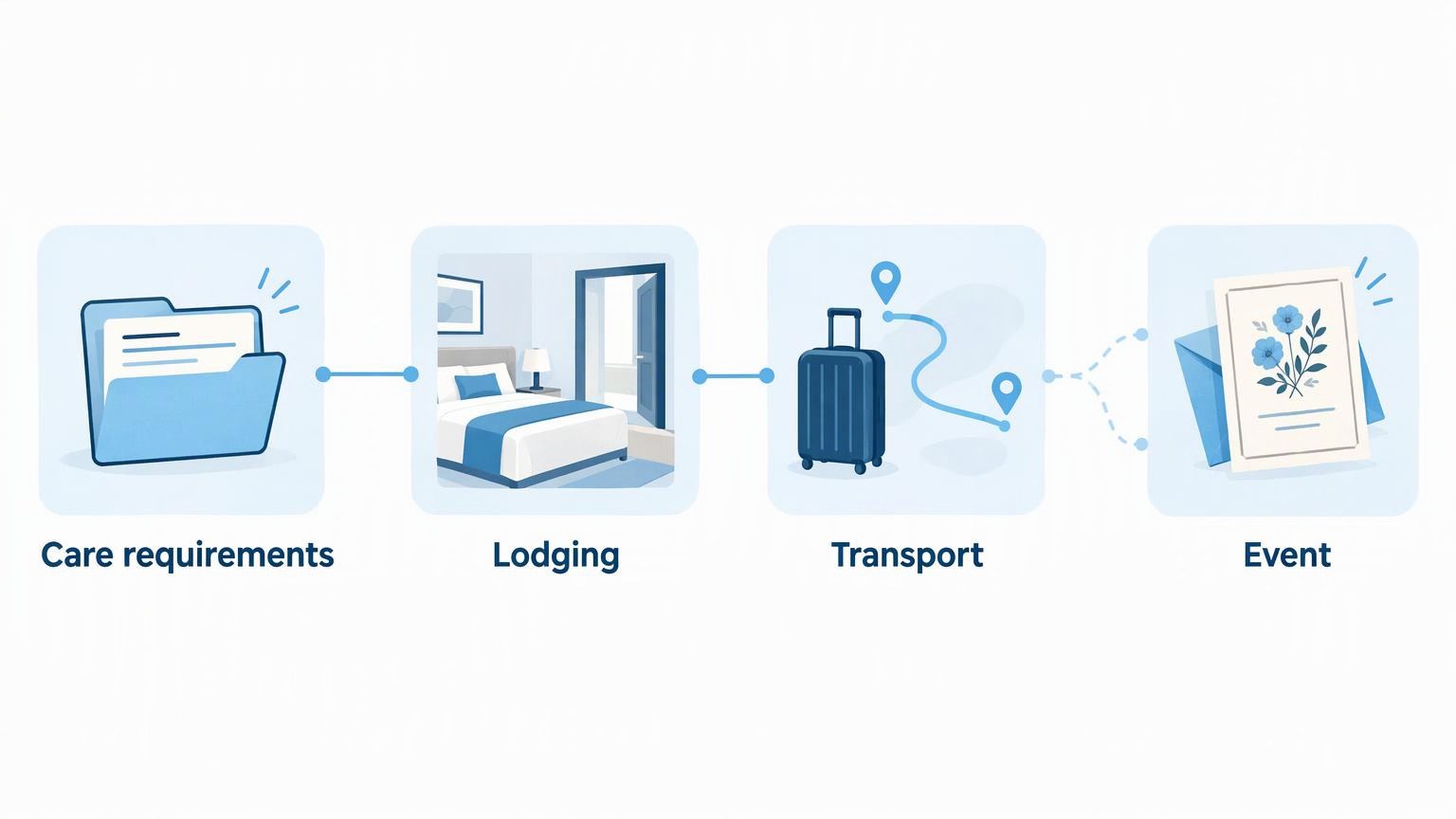
Use this sequence once you have a clinical plan:
- Identify the requirements: privately organize the appointments, support instructions and travel decisions that remain dependent on clinical review.
- Search lodging: use the confirmed appointment location and required accommodation features. Compare whether a room fits those needs before comparing its change terms.
- Compare transport: consider the actual appointment schedule and any clinician-directed travel requirements, rather than optimizing around event transfers.
- Fit in the event last: include only participation the clinician has addressed, and retain a workable plan if you cannot attend.
A companion leaving matters clinically only if it creates a gap in support the care plan requires. Otherwise, changing their flight or room is an ordinary logistics task. Our combined-procedure trip-planning guide offers related preparation.
What happens financially if the plan changes?
Compare the cost of changing commitments separately from the reason for the change. A clinically directed extra hotel night is still a lodging charge. The clinical reason alone does not establish who pays, whether it is included or which cancellation terms apply.
Before making financial commitments, keep a compact checklist of the variable terms:
- The service being purchased and who supplies it.
- What triggers a cancellation, amendment or extra charge.
- The applicable refund rules, deadlines and payment responsibility.
- Any relevant insurance exclusions, coverage conditions and claim requirements.
Supplier terms determine the contractual consequences of changing a hotel stay, flight, event booking or care reservation. Insurance is a separate question. Cancellation, medical and evacuation coverage concern different losses or services; none should be assumed to cover elective-procedure-related changes.
For an extra stay, you cannot determine inclusion, payer or coverage unless the applicable documents establish them. This distinction helps you compare flexibility honestly: a convenient initial itinerary may be less workable if changing it would create costs you cannot absorb.
Where does Hospitality Cancun fit in your next step?
Hospitality Cancun publishes travel and consultation-planning guidance for adults considering care in Cancun or the Mexican Caribbean. Use that guidance to organize your decision; keep suitability, treatment scheduling and recovery advice with your qualified treating clinician.
Review the website's stated destinations and medical-tourism focus before deciding whether an inquiry fits your needs. Reading the site or opening its contact section does not itself establish a treating-provider relationship or arrange an appointment.
Before submitting any information, clarify who will receive it and for what purpose. The first submission allows only your name, email and optional contact-method preference. Travel details may be discussed later with the confirmed travel contact. Diagnoses, scans and clinical records belong only in a named provider-confirmed secure channel; do not send attachments, payment details or insurance identifiers through a general inquiry.
Permission to reply to your requested inquiry, optional marketing and referral to a specifically named provider are separate choices. Agreeing to a reply is not marketing consent.
Frequently Asked Questions
Can an outfit fitting help me choose the treatment plan?
An outfit fitting can clarify an appearance preference, but it cannot determine a surgical plan or predict fit on an event date. Treat the outfit as something you may need to adapt. If its exact fit is nonnegotiable, keep that commitment independent of treatment expectations.
Does a combined package mean both procedures are suitable for me?
No. A package describes an offer, not your individual eligibility. A treating clinician must assess the proposed procedures and whether combining them is appropriate. Separately, read the actual service description and terms rather than assuming that the package includes particular follow-up, lodging or transport arrangements.
Should I use someone else's event photos to judge my timing?
You can use photos to explain a preference, but not to set your schedule. Someone else's appearance at a celebration does not establish their clinical circumstances or your expected course. Keep the visual goal separate from the clinician's assessment of what is appropriate and when.
What if the event involves swimming, dancing or long periods seated?
Describe those activities specifically in your treating clinician's consultation. Permission to attend an event does not automatically answer whether every activity is appropriate. Avoid substituting a general statement about returning to normal activities for guidance that addresses the participation you actually want from this particular event.
Can I decide against surgery after researching travel?
Yes. Researching travel does not require you to proceed with treatment. You can decide that the proposed care, uncertainty or practical requirements do not fit your priorities. If you have already paid for anything, however, refunds and other financial consequences depend on the applicable supplier terms.