

Treatment-Area Comparison
Build a clear comparison of what each proposal describes before asking a clinician whether the differences matter for you.
Your immediate task is not to choose the largest treatment area or decide which procedure you need. It is to understand what each proposal actually says. A useful comparison preserves differences instead of smoothing them away, so your clinician discussion starts with a precise issue rather than an assumption.
Compare matching scope, and separate differences from missing detail
Descriptions are ready for a scope comparison when they identify the same region, extent and proposed work. When they differ explicitly, compare those differences. When details are missing, pause the equivalence judgment rather than interpreting silence as inclusion or exclusion.
Start with the treatment-area wording, not the proposal total or an area count. A longer list might divide one region into smaller labels; a shorter list might use a broader description. Neither format establishes how much work is proposed.
Also keep the assessment stage visible. An initial description and a description revised after an individual consultation should not be treated as equally settled. Label each according to its stated status, without assuming that a detailed document represents a final clinical recommendation.
The comparison below helps you choose the next action. It evaluates the clarity of descriptions, not which treatment is better or whether a provider is qualified. Those are separate decisions.
Map boundaries without inventing their meaning
Turn each label into a private comparison entry while keeping the original wording intact. Your plain-language restatement belongs beside that wording, not in its place. This lets you distinguish what the proposal says from what you still need explained.
Use the same compact checklist for every entry:
- Location: the exact body-area label used.
- Extent: stated boundaries or landmarks, with front, side or back coverage where specified.
- Sides: left, right or both, when relevant.
- Exclusions: anything expressly outside the proposed area.
- Status: stated, clarified or still needs clarification.
For a term such as “circumferential,” do not fill in a standard meaning yourself. Record the term and have the proposing clinician explain the intended coverage. If a provider supplies an annotated outline, connect its labels to the written description so neither stands alone.
If you are still deciding how to describe your own priorities, our guide to clarifying body-contouring treatment goals addresses that separate preparation task.
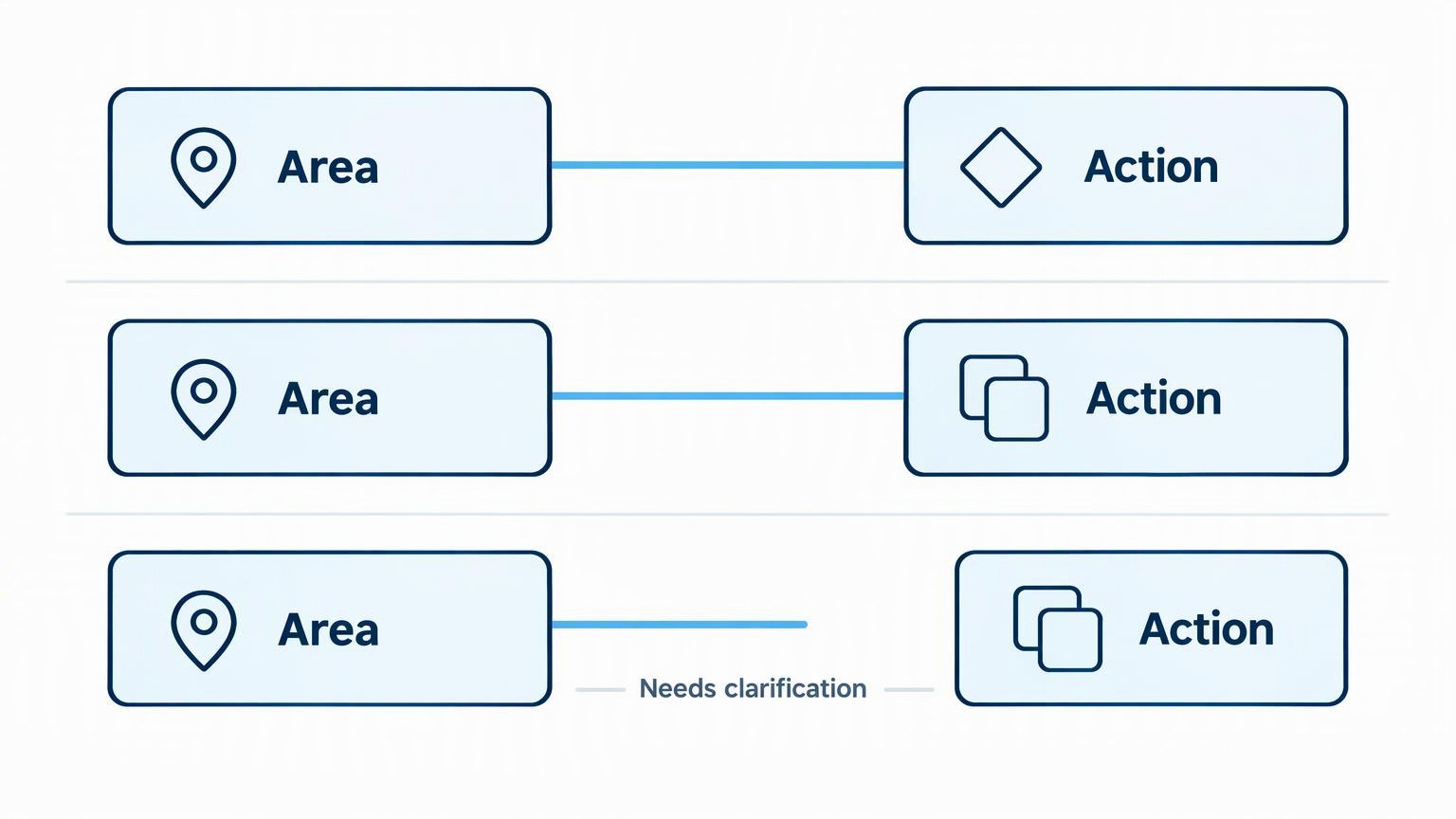
| Description comparison | Suitable next step | Reason | Limit |
|---|---|---|---|
| Boundaries, sides and proposed actions match | Compare remaining stated exclusions and assessment status | The written scope is aligned enough to examine finer differences | Matching scope does not establish suitability |
| An explicit boundary or action differs | Discuss the difference with the proposing clinicians | The descriptions identify different proposed work | Neither description is automatically preferable |
| A boundary, side or action is unspecified | Obtain clarification before judging equivalence | The missing detail could change the comparison | Silence establishes neither inclusion nor exclusion |
Separate where treatment is proposed from what is proposed
Matching body-area names does not establish matching treatment. Keep a separate entry for the action or procedure named in each proposal, then connect it to the area it is intended to cover.
For example, if one description specifies fat removal and another specifies skin removal in the same abdominal region, record that as a difference in proposed work. Do not translate both into a single entry called “abdomen treatment.” This is a document comparison, not a recommendation that either action is appropriate for you.
A description can also name several actions without showing whether each applies to every listed region. In that case, preserve the uncertainty: the area list and procedure list are present, but their relationship is not yet clear.
Before moving on, you should be able to connect each proposed action to its stated location. If you cannot, the useful clarification is that connection, rather than another general explanation of body contouring. Leave questions about technique, suitability and expected results to the qualified treating clinician.
Work through an abdomen-and-sides comparison
Say you have a proposal that reads “abdomen and sides” and another that reads “lower abdomen and both sides,” with a written exclusion of the upper abdomen. Your concern includes the upper abdomen, so that boundary affects whether the descriptions address the same region.
First, copy both descriptions into your comparison. The second has an explicit limit; the first does not establish whether the upper abdomen is included. Do not mark the first as broader simply because its label sounds broader.
Next, have the first proposing clinician clarify the abdominal boundary and whether “sides” covers both sides. If that clarification also excludes the upper abdomen, the location descriptions may align. You would then compare the proposed actions and any other exclusions.
If the first description includes the upper abdomen, the plans have a real scope difference. The next clinician discussion is why the recommendations differ and how each relates to your concern. If the boundary remains unspecified, you cannot yet determine whether the descriptions cover the same region. In none of these outcomes does the area count decide the better treatment.
Use the clinician discussion to resolve reasons, not just labels
Once your comparison is organized, a qualified clinician should resolve the clinical significance of its differences. Your worksheet can identify an omission or conflicting description, but it cannot establish eligibility, diagnosis or treatment suitability.
Keep your stated concern separate from the proposed treatment. An area you want to discuss is not automatically an area that should be treated. During consultation, distinguish an area intentionally excluded from one that was simply omitted from the wording or has not yet been assessed.
When a description changes, retain the earlier version and label the revision with its stated assessment status. Update the affected entry rather than silently rewriting the whole comparison. This makes it clear whether the change resolves wording, changes the proposed scope or reflects a new clinical recommendation.
Only after that discussion should you broaden the comparison to the surrounding care arrangements. Our guide to comparing body-contouring care plans addresses that next task; it does not replace procedure-specific clarification.

Review Hospitality Cancun's information separately from clinical advice
Hospitality Cancun's homepage mentions body contouring, making it relevant to your broader research. That mention is not an individualized definition of treatment areas. Keep proposal interpretation and clinical recommendations with a qualified clinician.
You can review the current website information and, in a later conversation, ask whether it addresses your research questions. Before submitting any information, clarify who will receive it and for what purpose. Once those details are clear, the first submission is limited to name and email, with an optional contact-method preference. Do not include proposal text, a narrative, records or attachments.
Permission to answer your requested inquiry, optional marketing permission and permission for referral to a specifically named provider are separate choices. A requested reply is not marketing consent. Diagnoses, scans and clinical records belong only in a named provider-confirmed secure channel, not a general inquiry form.
Frequently Asked Questions
Can I use an English translation to compare proposals?
Use it as a reading aid, but retain the original description beside it. Have the proposing clinician clarify any translated term that affects boundaries, sides or proposed work. A fluent translation alone does not establish that the clinician intended the same scope you understood from it.
Should I use promotional photographs as the area definition?
No. For your comparison, use the individualized written description rather than inferring coverage from a promotional image. If a clinician provides an annotated outline for your proposal, connect it to the written scope. Keep images and clinical records out of a general inquiry form.
What if a proposal lists an area as optional?
Keep optional areas separate from the currently proposed scope. Record any stated condition for adding the area, without treating it as already included. If the condition is unclear, discuss it with the proposing clinician. Compare the core descriptions first, then examine the optional alternative on its own terms.
Does a more detailed description prove a provider is better?
No. Detail makes the written scope easier to interpret; it is not evidence of qualifications, facility standards or likely outcomes. Keep provider-credential verification separate from document clarity. A precise description is useful preparation for consultation, but it cannot answer every question involved in choosing a treating provider.
Should I decide whether to proceed before the consultation?
Your comparison can help you decide what needs discussion, not whether treatment is appropriate. You can arrive with a clear account of matching details, differences and unknowns without committing to a procedure. Let the qualified clinician assess suitability and explain the recommendation before making a treatment decision.