

Occasion and Consultation Planning
Use graduation to clarify what you want, not to set a deadline for a care decision.
Graduation can bring photographs, outfit decisions, family expectations, and plans for what comes next. Those are useful topics to think through, but they answer a different question from whether surgery fits your health and longer-term goals. This guide is for adults deciding how much influence the occasion should have.
Would you still want to explore surgery without graduation?
Continue research if your interest stands independently of graduation. If the appeal depends mainly on the ceremony, photographs, or other people's reactions, give yourself room to revisit it after the occasion.
Privately write down what you hope would change. Separate a personal preference about your body from an event-specific wish, such as feeling comfortable in a particular dress or presenting a different image to classmates. Then ask whether that preference would remain if the ceremony were canceled or the photographs were taken today.
This is not a test you must pass. It helps you distinguish wanting information from wanting surgery on a deadline. You can be genuinely interested and still decide that graduation is the wrong time to pursue it.
Compare the routes below according to what you know now. Research does not require a deposit, a travel booking, or a commitment to proceed. Choosing to wait also does not require abandoning the subject permanently. The useful outcome is a decision you can explain without relying on the phrase “before graduation.”
What must the clinician clarify before you plan around the ceremony?
The clinician should assess suitability and explain the proposed recovery, follow-up, and travel plan before you build an itinerary around graduation. A package schedule cannot establish whether you can fly, attend the ceremony, or participate in celebrations.
Describe the activities you hope to manage during a clinical consultation, rather than asking only whether you will be “ready.” Ceremony attendance, a long journey, carrying luggage, dressing, and returning to work or school involve different practical demands. Ask the clinician to address the activities relevant to you; do not assume they all share one clearance date.
Keep a compact consultation checklist:
- What decisions remain open until assessment?
- What follow-up must happen before departure and after returning home?
- Who determines when travel is appropriate, and what could change that decision?
- How should you handle a concern while away or after returning?
Our breast augmentation buyer guide recommends a written recovery, follow-up, and travel plan before booking. Use that plan to evaluate your calendar, not as a promise of a particular appearance by graduation. You can seek clarification and take time to consider the answers without committing in the same conversation.
| Your situation | Suitable route | Reason | Trade-off |
|---|---|---|---|
| Your interest predates graduation and you can reconsider event plans. | Research care before graduation, subject to assessment. | The occasion is not the sole motivation. | You cannot assume ceremony attendance or a particular appearance. |
| Attending graduation is fixed, while the care and travel plan remains open. | Research now; consider care afterward. | Protects the occasion without compressing clinical planning. | The decision extends beyond the milestone. |
| Your interest mainly concerns photographs or a graduation outfit. | Address the occasion separately and revisit surgery later. | Tests whether the preference lasts beyond the event. | You defer a possible body-change decision. |
Test the calendar against a change, not just the planned return
A graduation-linked itinerary is workable only if you understand what happens when the proposed schedule changes. Count backward from your commitments to identify conflicts, not to calculate your own recovery deadline.
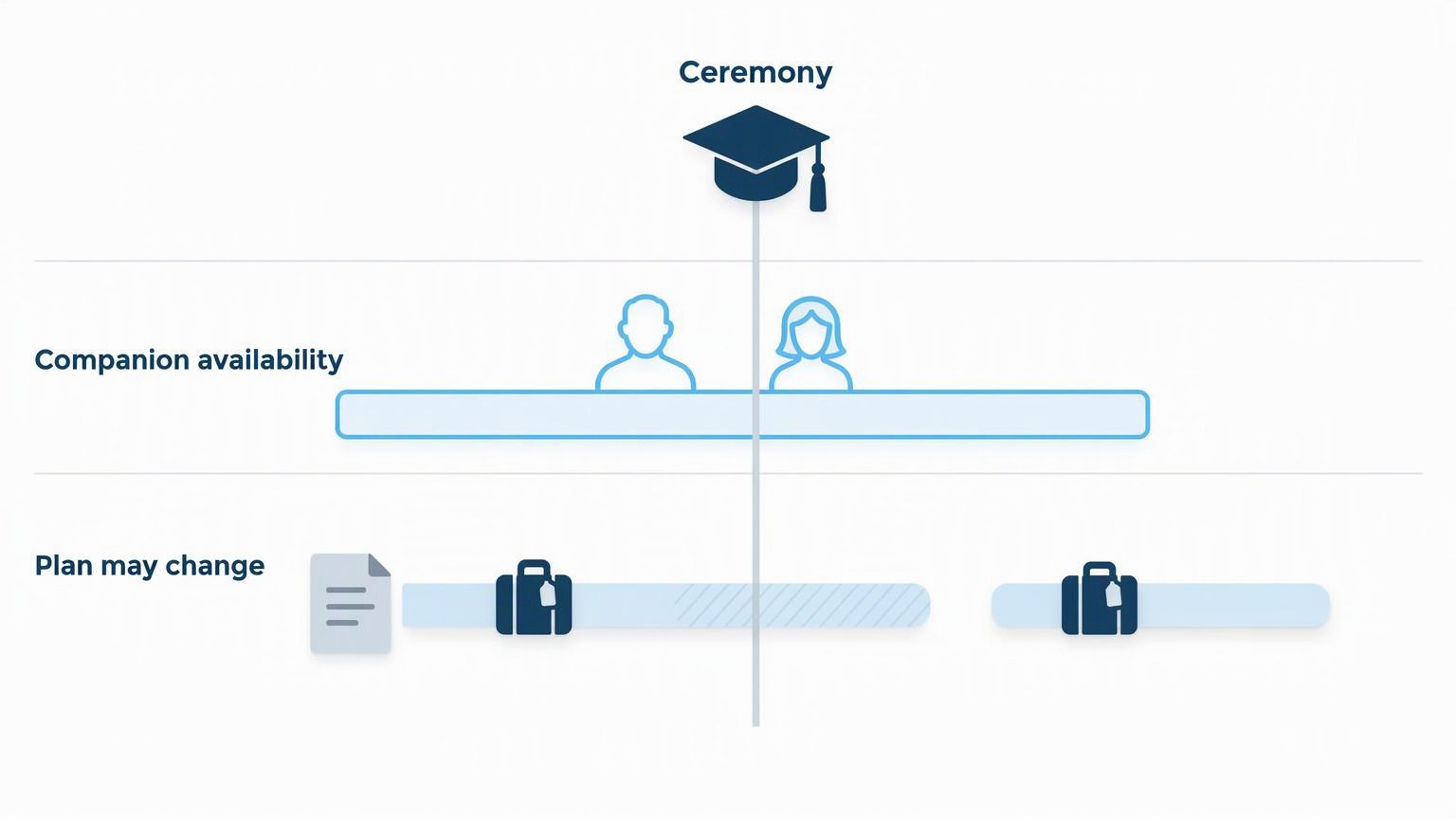
Say you want to attend a fixed ceremony, while a companion can travel only within a limited window. You are considering care beforehand, but the treating clinician has not yet established the follow-up and return-travel plan.
First, keep the ceremony and the companion's availability as separate calendar entries. Next, obtain the clinical plan. Then compare its requirements with both entries. The companion's willingness to travel does not establish that they can provide any support the clinician specifies, or remain available if the stay changes.
If the plan requires flexibility, changing flights or lodging may solve the travel problem. It does not create more time before a fixed ceremony or supply clinical support. If attending graduation is nonnegotiable and the care plan could conflict with it, the reasoned choice is to move the care decision beyond graduation rather than shorten the plan yourself.
A flexible ceremony preference might lead to a different choice, but only after clinical assessment. The key is knowing which commitment you are willing to change before making reservations.
Compare the budget beyond the advertised procedure price
Compare the complete proposed cost and the financial consequences of changing the plan. An offer is not more affordable for you merely because its headline price is lower.
Separate clinical charges from travel spending and graduation spending. Ceremony clothing or family celebrations should not disappear from your budget simply because you are evaluating surgery abroad. Likewise, do not assume a package includes lodging, transportation, or every follow-up appointment unless its written terms say so.
Consider an extra hotel night requested because the clinician changes the departure plan. The hotel stay remains a travel charge even though the reason is clinical. That reason does not establish who pays, whether the night is included, or which hotel terms apply. Those answers depend on the actual proposal and contracts.
Read supplier cancellation, refund, and change terms separately from insurance. Supplier terms determine the contractual consequences of changing a reservation; insurance coverage and claim conditions determine whether a policy may reimburse a covered expense. Neither should be inferred from the other.
If the plan is affordable only when every booking stays unchanged, it may not fit a fixed graduation commitment. Moving the timing can be more sensible than choosing a smaller headline price without knowing what changes could cost you.
Use destination information to evaluate the whole plan
Destination information can help organize your comparison, but it cannot establish that a particular provider or itinerary fits you. Start with an identifiable treating provider, then examine where care would occur, the journey required, and how follow-up would continue.
A useful sequence is to discover provider names, locate each provider's own explanation of its consultation process, and identify the proposed operating facility. Verify credentials independently rather than treating a directory listing or attractive destination description as proof. Compare complete plans once the relevant details are clear.
Our Cancun destination comparison explains why another destination, or care at home, can deserve consideration when the journey or follow-up arrangements fit better. Apply that comparison to your graduation commitments rather than choosing a destination first and trying to force the care plan into it.
Hospitality Cancun publishes travel and consultation-planning guidance. Reading that information does not mean you are choosing a treating provider or receiving a clinical assessment. Use it to identify the travel questions worth investigating, then keep treatment suitability and recovery decisions with the qualified clinician. Your research can remain useful even if your eventual choice is to wait.

Frequently Asked Questions
What if someone offers surgery as a graduation gift?
A gift can change how you might pay, but it should not decide whether or when you proceed. Separate the offer from your own preference and clinical assessment. You can appreciate the gesture while declining, postponing, or choosing to research without accepting a deadline attached to the gift.
Should I choose an implant to fit my graduation outfit?
Use the outfit to identify an occasion-specific preference, not to determine an implant choice. Discuss your broader goals and the reasons behind any recommendation with the treating clinician. For graduation itself, consider clothing options separately so one purchase does not become the deciding factor for a surgical plan.
Can a virtual consultation guarantee that treatment will proceed?
No. Use it to understand the proposed assessment process and identify decisions that remain open. The treating clinician determines what evaluation is needed and what can be decided before an in-person visit. Do not treat a preliminary conversation as a guarantee of treatment or a reason to commit to inflexible travel.
Can reviews establish that a surgeon is qualified?
Reviews may describe a person's experience, but they do not establish current licensing, specialty certification, or suitability for your care. Identify the clinician and operating facility, then independently verify the relevant credentials. Positive comments about travel or hospitality do not answer who would evaluate you or perform the procedure.
What belongs in a first Hospitality Cancun inquiry?
Clarify recipient and purpose before submitting anything. First submission permits only name, email, and optional contact-method preference. Travel details belong later. Inquiry replies, optional marketing, and referral to a specifically named provider require separate choices. Clinical records belong only in a named provider-confirmed secure channel. Do not send attachments, payment details, or insurance identifiers through a general inquiry.