
Conference Travel and Consultation Planning
Use your conference agenda to test a proposed care visit against its actual location, full appointment window and clinician-defined requirements.
A conference trip has fixed obligations: presentations, meetings and sessions you cannot move. A blank space on the agenda is a starting point, not proof that a care visit fits. Plan around the complete appointment window and when you must be ready for your next commitment.
Confirm the visit location and appointment status first
Obtain provider confirmation connecting your intended visit to a current Playa del Carmen location. A matching Costamed search result does not establish where the clinician will see you, and an inquiry is not an appointment.
Our guide to care questions before a Costamed visit distinguishes inquiries, proposed appointments and confirmed appointments. Keep a proposed slot tentative; use a confirmed visit to compare transport.
Keep this checklist privately with your agenda, then resolve it with the provider:
- Complete appointment address, entrance and check-in instructions.
- Named clinician and intended consultation or service.
- Appointment status, date, local start time and required arrival time.
- Expected duration and whether another appointment may be needed.
Match these details to your visit, not just the hospital brand. If the address changes, redo the route comparison before adjusting your conference schedule.
Build the full appointment window, not just a calendar slot
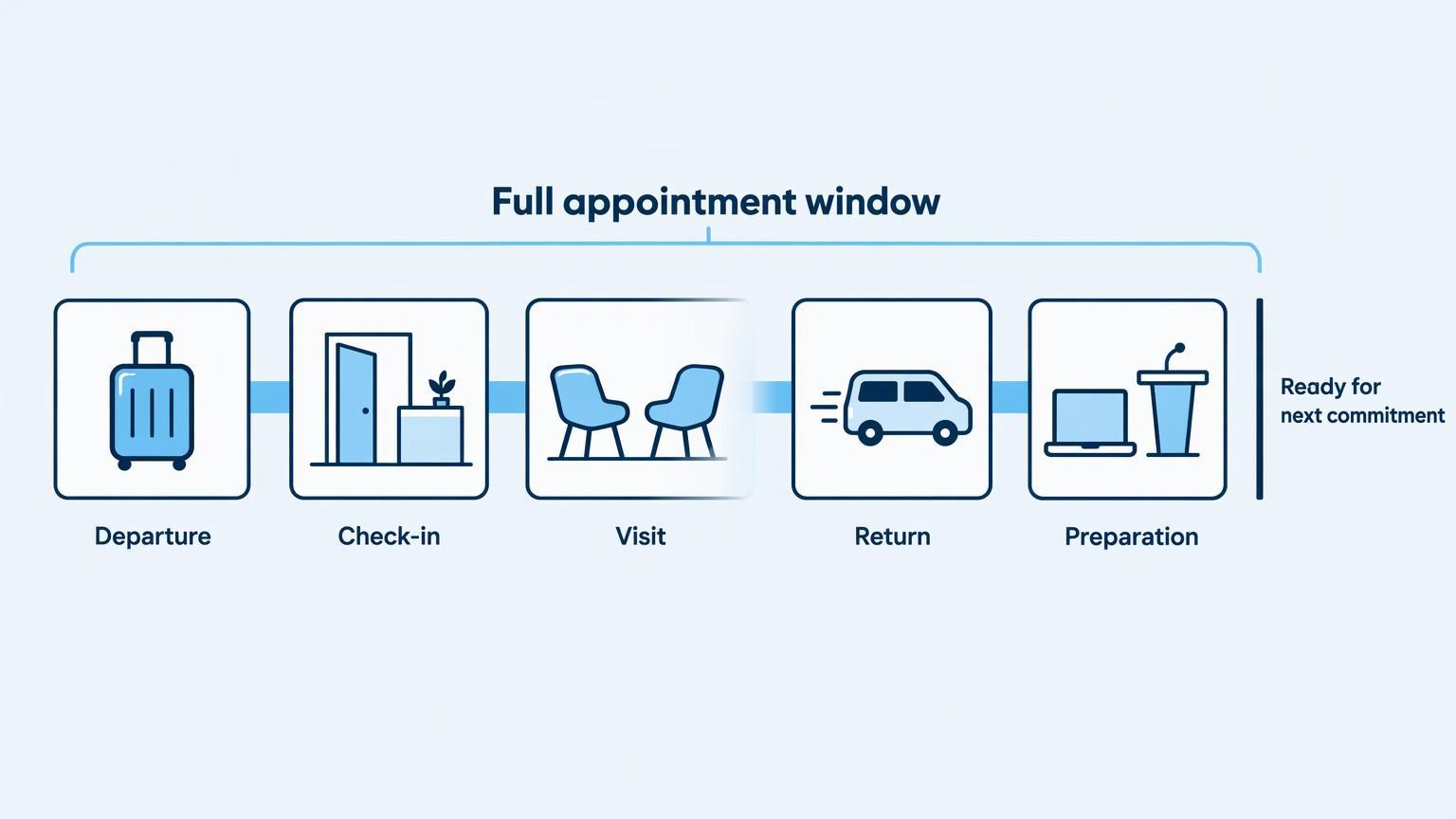
A conference break must accommodate your whole absence: departure, check-in, the visit, return transport and preparation for your next commitment. The appointment start time alone cannot establish whether it fits.
Work backward from the next session you must attend. Set your return-and-ready deadline, allowing for preparation such as presentation setup. Account for the return journey, then compare that boundary with the provider's expected visit window. Finally, work backward from check-in to determine when you must leave.
Compare the appointment and conference agenda in local time. Calendar settings can obscure this when entries were created before traveling.
Distinguish expected duration from a guaranteed finish. Do not promise colleagues a firm return based on an estimate. Reserve a broader window, move an optional meeting or schedule a nonurgent visit outside conference hours. General opening hours do not establish availability for your intended clinician or service.
| Situation | Suitable approach | Reason | Trade-off |
|---|---|---|---|
| Full visit window fits before an optional session | Consider the session break | The appointment and return plan fit the agenda | Optional conference time may be lost |
| Mandatory presentation follows an uncertain finish | Consider a separate appointment window | Protects a fixed work commitment | May require revising the itinerary |
| Follow-up needs are not yet established | Keep the nonurgent visit tentative | The clinical plan may change attendance or departure | Care planning must precede firm travel commitments |
Choose between a session break and a separate visit window
Use a session break when the complete visit window fits and the treating clinician's requirements allow it. Prefer a separate window when your next work obligation is fixed and the finish time is uncertain. Neither choice establishes treatment suitability.
For example, suppose optional sessions precede a presentation you must deliver. You have a proposed consultation, but no confirmed duration. The apparent agenda gap does not establish that you can return in time.
First, obtain timing and arrival instructions from the provider. Compare the full absence with your presentation preparation deadline. If it fits without conflicting clinical requirements, use the break. Otherwise, compare an appointment outside the mandatory program with postponing the nonurgent visit.
Skipping an optional session creates time, but cannot settle unknown care requirements. The fixed presentation deadline drives this choice. For urgent symptoms, do not use conference convenience to decide when to seek care.
Compare transport before deciding to change hotels
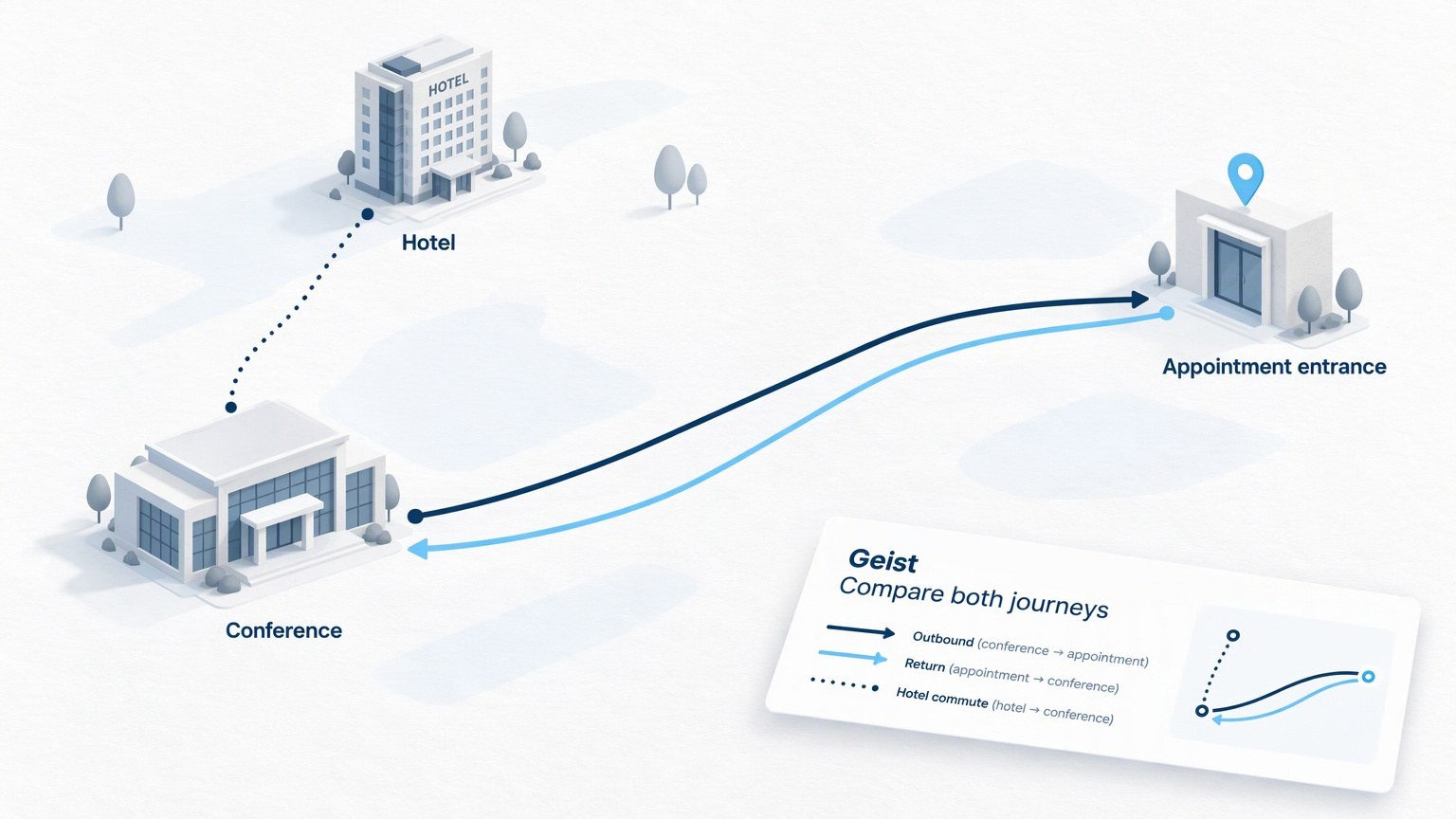
Keep conference lodging if a workable appointment route meets your needs. Change hotels only to solve a specific access or scheduling problem. Start with the confirmed appointment entrance, not a generic hospital map pin.
Search from your actual departure point, which may be the conference venue. Then search the return route to your next destination. Compare current estimates for the intended travel period and establish how to arrange the return journey.
Compare transport options by pickup arrangements, flexibility for a later finish and access needs. A consultation does not imply an included transfer; a hospital listing does not establish a transport service.
Moving hotels also changes your conference commute, so compare both journeys. Our location-confirmation guide develops this step. Journey estimates require your actual departure point, confirmed entrance and travel period.
Let the treating clinician determine care and follow-up compatibility
The provider confirms location and arrival arrangements. A qualified treating clinician determines suitability, follow-up and clinical restrictions affecting work or travel. An itinerary planner cannot make those decisions.
A consultation is separate from treatment discussed during it. Reserving consultation time does not establish that treatment will occur, that you can immediately return to work or that your existing flight is appropriate.
Identify the intended clinician and how to check relevant credentials through the appropriate official authority. Establish who will review results, whether another in-person visit is required and who handles follow-up after departure. Available results are not the same as a clinician reviewing them with you.
Use changes in the clinical plan to revise your itinerary. The clinician defines the clinical need; the travel supplier or confirmed travel contact handles lodging and transport. An extra hotel night alone establishes neither a clinical-support requirement nor who pays.
Use Hospitality Cancun's information without assuming appointment confirmation
Hospitality Cancun's homepage names Riviera Maya and Cozumel Island and discusses Costamed. This focus provides context, not confirmation of your appointment, treating clinician or an authorized provider relationship.
We publish travel and consultation-planning guidance. Individual appointment confirmation belongs with the provider; clinical decisions belong with the treating clinician.
Before submitting any information through the contact section, clarify recipient and purpose. If either is unclear, do not submit. The first submission permits only name, email and optional contact-method preference, with no trip details, narrative or attachments. Ordinary travel details may be discussed later with the confirmed travel contact.
Permission to reply to your inquiry, optional marketing and referral to a specifically named provider are separate choices. A requested reply is not marketing consent. Clinical records and scans belong only in a named provider-confirmed secure channel. Keep payment details and insurance identifiers out of general inquiries.
Frequently Asked Questions
Can I assume my consultation will be conducted in English?
No. Confirm language arrangements for your intended clinician directly with the provider. If you need language assistance, establish how it will work during consultation and consent. General website statements about bilingual care do not confirm arrangements for your individual appointment.
How much should I tell my conference organizer or employer?
Focus on scheduling consequences: which commitment you may miss and whether coverage is needed. Keep clinical details separate from conference coordination. For formal accommodation or expense approval, follow your organization's applicable process; a medical-travel inquiry does not supply that authorization.
Does insurance acceptance mean the visit is covered?
No. Provider acceptance and policy coverage are separate questions. Establish the intended service, provider billing arrangements and insurer's applicable conditions. A hospital name or general insurance-acceptance statement does not establish coverage, payment responsibility or approval for your visit under your particular policy.
What if I need to cancel a hotel booking because the care plan changes?
The hotel's cancellation and change terms determine booking consequences. A clinical reason alone creates no refund right. Insurance reimbursement depends separately on policy and claim conditions. Establish payment responsibility rather than assuming the provider or insurer will cover the resulting charge.
Can a colleague act as my follow-up contact after I leave?
A colleague can help with agreed work or travel arrangements, but is not thereby responsible for clinical follow-up. Establish the named clinician's follow-up process directly. Sharing clinical information or involving another person should follow provider consent arrangements, not an informal conference handoff.