

Facility and Travel Planning
Separate the destination you are researching from the exact facility, care team and follow-up arrangements you would be relying on.
A hospital name, surgeon profile and accommodation offer answer different questions. Putting them together in an advertisement does not establish that the listed surgeon would perform your proposed procedure at the pictured hospital. Your comparison needs to connect the clinician, the exact care site and the services proposed for you.
This guide focuses on those connections, not on choosing a treatment or deciding whether you are medically eligible.
Start by identifying the location for each stage of care
Find the proposed operating facility first, then establish whether the other stages use that same address. A city name or hospital network name is not enough to plan an arrival or evaluate a surgical site.
Begin with the provider’s own information rather than a country-wide package ranking. Search the proposed clinician’s full name together with the facility name. Open the relevant pages and separate the consultation office, operating site and accommodation. If a result names only a destination, your next task is identifying the provider and proposed facility, not comparing hotel choices.
If Costamed destination information is your starting point, use it to frame the location discussion. Confirm directly with the provider whether liposuction is available and which exact facility would be used. Do not infer availability from a destination description or a broader specialty label.
Build a simple private care map: consultation address, surgical address, postoperative monitoring location and follow-up location. Matching addresses may simplify logistics, but different addresses are not automatically a problem. What matters is that the proposed sequence is explicit and workable.
Compare facility evidence, not just hospital and clinic labels
Neither a hospital label nor an outpatient label settles the choice. Continue evaluating the setting whose identity, authorization and proposed care arrangements can be established; if the operating site is unnamed, establish its identity before comparing it.
Keep the clinician and facility checks separate. For the surgeon, identify the full professional name, claimed specialty credentials and issuing authority, then seek confirmation from that authority. For the facility, request its legal name, exact address and current sanitary authorization applicable to the proposed surgical activity. Match the documents to the operating site, not another branch or an office where consultations occur.
If accreditation is claimed, identify the accrediting organization, covered facility and current scope. A logo does not tell you whether the claim applies to the site in your proposal. Likewise, a surgeon’s credential does not establish the facility’s status.
The table compares research routes, not clinical suitability. Your treating clinician must explain why the proposed setting fits your assessed care needs. For the wider treatment comparison, see comparing liposuction care plans in Mexico.
| Proposal | Useful route | Reason | Trade-off |
|---|---|---|---|
| Named hospital operating site | Evaluate that site and its proposed care arrangements | An identifiable facility allows site-specific comparison | A hospital name does not establish every service or credential |
| Named outpatient surgical site | Evaluate authorization, monitoring and escalation arrangements | The setting can be assessed against the clinician’s care plan | Do not assume hospital-level services are on site |
| Destination or package with no operating address | Resolve the facility identity before selecting lodging | You cannot map surgical and follow-up journeys yet | Travel plans may need to change once the care locations are confirmed |

Look for named responsibility across monitoring and follow-up
The useful answer is who provides care, where it happens and how responsibility changes after you leave the operating site. “Aftercare included” is too broad to answer those questions.
Have the provider explain the anesthesia arrangements, postoperative monitoring and discharge process for the proposed plan. The clinician should determine the appropriate level of care. Your task is to establish what the proposal actually supplies, including who performs reviews and how you reach the care team.
Distinguish emergency capability at the operating facility from a plan to transfer you elsewhere. A transfer arrangement is not the same as having a service on site. The provider should explain the destination, responsibility for arranging the transfer and how care is handed over, without presenting either arrangement as a guarantee.
Also separate lodging assistance from clinical monitoring. An accommodation described as a recovery stay does not, by that wording alone, establish qualified clinical staffing or services. Follow-up should identify both the reviews before departure and the contact process after returning home. That makes it possible to evaluate continuity rather than simply count included visits.
Use the care map to choose lodging and transport
Choose accommodation around confirmed care locations and required visits, not around the address that appears most prominently in an advertisement. Medical decisions set the care sequence; transport and room reservations then need to fit it.
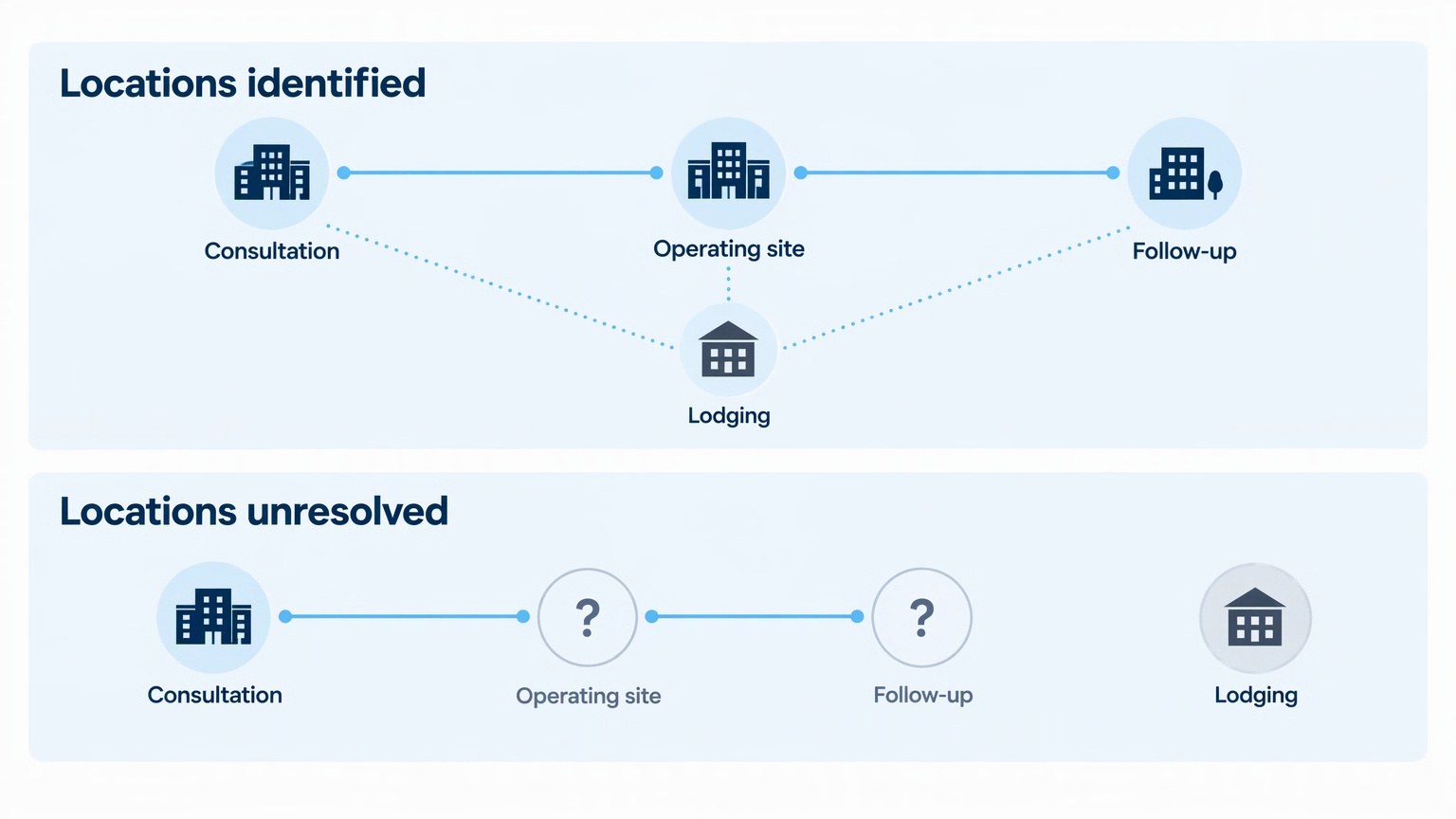
Say you are comparing two proposals. One names the consultation, operating and follow-up locations. The other identifies a consultation office but says the surgical site will be assigned later. You want to reserve accommodation without repeatedly rebuilding the itinerary.
For the first proposal, compare lodging using the confirmed visit addresses, actual route information and the clinician’s support requirements. For the second, keep lodging undecided until the operating and follow-up sites are established. Booking around the consultation office could leave you without enough information to plan the more important journeys.
The first proposal is more usable for travel planning, not automatically better clinical care. If its care plan cannot fit your available leave or support, a clear address does not solve that problem. Flight timing and length of stay must follow the clinician’s individual assessment and follow-up plan, not a fixed recovery-day promise. Our guide to comparing Cancun trip details covers the travel side separately.
Prepare one facility checklist for the provider conversation
Consolidate your comparison into a short private worksheet, then resolve the clinical and facility questions directly with the provider. This keeps location research from becoming a pile of disconnected advertisements.
- Procedure availability and the exact proposed operating facility.
- Legal facility name, address and site-specific authorization evidence.
- Named surgeon, credential issuer and anesthesia arrangements.
- Monitoring location, discharge responsibility and emergency pathway.
- Follow-up locations, responsible clinician and post-return contact process.
Record each item as established, awaiting a provider answer or inconsistent with another document. An inconsistency needs resolution before you use the proposal as the basis for travel commitments. Clear location information lets you continue comparison; it does not establish treatment suitability or guarantee an outcome.
For any website inquiry, clarify the recipient and purpose before submitting information. The first submission is limited to name and email, with optional contact-method preference. Keep this worksheet private at that stage. Travel details may be discussed later with the confirmed travel contact; clinical records belong only in a named provider-confirmed secure channel.
Frequently Asked Questions
Can a photograph prove that the pictured operating room is the one I would use?
No. Treat a photograph as presentation, not proof of your assigned care site. Match the proposal to a named facility and address, and have the provider establish where your procedure would occur. Images cannot replace site-specific authorization evidence or an explanation of the proposed services.
What if the proposed facility changes after I have compared it?
Revisit the facility-specific evaluation rather than carrying the original conclusions over to a new address. Establish the new site’s identity, applicable authorization and care arrangements, then review the effect on your itinerary. Separately, consult the supplier’s written change and cancellation terms before altering or cancelling reservations.
Does an English-language website establish language support during care?
No. Establish who can communicate with you during consultation, consent, anesthesia discussions, discharge and follow-up. Website language does not identify those people or their availability. If interpretation is proposed, clarify how it would be arranged with the provider so that language support is part of the care discussion.
Does permission to answer my inquiry also allow marketing or a provider referral?
These are separate choices. Permission to respond to your requested inquiry is not optional marketing consent. Referral requires a distinct decision involving a specifically named provider. Do not treat a planning conversation as blanket permission to distribute your information, and keep clinical records out of a general inquiry form.
If the clinician recommends a longer stay, is the extra hotel night included?
That recommendation does not establish inclusion or who pays. The additional night remains a lodging service, even when a clinical decision causes the change. The proposal and hotel terms determine payment and reservation consequences. Insurance coverage, exclusions and claim requirements are separate and must be evaluated under the actual policy.