
Provider Research
Build a traceable credential file before deciding which surgeon to consult about liposuction in Mexico.
A polished profile can combine education, certification, memberships and patient photos into one persuasive presentation. Your job is to separate those elements and determine which claims you can substantiate. This guide focuses on the proposed surgeon's credentials, not package value, treatment recommendations or a ranking of providers.
What credential information should you collect?
Collect enough information to identify both the proposed operating surgeon and each qualification being claimed. A clinic brand, first name or unexplained certification badge is not a complete starting point.
Keep the following checklist in your private research file. These are details to obtain about the professional, not fields to submit through a general first-contact form:
- Identity: full professional name, including all surnames shown on credential documents.
- Medical qualification: exact credential title, issuing institution or authority, and identifying number where applicable.
- Specialty qualification: exact specialty title and the corresponding credential details. If a cédula is claimed, record its number and what qualification it identifies.
- Certification: named certifying organization, specialty, certificate or registration number, and any stated validity dates.
- Membership: exact association name and the membership category being claimed.
Preserve the original Spanish credential wording alongside any English explanation. Do not silently turn “cosmetic surgeon” into a specific specialty qualification. Likewise, keep courses, fellowships and conference attendance separate from the credential they are offered to support. Your file should make every claim traceable rather than merely impressive.
How do you investigate the claims independently?
Start with the organization that issued the credential, not another clinic profile repeating it. Search for the exact issuer name and its verification or contact information, then use the surgeon's full name and identifying number to investigate the specific claim.
For a Mexican plastic-surgery certification lead, Placidway's guide identifies the Mexican Council of Plastic, Aesthetic, and Reconstructive Surgery, abbreviated CMCPER. Use that name to locate the council itself. The commercial guide is a starting point for research, not confirmation that a particular surgeon is currently certified.
- Open the issuing organization's own website and establish that you are looking at the issuer, rather than a sponsored profile or similarly named association.
- Use its available verification procedure. Search with the supplied identity and credential number where the procedure allows.
- Read what the result actually establishes: identity, qualification, certification status or another category. Do not infer information the result does not show.
- If current validity is unclear, seek clarification through the issuer's own contact procedure.
Save the result, source and date in your private file. A certificate image supplied by a clinic can help identify the claim, but independent confirmation must come from the organization responsible for that credential.
| Evidence state | Suitable next step | Reason | Limit |
|---|---|---|---|
| Identity and claimed credential match issuer information | Proceed to a clinical consultation | The specific credential claim has supporting evidence | Does not establish individual suitability or an outcome |
| Only a badge or certificate image is available | Investigate with the named issuer | The claim is identifiable but not independently confirmed | May require direct issuer clarification |
| No result appears for the supplied details | Review identifiers and seek clarification | A missing result leaves uncertainty | Not proof of disqualification |
| Number, identity or status conflicts with the claim | Pause consideration while resolving the conflict | The evidence does not support the claim as presented | Do not substitute reviews or price for an explanation |

What do a match, missing result or discrepancy mean?
A matching record supports the particular claim it confirms. A missing result means you have not confirmed the claim; a conflicting result calls for an explanation. Neither an unsuccessful search nor a spelling difference, by itself, establishes that a surgeon is unqualified.
Say you are comparing two surgeons for a liposuction consultation. One profile has extensive photos and several badges, but the certification number supplied appears under a different name. The other profile is less elaborate, yet the identity and claimed specialty certification match information obtained from the issuer.
The second is the better-supported option for the next consultation step. The first remains on hold while you resolve the discrepancy. Photos cannot explain the identity mismatch, and a lower quote would not resolve it either. This is a decision about evidence, not a prediction of either surgeon's results.
For an ambiguous result, compare the full name, credential title and number before repeating the search. Then seek an explanation from the professional and clarification from the issuer. If the mismatch remains unexplained, leave that provider out of your active shortlist rather than treating the claim as verified.
The table separates these evidence states so you can choose a proportionate next action.
Does surgeon verification also confirm the operating facility?
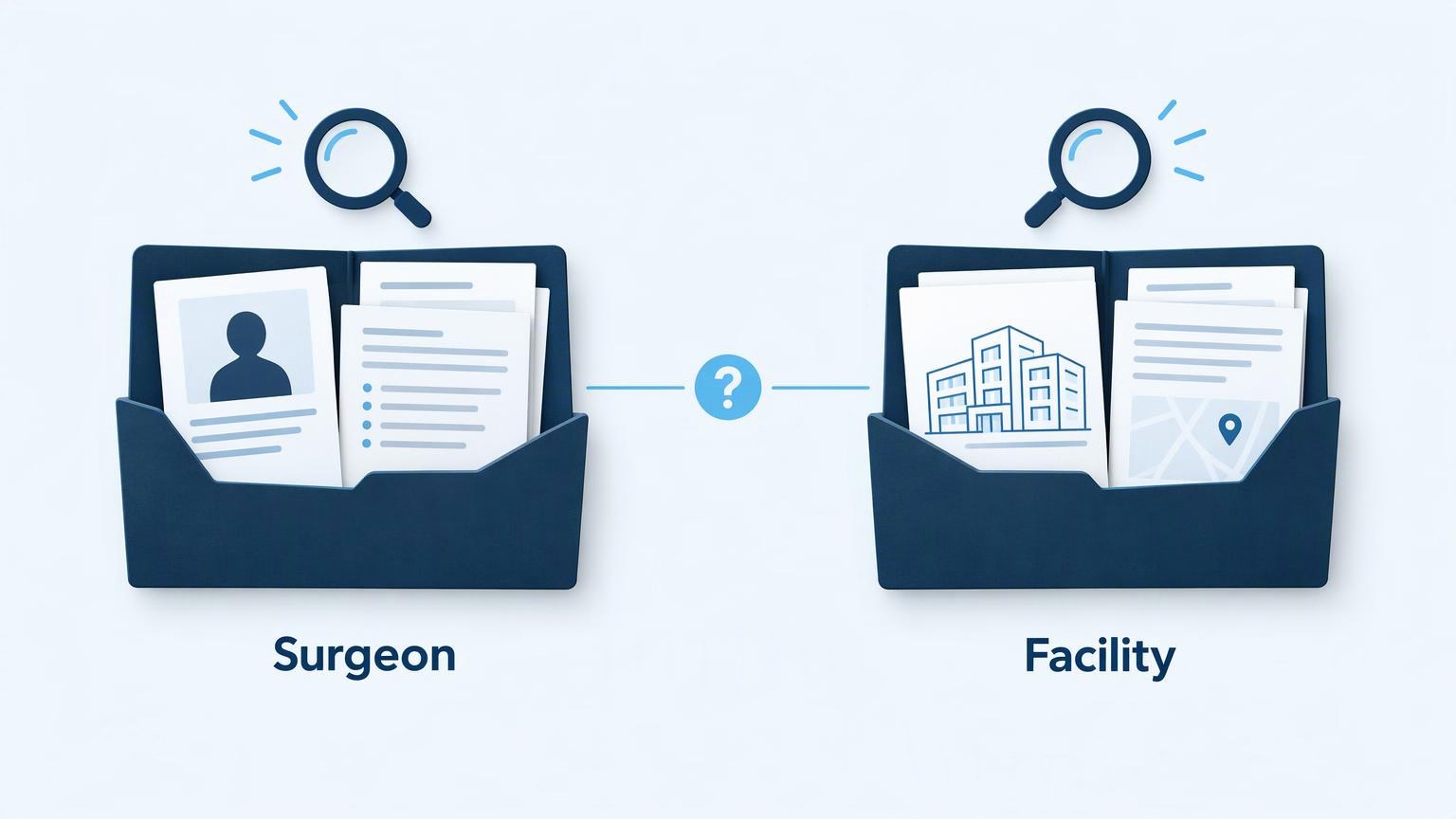
No. Researching an individual's credentials does not establish the status of the proposed operating facility or confirm that the surgeon can perform the planned procedure there. Keep the person, location and procedure connected, but verify their claims separately.
Once there is a proposed care location, establish its exact name and address. Seek facility-issued confirmation of the named surgeon's authorization or privileges to perform the proposed liposuction procedure there. A surgeon's statement can identify what needs confirmation, but it should not stand in for the facility's own answer.
If accreditation is claimed, identify the accrediting organization and investigate that claim for the specific location. Do not treat personal certification as facility accreditation, or assume a brand-level statement covers every operating site.
You do not need to invent a universal document title. The practical aim is a traceable answer from the facility about the proposed surgeon and procedure. For the broader location question, see where liposuction care in Mexico is provided. Keep that location research separate from comparing a destination's vacation appeal.
How should you use your findings before consultation?
Use your findings to decide whom to consult and which claims still need clarification. Credential verification does not determine whether liposuction is appropriate for you; eligibility, treatment suitability, risks and recovery planning belong with the qualified treating clinician.
Prepare a short private summary containing the proposed surgeon's identity, claims confirmed by their issuers, outstanding discrepancies and proposed operating facility. This prevents a general impression of credibility from obscuring an unanswered question. Keep it updated if the proposed surgeon or care location changes.
Only after that research should you broaden the comparison to the proposed care plan. Our guide to comparing liposuction plans in Mexico addresses that separate task. Flight timing and length of stay depend on the clinician and follow-up plan, not on a credential match.
Before submitting any information, clarify the recipient and purpose. The first submission allows only name, email and optional contact-method preference. Permission to reply, optional marketing and referral to a specifically named provider are separate choices. Travel details belong in later discussion with a confirmed travel contact.
Frequently Asked Questions
Does a claimed US certification replace checking credentials for care in Mexico?
Do not use it as a substitute. Identify the US organization and investigate exactly what it confirms, then separately investigate the qualifications claimed for the proposed care in Mexico. An international membership, training affiliation and certification are different claims; the location of an organization does not make them interchangeable.
Can before-and-after photos help me verify qualifications?
Photos may help you describe visual preferences during consultation, but they do not establish the photographer's subject, the operating surgeon's identity or current credential status. Keep aesthetic discussion separate from verification. A compelling portfolio should not outweigh a discrepancy about who would perform your procedure that still needs an explanation.
What if I cannot understand the Spanish credential wording?
Retain the original wording and obtain a clear translation or explanation before interpreting it. Compare the explanation with what the issuer says the credential represents. Avoid replacing an unfamiliar title with a familiar US qualification on your own. If its meaning remains unclear, note that you have not established equivalence.
Do I need to send my medical records to research a surgeon?
No. This task concerns the professional's identity and qualifications, not your health history. Do not send diagnoses, scans, clinical records, insurance numbers, payment details or attachments through a general inquiry form. If a later clinical consultation requires records, use only a secure channel confirmed by the specifically named treating provider.
Does verified certification tell me how experienced the surgeon is with my proposed liposuction?
Not by itself. A confirmed certification claim is different from procedure-specific experience. During consultation, discuss the surgeon's experience with the proposed approach and how they assess its suitability and limitations for you. Do not turn a general qualification or a self-reported procedure count into a guarantee of your result.