

Provider Comparison
Build a meaningful comparison from identifiable clinicians, useful replies and clearly defined services, not a directory ranking.
A polished website can introduce an option, but it cannot settle your comparison. Your task is to establish whether the people, information and proposed services fit together. Keep a private comparison sheet for each candidate, separating confirmed details from undecided items. That makes an incomplete proposal visible without treating every missing detail as proof of poor care.
Choose direct contact or a clearly defined planning intermediary
Direct provider contact is a sensible starting point when you can reach the treating practice and manage ordinary travel arrangements yourself. An intermediary is worth considering when it offers a specific planning task you need and preserves access to the clinician. Neither arrangement is inherently better.
Separate the roles before comparing brands. A clinician evaluates treatment suitability and explains the care plan. A facility supplies the setting for care. A travel contact may discuss logistics, while a referral intermediary may introduce you to a provider. One organization might describe several roles, but each still needs a named responsible party and a defined scope.
The useful question is not how many reservations you have. It is whether anyone is responsible for a task you cannot resolve independently. A straightforward hotel booking does not require clinical coordination. An unanswered treatment question requires the treating clinician, not a more comprehensive travel package.
Search for identities you can verify
Start with your treatment category and Mexico, then narrow results to pages that identify an actual clinician and facility. A country-level popularity claim does not establish the suitability of an individual provider.
Open the practice or facility page rather than relying on the search preview. Record the clinician's full name, stated specialty, proposed treatment location and the organization offering the service. Search those exact names separately. If a company presents several clinicians, keep their claims separate rather than assigning the company's description to everyone.
For a claimed license, specialty credential or facility accreditation, identify the issuing organization and seek confirmation through its own records or official contact route. Match the person or facility, credential scope and current status. A logo alone is not enough.
Use the result to decide the next step: an identifiable candidate moves to communication review; an unclear identity stays out of the final comparison. Independent verification supports identity and credential assessment, not a prediction of your treatment outcome.
| Situation | Suitable route | Reason | Trade-off |
|---|---|---|---|
| The treating practice is identifiable and your travel needs are straightforward. | Direct provider contact | Clinical questions reach the practice without an additional intermediary. | You handle separate travel purchases and their terms. |
| You need a specific planning task and the intermediary defines its role. | Provider contact plus planning help | The extra contact has an identifiable logistics job. | Clinical and travel responsibilities still need separate owners. |
| The treating clinician or facility remains unidentified. | Delay commitment | You cannot verify the proposed care arrangement yet. | Research continues before payment or travel commitments. |

Judge replies by what they help you decide
A useful reply answers the question, identifies who owns the answer and explains what remains undecided. Speed and friendliness matter for convenience, but they are not substitutes for clinical access or clear information.
During a later, appropriately routed conversation, distinguish scheduling questions from clinical ones. A planning contact can explain its own responsibilities. Eligibility, treatment options, recovery advice and clearance to travel belong with the qualified treating clinician.
Consider the phrase “aftercare support.” By itself, it tells you little. A useful explanation identifies who receives postoperative questions, the contact method, the stated hours or availability, and the process outside those arrangements. It also distinguishes planned follow-up from additional care that may carry separate charges.
For an English-speaking traveler, assess whether you can understand consultation discussions and written instructions, not just the sales reply. If answers conflict, seek a corrected written explanation from the responsible party. If the explanations still conflict, pause even when the conversation feels reassuring.
Compare written scope before comparing totals
Totals are comparable only when you know what each proposal purchases. A care-only estimate and a proposal containing travel services answer different budget questions; neither is automatically better value.
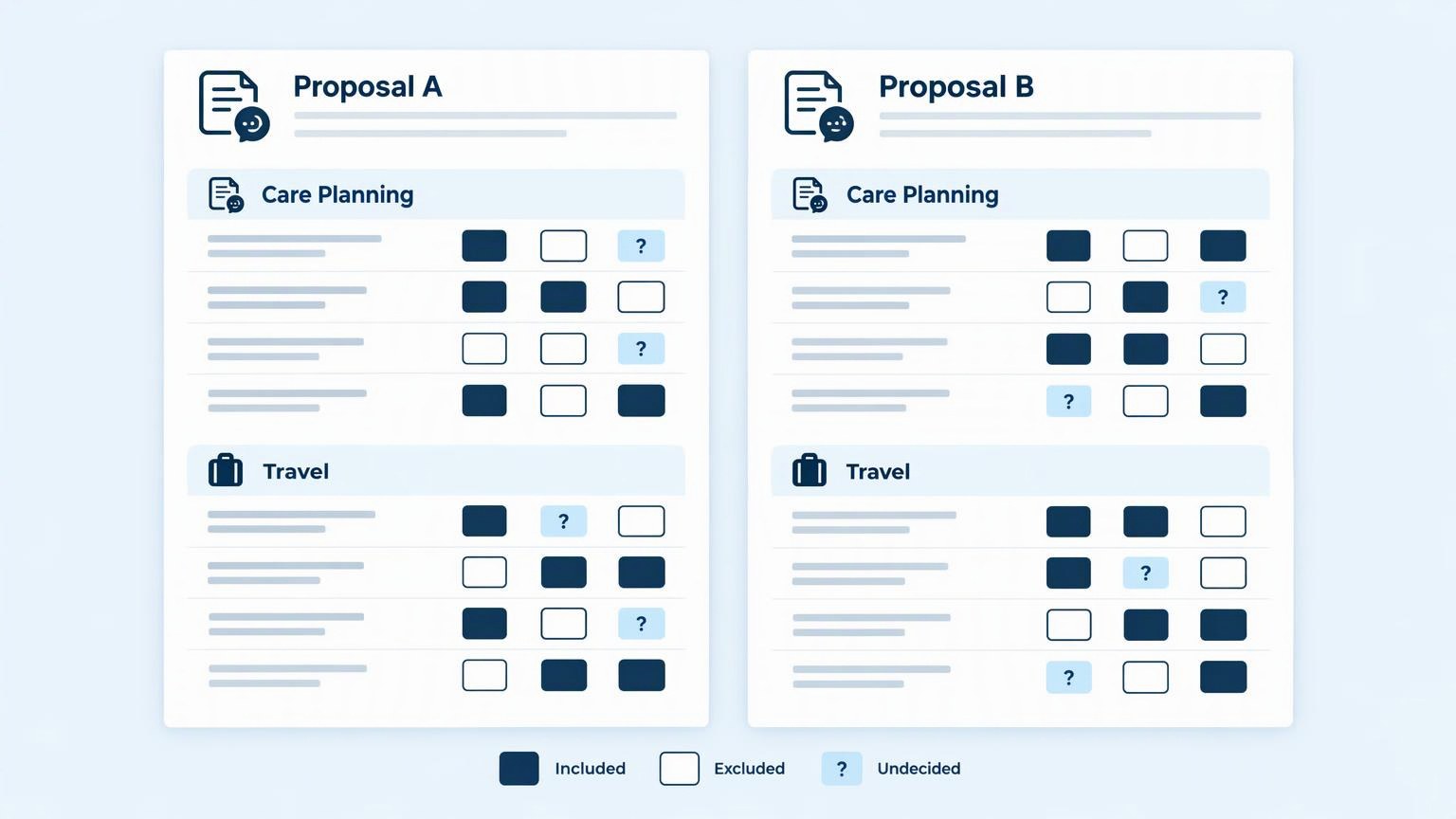
Organize each proposal using the same short checklist:
- Care: consultation, proposed treatment, facility services, medications and planned follow-up, as applicable.
- Travel: lodging, transport and any separately described planning service.
- Status: included, excluded or undecided for each item.
- Payment: named seller and recipient, deposit conditions, balance timing, currency and proposal validity.
Do not assign a zero cost to an undecided item. If a proposal depends on clinical assessment, keep it labeled as preliminary rather than treating it as a confirmed treatment offer. Before payment, reconcile the current proposal with the applicable contract and payment instructions.
Our guide to comparing medical-tourism packages in Mexico provides a related framework for separating care from trip components. The objective is a comparable scope, not the longest list of inclusions.
Test the proposals against an extended stay
A change test reveals whether an attractive original proposal remains usable when the schedule moves. Keep the service, the reason for the change and the payer separate.
Say you are comparing a care-only proposal with one that also lists lodging. Your clinician later directs you to remain longer for follow-up. The extra hotel night is still a travel service. The clinical reason does not establish who pays, whether it is included or whether insurance covers it.
If the lodging proposal leaves those points undecided, you cannot count it as protection against an extended stay. If the care-only option lets you select lodging with clear extension and change terms, that may be the more manageable arrangement. Conversely, a combined proposal may suit you when its written terms clearly allocate the additional expense and explain the process. The outcome follows from the terms, not the bundle label.
Supplier cancellation, refund and change terms govern contractual consequences. Insurance is separate: coverage depends on the policy, exclusions and claim conditions. Neither a clinical recommendation nor buying insurance establishes a refund right. Flight timing and length of stay must follow the clinician's individual plan.
Move to the next conversation with clear roles
Advance the candidate whose remaining questions have identifiable owners. Keep clinical review with the treating clinician and ordinary travel discussion with the confirmed travel contact. Our guide to who handles each step in a Cancun medical trip can help organize that handoff.
At Hospitality Cancun, we publish travel and consultation-planning guidance. Our information can support your comparison; it is not a treating provider's assessment or confirmation of an appointment.
Before submitting any information through the contact section, clarify the recipient and purpose. The first submission is limited to name and email, with optional contact-method preference. Travel details may be discussed later with the confirmed travel contact. Do not put narratives, diagnoses, records, scans, insurance numbers, payment details or attachments in the general form. Clinical records belong only in a named provider-confirmed secure channel.
Permission to answer your requested inquiry, optional marketing and referral to a specifically named provider are separate choices. Agreeing to a reply does not mean agreeing to marketing or a referral.
Frequently Asked Questions
Can patient reviews replace provider verification?
No. Reviews may describe an individual's communication or travel experience, but they do not independently establish a clinician's credentials, your treatment suitability or the terms of your purchase. Use them to identify issues worth investigating, then evaluate those issues against named providers and current written information.
Does “all-inclusive” mean every possible expense is covered?
Do not interpret the label that way. Its useful meaning comes from the proposal's actual inclusions, exclusions and conditions. Additional care, changed travel and services not expressly addressed remain separate comparison questions. If the terms do not say who pays an expense, a broad package description does not supply that answer.
What if a different clinician appears on the final proposal?
Treat the change as a new provider-verification task, not a minor administrative edit. Recheck the named clinician's identity and relevant credential claims, and establish who will conduct the consultation and treatment. Information about the original clinician does not automatically apply to the replacement, even within the same organization.
How should I compare proposals in different currencies?
Keep the original currency visible and use the same dated exchange-rate basis for your private comparison. Distinguish that estimate from the amount ultimately payable. The written payment terms should establish the billing currency and any applicable conversion or transaction charges; do not assume a converted display total is fixed.
Should I commit if a consultation might change the treatment plan?
Keep the preliminary proposal separate from a confirmed clinical plan. Before committing financially, understand what the consultation determines and which supplier terms apply if treatment changes or does not proceed. A travel reservation does not establish clinical suitability, and a preliminary estimate should not be treated as approval for treatment.