
Provider Research
Build a research shortlist around independently supported credentials, then evaluate the proposed care and travel arrangements separately.
A polished biography can give you useful search leads, but it is not independent confirmation. Your task is to connect the person who would treat you with the exact qualification being advertised, then decide what you still need to establish before moving toward a consultation.
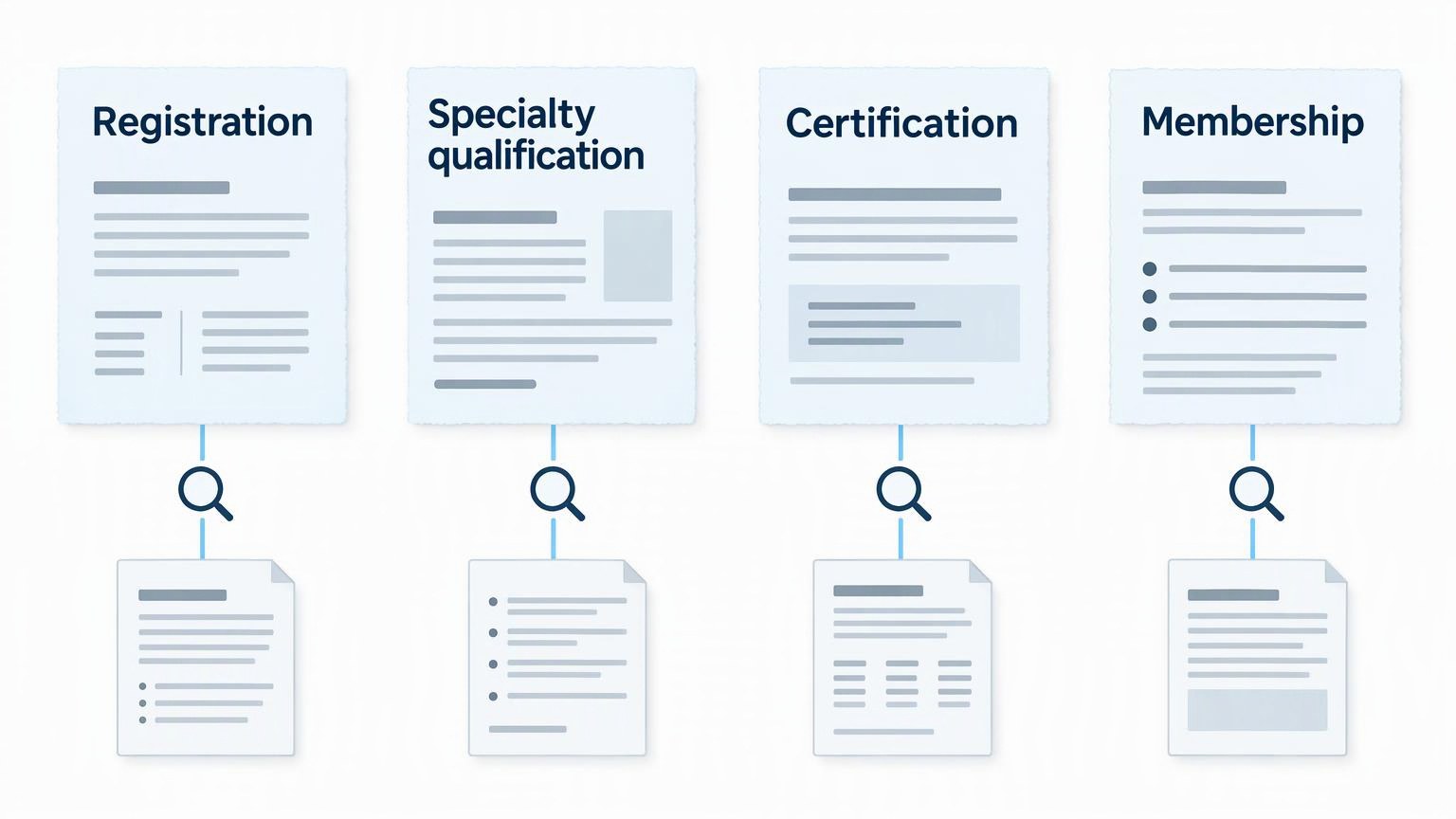
Separate registration, specialty qualifications and membership
Break the profile into individual claims before judging it. A professional registration claim, a specialty qualification, a certification claim and membership in an association describe different things. Evidence for one should not stand in for the others.
For example, the Face Lift Mexico surgeon profile separately lists professional and specialty certificates, education and professional membership. Those labels are useful research leads, not independent confirmation of current status or a recommendation of that provider.
Copy the exact credential title, issuing organization and identifying number where provided. For a statement such as “board certified,” identify which board, which specialty and whose certification is being claimed. Do not translate a broad promotional phrase into a more specific qualification yourself.
Keep training history separate, too. A course, fellowship or university affiliation may prompt further research, but the question is what qualification it actually documents. Your initial shortlist should reflect identifiable claims, not the length of a biography or the number of logos displayed.
Search the issuing authority rather than the biography
Start with the surgeon's full professional name and the exact credential identifier. Then locate the named issuing authority independently, rather than relying solely on a link, badge or screenshot supplied by the clinic.
Search the full name in quotation marks alongside the issuer's name or credential number. This can help locate records, but a search-engine result is only a lead. Open the underlying page and establish whether the organization responsible for that credential controls it. Several clinic pages repeating the same wording still represent the same unsupported claim.
If the authority offers a public lookup, use the name or identifier supported by that lookup. Compare the returned name, credential category, specialty and any status information shown. Record the source address and the date you checked it.
If there is no usable public search, use contact information published by the issuer itself to seek confirmation of the claim. Keep that request focused on the professional credential; your health history is not needed to establish whether a professional record matches.
| Finding | Next Step | Reason | Limit |
|---|---|---|---|
| Identity and claimed specialty match the issuer's record | Continue to consultation research | The specific claim has independent support | Individual suitability remains undecided |
| Historical certificate found, present status unclear | Seek current confirmation from the issuer | A past award does not answer a current-status question | Do not invent renewal or expiry rules |
| No usable result found | Retry identifiers, then seek issuer confirmation | An unsuccessful search is inconclusive | The claim still needs confirmation |
| Name, identifier or specialty substantively conflicts | Pause and resolve the discrepancy | The record does not support the claim as presented | Do not dismiss the conflict as a harmless typo |
Let the result determine whether to continue or pause
A match supports only the fields actually confirmed. A missing result does not confirm or disprove the claim; a substantive conflict requires clarification before you use that credential to justify proceeding.
Read the record rather than stopping at a familiar name. A matching name with a different credential category does not confirm the advertised specialty. Likewise, a dated document may establish a historical award without establishing present certification status. Do not infer a renewal rule, expiry date or current standing that the issuer does not provide.
When nothing appears, retry using the identifier and the full name as published. Differences in spelling or an incomplete search can obstruct a match, but they do not explain every absence. Seek issuer confirmation rather than deciding that no result proves either validity or misconduct.
Keep your conclusion precise: “identity and specialty matched,” “current status not established,” or “identifier conflicts.” These distinctions let you compare candidates without turning partial evidence into either an endorsement or an accusation.
Use credential findings to narrow competing offers
Give priority to candidates whose relevant credential claims can be independently supported. An attractive package can remain an option for later research, but its convenience does not resolve an unidentified surgeon or an unconfirmed qualification.
Say you are comparing a surgeon-led offer with a package that appears easier to organize. The surgeon-led offer names the proposed surgeon, and the issuer's record matches the claimed specialty. The package displays certification language but does not make clear which surgeon would operate or which issuer supports the claim.
You could focus your next clinical consultation research on the identifiable surgeon, or hold both options while resolving the package's missing information. What does not follow is choosing the package because its presentation is more complete. Its travel detail answers a different question.
If both candidates eventually have supported credentials, that filter no longer distinguishes them. Move on to the proposed clinical assessment, care setting and follow-up arrangements. Neither a higher price nor a lower price settles those questions.
Evaluate the proposed care separately from the credentials
Credential verification is a documentary filter, not an individual clinical assessment. Even after records match, the qualified treating clinician must assess your goals, treatment suitability and proposed approach.
Keep the surgeon and facility as separate subjects. A surgeon's credential does not establish the status of every facility where that surgeon might work. Once a care setting is proposed, identify the actual facility and seek evidence for any authorization or accreditation claim attached to it. A photograph or hospital logo alone does not establish the proposed arrangement.
Procedure-specific discussion also matters. If you have cosmetic goals, breathing concerns or prior nasal surgery, prepare those topics privately for the clinical consultation. Ask the clinician to explain how the assessment addresses your concerns and what limitations remain; an advertised label is not that assessment.
Follow-up responsibilities, length of stay and flight timing belong with the clinician's actual plan, not a credential record. For the later travel stage, our guide to planning a rhinoplasty visit in Cancun addresses a separate planning task.

Prepare a focused handoff before discussing costs
Keep a short private research summary so the next conversation addresses remaining uncertainties rather than restarting your search. Review our questions before requesting a rhinoplasty quote before moving into cost comparison.
- The surgeon's full professional name and claimed credentials.
- The issuer sources you checked and what each confirmed.
- Any identity, specialty or status issue that still needs clarification.
- The clinical questions reserved for the treating clinician.
Hospitality Cancun publishes travel and consultation-planning guidance. A later scope conversation can establish whether your planning inquiry fits its current scope; it is separate from clinical evaluation.
Before submitting any information, clarify the recipient and purpose. The first submission allows only name and email, with an optional contact-method preference. Discuss ordinary travel details later with the confirmed travel contact. Keep permission for a requested reply, optional marketing and referral to a specifically named provider separate. Clinical records belong only in a named provider-confirmed secure channel, not a general form.
Frequently Asked Questions
Can patient reviews help me research a surgeon?
Reviews can suggest communication topics to investigate, but they do not independently confirm a professional qualification. Use them to identify questions for a consultation, not to replace issuer records. A positive account also does not establish that the same clinician, facility or care arrangements would apply to you.
What if the credential information is in Spanish?
Keep the original credential title and issuer name in your notes, even if you use a translation to understand the page. Translation should not turn a membership into certification or broaden a specialty. If the wording affects your decision, seek clarification from the issuing organization rather than relying on an ambiguous translation.
Should a before-and-after gallery influence my decision?
A gallery can help you describe aesthetic preferences, but it does not confirm credentials or establish what result is achievable for you. Keep visual preferences separate from professional verification. Discuss your goals with the treating clinician, who must explain the proposed approach and its limitations after an appropriate assessment.
Does an international affiliation replace verification in Mexico?
No. Investigate the international claim on its own terms and separately verify the credentials presented for the proposed care in Mexico. An overseas affiliation may describe membership, training or another relationship. Do not assume it establishes a Mexican specialty qualification or current certification without evidence for that specific claim.
Do I need to send medical records to verify credentials?
No. Credential research concerns the professional's identity and qualifications, not your diagnosis. Do not send clinical records, scans, insurance numbers, payment details or attachments through a general inquiry form. If a clinical consultation later requires records, use only a secure channel confirmed by the specifically named treating provider.