

Provider Shortlist Guide
Use traceable information and practical fit to decide which providers deserve closer investigation before you request personalized details.
Your goal at this stage is not to select a procedure or approve a surgeon. It is to decide where further investigation is worthwhile. Build a private comparison sheet from public information, recording the source beside each claim. This keeps an attractive advertisement from becoming an assumption about care, services, or suitability.
Keep, pause, or remove each shortlist entry
Keep an entry for closer investigation when its basic claims are traceable; pause it when a specific omission could change your decision. Remove it from your current shortlist when contradictory information prevents you from identifying the provider or when a known requirement does not fit.
These are research decisions, not judgments that a provider is safe or unsafe. A page without a published detail may simply require clarification. A page that names different surgeons in different places presents a more fundamental problem: you do not yet know whose care you are comparing.
Write the reason beside each status. “Pause: operating facility not named” gives you a useful next question. “Looks trustworthy” does not. Avoid assigning points that let strong photography compensate for an unanswered identity question. The comparison below shows how different findings should lead to different actions.
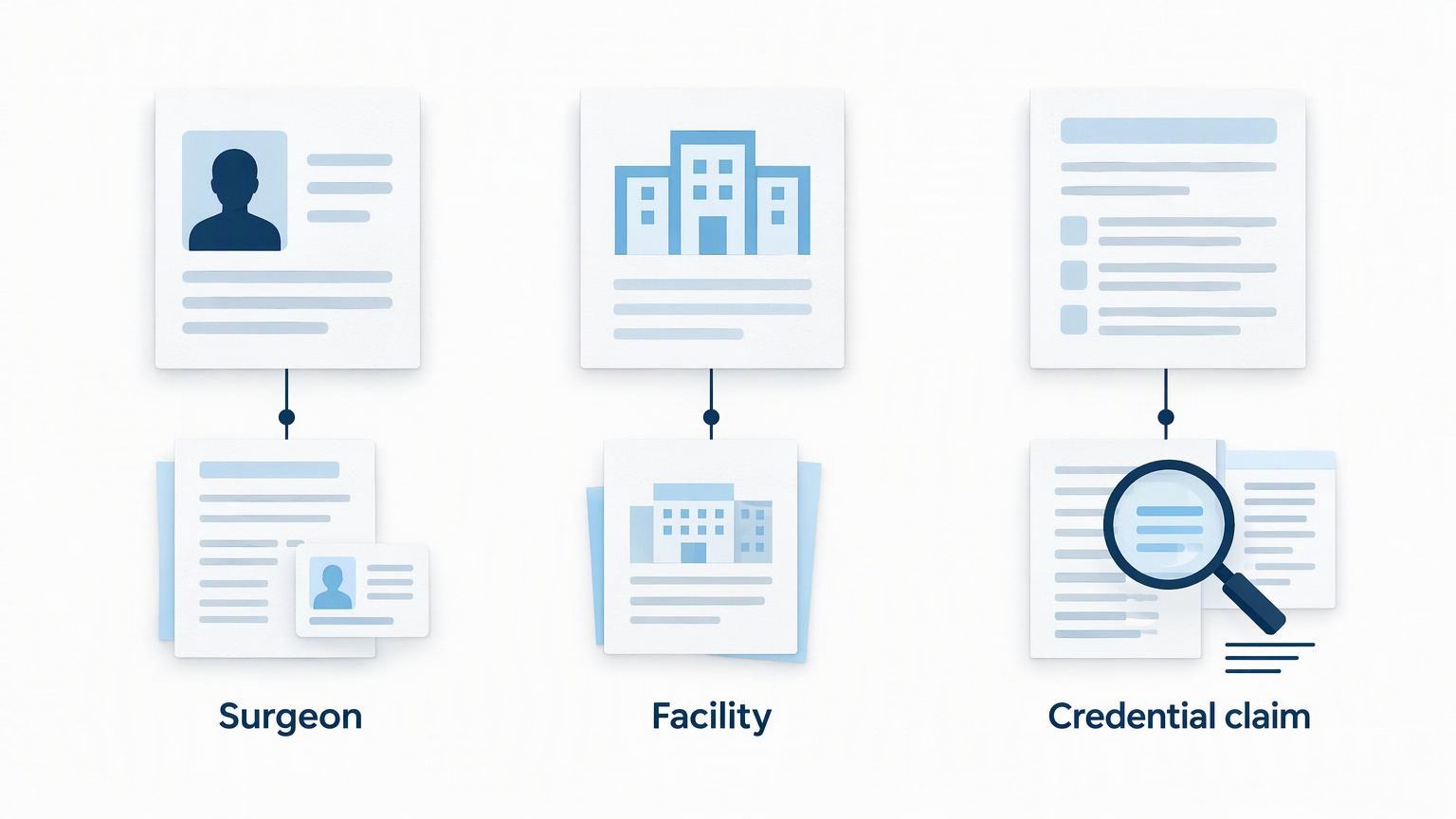
Search the surgeon, facility, and credential claim separately
Start with the surgeon's full name, then investigate the proposed operating facility and each credential claim independently. A clinic brand, hospital listing, and travel intermediary may refer to different entities.
Search the full name alongside the specialty claimed on the provider's page. Compare the spelling and identity across the provider profile and any credential issuer's own records. For a certification claim, look for the issuer, specialty, identifier, and current status where available. A logo or screenshot is a lead to investigate, not the final verification.
Next, search the exact facility name. Distinguish the consultation address from the place where surgery would occur. If an accreditation is advertised, investigate that exact facility and the accreditation's scope through its issuer rather than transferring the claim to the surgeon.
If you cannot find a matching record, mark the claim “not yet verified” rather than guessing. Your next step is a targeted clarification through an appropriate confirmed contact, not a broader search for favorable reviews. Even a confirmed qualification does not determine your individual eligibility or treatment suitability.
| Finding | Suitable Action | Reason and Limit |
|---|---|---|
| Identity and core claims are traceable | Keep for closer investigation | Enough evidence to continue, not approval for treatment. |
| A specific service or facility detail is missing | Pause for targeted clarification | The omission may be resolvable without restarting your search. |
| Surgeon names conflict across materials | Remove until the conflict is resolved | You cannot meaningfully compare an unidentified treating person. |
| A confirmed care requirement cannot fit your available time | Reconsider the timing or remove the option | A convenient itinerary cannot override the care plan. |
Use reviews and photos for the questions they can answer
Reviews can help you identify questions about communication and the patient experience. Photos can show what a provider chooses to present. Neither establishes current credentials, the operating location, or the result you should expect.
For example, Medical Tourism Chat's Mexico tummy tuck directory presents facility listings with ratings. That format can help you discover names, but a facility rating does not identify the surgeon who would treat you.
Similarly, PlacidWay's cosmetic surgery testimonial page presents patient stories and image galleries. Treat these as selected accounts, not a substitute for your own consultation or independent credential investigation.
When reading an account, look for the procedure, treating person, date, and stage of follow-up. An account about a different procedure may offer a communication clue without answering a tummy tuck question. Save a specific issue to clarify, such as whether postoperative questions reach a clinician. Do not turn repeated positive adjectives into a clinical conclusion.
Separate clinical responsibility from package language
A useful provider description separates who makes clinical decisions from who supplies lodging, transportation, or planning assistance. “All-inclusive” alone does not tell you those responsibilities or establish that the same services appear in competing offers.
For your private comparison sheet, use this short checklist:
- Named surgeon, operating facility, and consultation process.
- Who assesses suitability and explains the proposed procedure.
- Who provides follow-up and handles clinical concerns.
- Listed clinical and travel services, exclusions, and responsible suppliers.
- Change, cancellation, refund, and payment terms that still need clarification.
Do not demand a personalized treatment plan from public pages. At this stage, look for a clear route to clinician assessment and enough scope information to identify the next question.
If a clinician later directs an extra hotel night, it remains a lodging service. The medical reason does not establish who pays, whether it is included, or which hotel change terms apply. Supplier cancellation and refund obligations remain separate from any insurance coverage and claim conditions. For the later price-comparison stage, use our guide to what to compare in tummy tuck costs.
Apply your travel limitation before choosing whom to investigate
A fixed travel deadline should affect which provider you investigate next, but it cannot determine when you are medically ready to leave. Flight timing and length of stay depend on the clinician and follow-up plan.
Say you have a firm date to resume work. One shortlist entry advertises a set departure schedule but does not explain how follow-up or travel clearance is determined. Another describes a clinician-led assessment and follow-up process but leaves travel timing open.
Investigate the second entry first because its process allows the clinician to assess travel timing rather than assume a fixed departure date. Pause the first until the advertised schedule is reconciled with individualized care. This is not proof that the second provider is better clinically; it is a reasoned choice about where to seek clarification.
If the eventual care plan cannot fit your available time, changing the travel window or postponing is more appropriate than selecting whoever promises the earliest return. A flight or room change is a logistics task, not clinical clearance. Our tummy tuck aftercare guide covers the follow-up questions to address next.

Move from screening to the appropriate conversation
After screening, separate your clinical questions from your travel-planning questions. Keep eligibility, diagnosis, treatment suitability, and recovery advice with the qualified treating clinician. We publish travel and consultation-planning guidance at Hospitality Cancun; use a later conversation to determine whether your inquiry fits our current scope.
Prepare your shortlist findings privately. Before submitting any information, clarify who receives it and for what purpose. The first contact submission is limited to your name and email, with an optional contact-method preference. Do not add trip details, a narrative, attachments, payment details, or insurance identifiers.
Later, ordinary travel details may be discussed with the confirmed travel contact. Diagnoses, scans, and clinical records belong only in a named provider-confirmed secure channel.
Permission to respond to your requested inquiry, optional marketing consent, and permission for referral to a specifically named provider are separate choices. A requested reply is not marketing consent. A planning conversation also does not itself establish an appointment, provider relationship, or acceptance for care.
Frequently Asked Questions
Should I eliminate a provider because its website looks dated?
Not on appearance alone. A polished website and an older design can both contain accurate or incomplete information. Give more weight to identifiable people, traceable claims, and a coherent consultation process. If the information is outdated or contradictory, investigate that specific issue rather than using design quality as a proxy.
Can a published BMI limit tell me whether I qualify?
No. A published threshold may describe a provider's stated screening approach, but it does not establish your eligibility. Record it as a possible fit issue for clinician assessment. Do not use a website limit, another patient's experience, or a planning conversation as a substitute for an individualized clinical evaluation.
Should I favor a provider offering several procedures together?
Not merely because the offer appears convenient. Keep the proposed procedure scope clear so you do not compare a tummy tuck alone with an offer containing additional procedures. Whether combining procedures is appropriate belongs with the treating clinician. Added services are not automatically added value for your particular needs.
Does a remote consultation replace an in-person assessment?
Do not assume it does. Determine what the remote conversation is intended to accomplish and what assessment remains before a treatment decision. A discussion may help clarify questions without establishing final suitability. Keep your shortlist status separate from clinical approval, and follow the named provider's confirmed process for clinical information.
What if a discount expires before I finish screening?
Let the discount expire rather than use its deadline to resolve an unanswered provider question. A promotional deadline does not verify identity, clinical suitability, or contractual terms. Before any later financial commitment, understand the named payee, the service purchased, and applicable terms without sending payment information through a general inquiry form.