

Surgeon Credential Comparison
Build a consultation shortlist by separating credential claims, tracing their supporting documents and resolving discrepancies before choosing a surgeon.
A polished profile can display certificates, memberships and facility logos together, making different claims look interchangeable. Your task is to identify what each item actually supports and whether it belongs to the person who would operate on you.
Keep your comparison notes privately. Before submitting any information through a contact form, clarify the recipient and purpose. The first-submission limits explained below apply even after that clarification.
Compare Separate Credential Claims, Not a Collection of Badges
Build your comparison around separate claims: medical registration, specialty qualification, current board certification if claimed, and professional-association membership. Do not let evidence for one fill an empty space under another. This is a document-comparison method, not a statement of Mexican licensing requirements.
In a later credential discussion with a confirmed provider contact, request a readable copy or issuer-verifiable reference for each claim:
- Medical license or registration: the holder's full name, credential number and issuing authority.
- Specialty qualification: the exact qualification title, awarding institution or authority, and identifying reference.
- Board certification: the board's full name, specialty, certificate identifier and any stated validity dates.
- Association membership: the organization's name, membership category and current-status evidence.
Preserve the original Spanish titles alongside any English explanation. A broad English phrase such as “certified cosmetic surgeon” is not specific enough to compare without knowing who issued the credential and what it covers.
A membership document answers a membership question. Unless its issuer separately confirms a certification claim, do not count it as evidence of that certification.
Trace Each Credential to Its Issuer
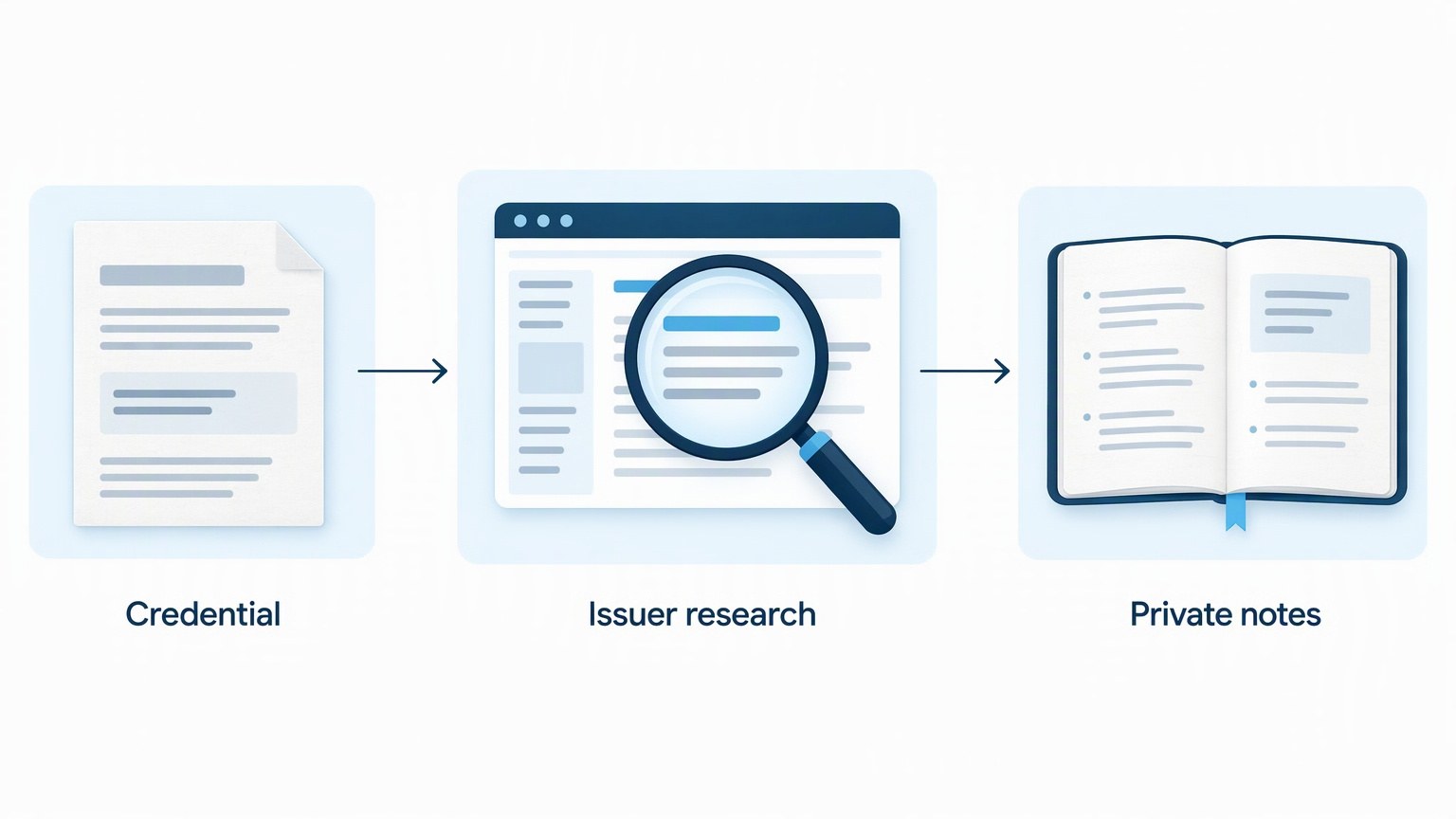
Start with the organization named on the document, not a search for the “best tummy tuck surgeon.” The useful result is an issuer's record or direct confirmation that matches the individual and credential.
- Identify the issuer. Search its full original-language name with the credential type. Establish that the page belongs to that organization rather than a clinic, advertising directory or intermediary.
- Find its verification route. Look for a credential directory, verification service or official contact instructions. A public search tool may not answer every question.
- Search precisely. Use the credential identifier where supported, then the full name as printed. Compare the holder, specialty, credential category and any displayed status or dates.
- Record the result. Save the source address, date checked and exact information corroborated. If necessary, seek clarification using contact details obtained independently from the issuer.
A search result containing the surgeon's name is only a lead. Open the record and read it. Likewise, a certificate image on the surgeon's website is material to authenticate, not independent confirmation.
Keep your conclusion narrow: “This issuer corroborated this credential” is more useful than “Everything about this surgeon is verified.”
| Evidence Situation | Suitable Next Step | Reason | Limit |
|---|---|---|---|
| Relevant claims corroborated by their issuers | Advance to clinical consultation | The documentary prerequisite is resolved | Personal suitability remains a clinical decision |
| Membership shown, specialty claim not yet corroborated | Pause and resolve specialty evidence | Different claims need different support | Membership alone does not answer the specialty question |
| No result from a name search | Try identifiers and seek issuer clarification | The search may be incomplete | Do not label the credential invalid from this alone |
| Issuer confirms a material contradiction | Do not rely on the disputed claim | Independent evidence conflicts with the presentation | Reconsider only after a substantiated correction |
Resolve Missing Records and Conflicting Details
A missing result means your check is incomplete; it does not by itself prove that the surgeon lacks the credential. A contradiction confirmed by the issuer is a different finding and should not be treated as a search inconvenience.
For a name mismatch, compare the complete name on the document with the public profile. Search the original spelling and any additional surnames shown, then use the credential identifier if available. Do not decide that similar names identify the same person without corroboration.
For unclear dates, separate when a certificate was issued from any validity period or current status. An old issue date alone does not tell you whether the credential remains current. Conversely, a provider's statement that it is current does not resolve an issuer record saying otherwise.
Use simple labels in your notes: corroborated, pending clarification or contradicted. These labels distinguish what you have confirmed from what still needs an answer, so you do not mistakenly mark an incomplete check as passed.
Let Evidence Quality Change Your Shortlist
Advance candidates with corroborated, relevant credential information to consultation. Pause candidates whose important claims still need confirmation, rather than compensating with attractive photos or persuasive sales language.
Say you are comparing a polished profile displaying association badges with a simpler profile supplying identifiable specialty and certification documents. You trace the simpler profile's documents to their issuers, while the polished profile's specialty claim remains unclear.
The simpler profile is the more defensible choice for the next consultation because you have answered a prerequisite question about its credential claims. That does not prove better surgical results or make the other candidate unqualified. It identifies which candidate has cleared your documentary comparison so far.
If the other candidate later supplies matching, corroborated evidence, both can remain on your shortlist. The decision then moves to the clinical consultation, proposed setting and care arrangements. If neither candidate's important claims can be resolved, broaden your search rather than choosing the more convincing presentation.
Check the Surgeon and Facility as Separate Subjects
A credential naming a facility is evidence about that facility and the scope stated on the document. It does not, by itself, establish an individual surgeon's specialty qualification or confirm that the surgeon may perform your proposed operation there.
Read the credential holder's name first. If the claim concerns accreditation, compare the accrediting organization, exact facility identity, covered location, scope and stated status. Do not transfer a claim from one entity or location to another because their branding is similar.
Next, obtain confirmation from the proposed facility about the named surgeon's role and authorization to perform the proposed operation there. Use contact information found independently for that facility, rather than relying solely on a message forwarded by an intermediary. Ask the facility to explain precisely what its confirmation covers.
This resolves a different question from the personal credential search: whether the surgeon and proposed surgical setting actually connect as described. If the operating surgeon or facility changes, revisit the affected checks. The original evidence does not automatically apply to a replacement.

Carry the Shortlist Into a Clinical Consultation
A credential comparison prepares you to consult a candidate; it is not clearance for surgery. Your qualified treating clinician must assess eligibility, treatment suitability and the individual care plan.
Prepare a short private summary of the surgeon's full name, documents reviewed, issuer confirmations and remaining questions. Keep documentary uncertainties separate from clinical questions so neither gets lost. A clear credential record still leaves the clinician to explain the proposed procedure, risks, alternatives and follow-up.
For that next stage, read tummy tuck aftercare questions to ask. If you are also comparing care across countries, use what to compare for a tummy tuck in Mexico versus the USA as a separate decision aid.
Clinical records belong only in a named provider-confirmed secure channel. Flight timing and length of stay should follow the clinician's assessment and follow-up plan, not a credential badge or advertised itinerary.
Frequently Asked Questions
Can before-and-after photos replace credential checks?
No. Photos do not identify the authority that issued a qualification, establish its status or authenticate the surgeon's identity. You can discuss images during consultation, but keep that discussion separate from credential verification. An appealing portfolio should not turn a pending documentary question into a resolved one.
What if the credential documents are only in Spanish?
Keep the originals and use a translation to understand them, rather than replacing their titles with broad English labels. Compare names, identifiers, issuer and dates against the original document. If a translated phrase changes the apparent scope of a qualification, seek an explanation from the issuer before relying on it.
Does training in the United States settle the credential comparison?
Not by itself. Treat a US training claim as another claim to substantiate: identify the institution, program and qualification awarded. Do not assume that it answers questions about other credentials or the proposed facility relationship. Compare what the training document actually establishes rather than relying on the country named.
How long should I keep my verification notes?
Keep them through your selection and consultation process so you can trace each conclusion back to its source. There is no universal recheck interval established here. Revisit time-sensitive status information before relying on it, and repeat affected checks if the named surgeon, credential claim or proposed facility changes.
What may I submit in a first travel-planning inquiry?
Clarify the recipient and purpose before submitting any information. The first submission allows only name and email, plus optional contact-method preference, with no narrative or attachments. Later travel discussion follows recipient and purpose confirmation. Permission for a requested reply, optional marketing and referral to a specifically named provider are separate choices. A reply is not marketing consent.