

Consultation and Travel Planning
Compare care arrangements by who answers your questions, what happens when that contact is unavailable and how communication continues at home.
After discharge, a contact list needs to do more than store phone numbers. It should tell you which person handles each issue and what happens next. This guide helps you compare those arrangements before choosing care, without prescribing recovery steps or assuming a coordinator speaks for your clinician.
Choose a routine route with clear clinical responsibility
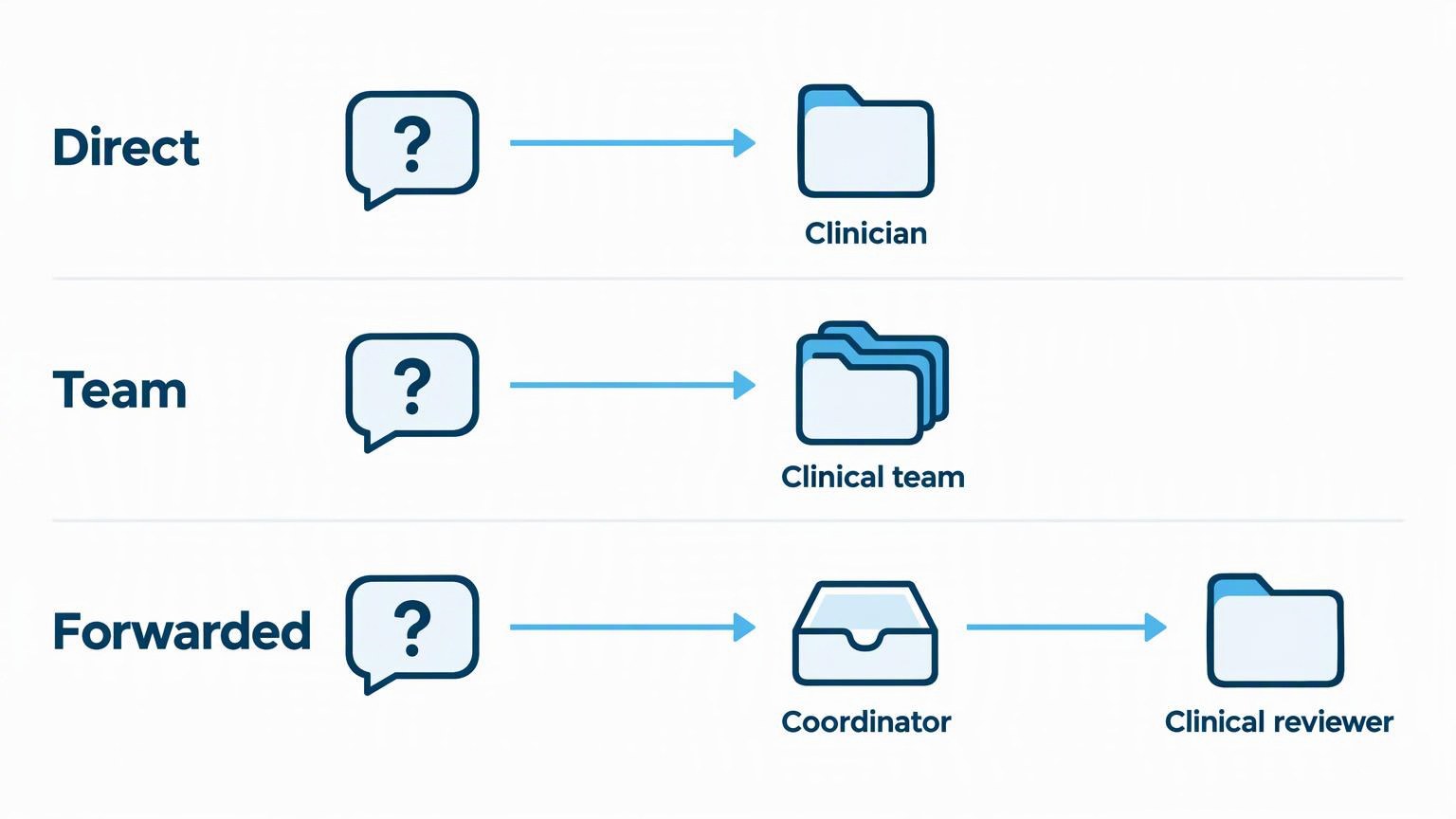
Routine questions should reach the treating clinician or a clinical team with an explained review process. Direct access to the surgeon is one possible arrangement, but it is not automatically better than team-based contact. The useful distinction is who can answer and how the question reaches that person.
Start with the prospective provider's own contact information. Have the provider identify the post-discharge channel rather than assuming its appointment desk also handles care questions. Establish whether the first recipient reviews questions clinically, passes them to someone else or handles scheduling only.
A coordinator can forward a question without being responsible for the clinical answer. If forwarding is the arrangement, identify the reviewing clinician or team and how you will receive their response. Do not treat an acknowledgment from the coordinator as clinical advice.
Compare the alternatives below by responsibility and access. Keep broader care-plan questions separate; our tummy tuck aftercare questions guide provides related consultation preparation.
Make contact hours and silence actionable
Record the channel's stated contact hours, time zone and backup instructions. A route is more usable when you know what happens outside its normal hours, not merely that you can send a message at any time.
Separate three events: your message is delivered, someone acknowledges it and a clinician reviews it. An automatic reply or read receipt does not tell you that the clinical review has occurred. Ask the provider to explain its response expectations without interpreting them as a guaranteed outcome.
The fallback should specify the next action if the primary contact is unavailable or does not respond. That might involve a different provider-designated contact or another instruction supplied by the care team. Do not invent your own waiting interval from a travel article.
Write availability in the provider's stated time zone, then note what that means where you will be staying or returning home. If different people cover different periods, connect each period to its route. “Contact us anytime” needs an explanation of who receives those contacts and what happens next.
| Arrangement | Useful when | Reason | Trade-off to resolve |
|---|---|---|---|
| Direct clinician contact | The provider confirms that the clinician receives these questions | Clinical recipient is explicit | Availability and backup still need definition |
| Clinical-team channel | The provider explains who reviews and answers | Questions can follow a defined team process | You need to understand how review is assigned |
| Coordinator forwarding | The provider identifies the clinical reviewer and forwarding process | Administrative routing can connect you to clinical review | Coordinator acknowledgment is not a clinical answer |
Separate urgent concerns from routine messages
Obtain the treating provider's instructions for urgent concerns and emergencies before discharge. Routine email, messaging and accommodation support should not be treated as substitutes for emergency care.
The clinician should define which concerns need prompt contact and when emergency assessment is required. This guide cannot determine those thresholds for you. Have the provider explain them in language you understand and identify the action attached to each instruction.
A clinical urgent-contact route and an emergency-care route may serve different purposes. Make sure the instructions distinguish them, including what to do when the provider cannot be reached. Do not assume an after-hours contact is an emergency service simply because it operates outside office hours.
Keep lodging and transport contacts in a separate category. They may handle a room problem or reservation change, but those tasks do not establish clinical capability. If you believe you are facing an emergency, seek emergency care rather than waiting for a routine message reply. Clarify any unclear instructions with the clinician before leaving the facility.
Test the arrangement with an evening question
Choose based on whether the contact process resolves the uncertainty you would actually face. A simple example can reveal more than a long list of available communication apps.
Say you expect to stay in accommodation after discharge and have a routine question about a written care instruction in the evening. One proposal gives you a coordinator's messaging account and says questions will be passed along. Another identifies the clinical reviewing team, its availability and the provider's next-step instructions outside those hours.
The second proposal gives you a clearer route for that situation. That does not establish the provider's credentials or the quality of treatment, but it answers the communication question more fully. The first proposal could become equally workable if the provider explains who reviews forwarded messages and supplies the missing fallback.
Now change the issue to a lodging reservation problem. The accommodation supplier or confirmed travel contact is the relevant route; clinical review is not needed merely to change a booking. If the concern is urgent under your clinician's instructions, use that urgent route instead of the routine evening process.

Keep a compact discharge contact card
Turn the agreed arrangements into a short contact card you keep privately and can access without searching old messages. Keep the provider's clinical instructions alongside it, not rewritten as your own interpretation.
- Routine care: recipient or team, role, exact route and stated availability.
- Backup: provider-designated alternative and the instruction for using it.
- Urgent and emergency: the provider's separate routes and next actions.
- Travel: lodging and transport contacts, labeled by the bookings they handle.
- Follow-up: scheduling contact and where to find the agreed review plan.
Before departure, read the card back to the provider so any mismatch can be corrected. If English communication matters to you, establish how instructions and replies will be provided in English rather than assuming every channel offers it.
Save an accessible offline copy. A companion can help locate contacts, but being present does not automatically authorize disclosure of your health information. Establish that permission directly with the provider if you want the companion involved.
Define the contact handoff before returning home
Establish how long the treating provider's communication arrangement continues and what follow-up can be handled remotely. A channel used during your stay does not by itself establish ongoing responsibility after you return home.
If the care plan involves a clinician at home, establish that clinician's agreement separately. A suggested introduction is not an accepted appointment or a completed transfer of responsibility. Identify who arranges the handoff and how you will learn that it has been accepted.
Keep the treating provider's remaining role clear during the transition. For clinical records, use a named provider-confirmed secure channel. Ordinary travel discussions belong with the confirmed travel contact later, not in a clinical-records channel.
Flight timing and length of stay depend on your clinician and follow-up plan; the contact map does not provide clearance to fly. Our guide to returning home after medical care in Mexico addresses that separate planning decision. Update your contact card when the handoff is established so the next recipient is clear.
Frequently Asked Questions
Does a quick reply prove that after-discharge support is good?
No. A quick administrative reply can be useful, but it does not establish clinical review, credentials or the scope of follow-up. Judge the content of the arrangement: who answers care questions, what responsibility they hold and whether the next action is clear when that person is unavailable.
Should I use the same group chat for care and hotel questions?
Do not assume a shared chat is appropriate for both. Clinical questions need the provider-confirmed route, while hotel questions belong with the relevant supplier or confirmed travel contact. If a provider proposes a group chat, establish who participates and what information each recipient is authorized to receive.
What if the contact person changes before surgery?
Have the provider update the recipient, role, route and backup instructions before you rely on the arrangement. A replacement name alone is not enough if the new person handles different tasks. Keep the updated version on your contact card and retire superseded details to avoid conflicting routes.
Can I attach my discharge papers to a general travel inquiry?
No. Clarify recipient and purpose before submitting any information. The first submission allows only name, email and optional contact-method preference. Clinical records belong in a named provider-confirmed secure channel. Permission to answer your inquiry, optional marketing and referral to a specifically named provider are separate choices.
What if a provider has not finalized the contact arrangement?
Treat the communication part of the proposal as unfinished, not as a promise you can fill in yourself. Continue comparing options on the same criteria and resolve the missing responsibility or route before relying on it. A polished package description cannot replace a usable post-discharge contact process.