

Consultation and Travel Planning
Compare the practical demands of each schedule after a qualified treating clinician establishes which options are appropriate for you.
Your useful starting point is not a package label. It is a clear description of what would happen during each visit, who would provide care and what must happen before you return home. That lets you compare schedules without treating travel convenience as medical advice.
Compare one stay and staged trips on the same terms
One stay is worth considering when the clinician supports a combined plan and its complete itinerary is workable. Separate trips deserve comparison when staging is recommended, or when a clinically supported staged option fits your available leave and assistance better. Neither schedule is automatically preferable.
First define the alternatives. “Combined procedures” and “one trip” are not interchangeable: a proposal could describe one operation, separate operations during one visit, or procedures across different visits. Ask the provider to identify which arrangement is actually proposed. Do not assume a longer hotel booking makes separate operations during one visit appropriate.
Then compare practical trade-offs. A combined itinerary concentrates arrangements into one visit; separate trips require planning each journey but may allow different leave and companion arrangements. Neither description establishes total cost, recovery duration or medical suitability. If only one schedule is supported clinically, the decision becomes whether you can accommodate that plan or need to defer it, not which package looks more convenient.
Establish availability and the clinician's role first
Verify procedure availability directly with the relevant care provider before comparing travel dates. Destination information about Costamed does not, by itself, establish that BBL, breast augmentation or their combination is available at a particular facility.
Separate the facility question from the clinician question. Identify the proposed treating clinician, the facility where each procedure would occur and who assesses combining versus staging for you. Request credential details and establish how to check them with the issuing organization rather than relying on a profile label.
For the assessment, bring focused questions: What makes you recommend combining or staging in my case? What remains undecided? If staged, what determines procedure order and readiness for the next stage? These ask the clinician to explain the decision rather than asking a travel contact to select a treatment schedule.
Keep your procedure goals and questions about sequence together in private notes. The related guide to discussing procedure sequence is a separate reading resource, not evidence that a provider offers either procedure.
| Situation | Route to consider | Reason | Trade-off |
|---|---|---|---|
| A combined plan is clinically supported and its full itinerary fits | One stay | Concentrates travel arrangements into one visit | Leave and assistance must cover the complete plan |
| Staging is recommended or a supported staged plan fits better | Separate trips | Allows each visit to be planned around its own requirements | Requires repeated travel and a provider-defined interval |
| Suitability or the follow-up schedule has not been established | Defer firm commitments | Avoids building bookings around an undefined plan | Travel dates remain unsettled |

Translate each care plan into an itinerary
Use the clinician's requirements to build each itinerary from consultation through follow-up and return travel. A procedure date alone cannot establish the departure date or the lodging arrangement you need.
For every supported option, prepare one compact comparison:
- Visit sequence: consultation, procedures and required follow-up appointments.
- Local stay: the proposed duration and what could change it.
- Positioning and activity: the clinician's instructions for resting, sleeping, sitting and travel.
- Assistance: tasks requiring help and whether clinical support is specified.
- Departure: who assesses readiness to fly and when that assessment occurs.
The positioning question matters because the plan must address both procedures together. Do not combine separate sets of internet recovery tips into your own instructions.
Translate the answers into ordinary logistics: lodging that can accommodate the stated needs, assistance covering the required period and flight terms that suit the remaining uncertainty. A companion is not automatically a substitute for prescribed clinical support. For broader arrangements, see planning the trip around BBL and breast augmentation.
Work through a fixed-leave conflict before booking
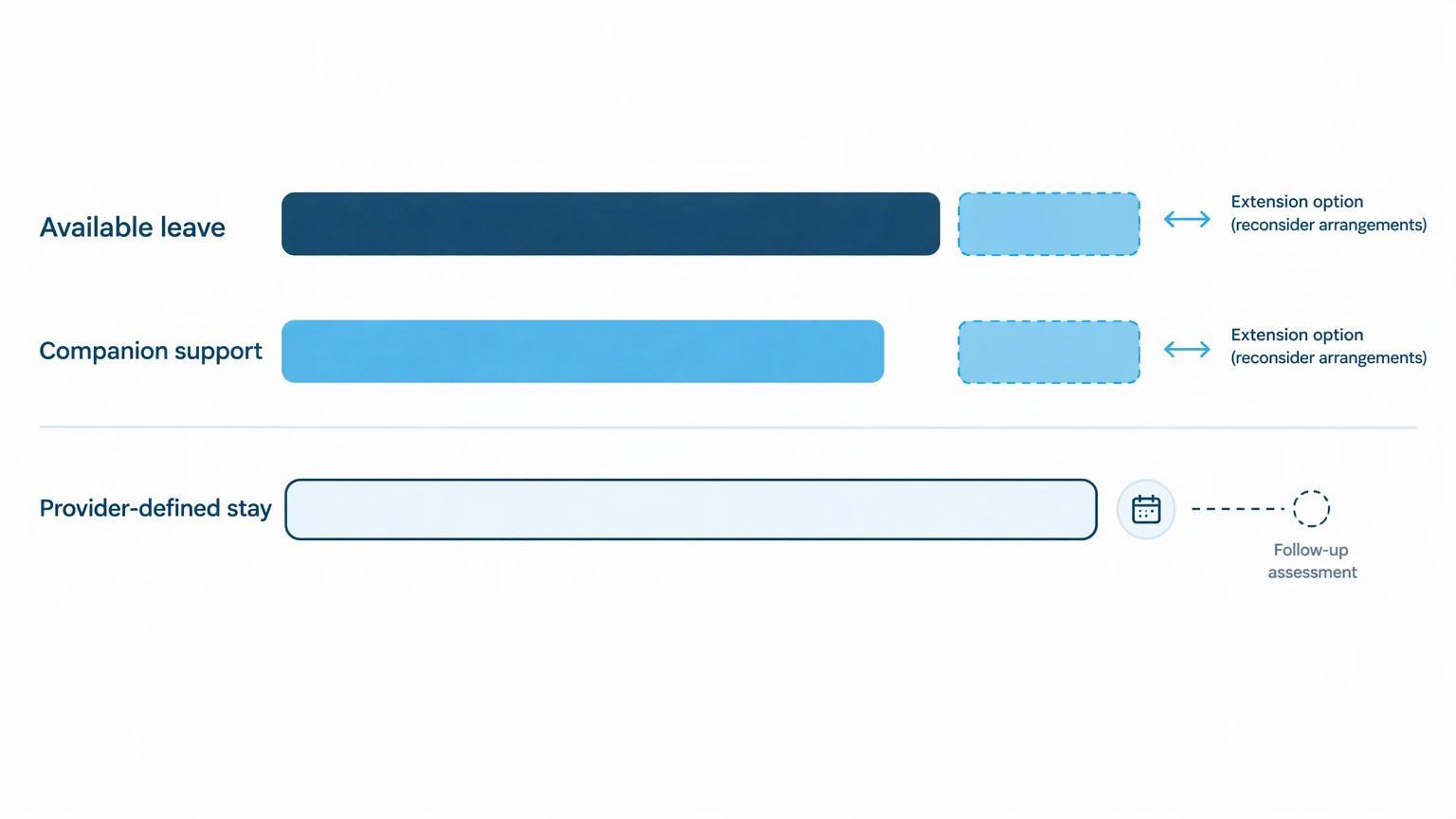
If your available leave ends before the proposed follow-up and departure assessment, the itinerary does not fit yet. The useful response is to change the arrangements or reconsider the supported options, not shorten the clinical plan yourself.
Say you prefer one trip because arranging leave is difficult, and your companion must return to work on a fixed date. The clinician proposes a combined plan whose local follow-up extends beyond that date. First separate the problems: your companion's departure affects assistance, while your own leave affects how long you can remain.
If leave can be extended and appropriate assistance arranged, the combined itinerary may become workable. If a clinician-supported staged alternative fits separate leave windows, compare each trip's complete requirements rather than assuming each will be shorter. If neither fits, postponement is a valid outcome.
The clinician determines whether the treatment plan can change. You or a confirmed travel contact can handle room and flight changes. An ordinary booking conflict does not, by itself, create a need for clinical support.
Compare charges, change terms and who pays
Compare the same service categories across both plans, then examine the consequences of changes. One trip is not proven cheaper merely because it involves fewer journeys, and separate trips are not proven more expensive without comparable proposals.
Separate procedure and facility charges from lodging, transportation, assistance and follow-up charges. For staged care, account for each visit and identify anything still unpriced. Before paying, establish which supplier receives each deposit, what it reserves and the applicable cancellation, refund and change terms. A flight change and a procedure cancellation can have different contractual consequences.
Suppose the clinician directs an extended local stay. An additional hotel night remains a lodging charge; the clinical reason does not establish who pays, whether it is included or which hotel terms apply. Those answers must come from the applicable written agreement.
Insurance is a separate question. Cancellation, medical and evacuation coverage depend on the actual policy, exclusions and claim conditions. Do not treat insurance as a replacement for supplier obligations, or budget on the assumption that an expense will be reimbursed.
Keep clinical and travel handoffs separate
Direct availability, suitability, procedure sequence and recovery questions to the relevant qualified care provider. Travel arrangements can be discussed separately after the recipient and purpose of that conversation are clear. A travel inquiry is not an appointment confirmation or a provider's acceptance of your case.
Before submitting any information through a general inquiry, clarify who receives it and for what purpose. The first submission is limited to name, email and an optional contact-method preference. Do not add trip details, a planning narrative or attachments. Ordinary travel details may be discussed later with the confirmed travel contact.
Keep permission to answer your requested inquiry separate from optional marketing and from permission for referral to a specifically named provider. Clinical records, diagnoses and scans belong only in a named provider-confirmed secure channel. Do not put payment details or insurance identifiers into a general inquiry.
Your practical handoff is a privately prepared itinerary comparison. Use it later to discuss arrangements while leaving clinical decisions with the treating clinician.
Frequently Asked Questions
Does offering both procedures mean a provider will combine them for me?
No. Availability of each procedure does not establish that combining them is appropriate for you. Treat a combined listing as a reason to seek an individual assessment, not as approval. The relevant clinician needs to explain the proposed approach and what still needs to be decided before you make travel commitments.
Can I reserve flights while I am still deciding?
You can compare flight options privately, but distinguish an itinerary you are considering from a confirmed booking. Before committing money, understand the fare's change and cancellation terms and which clinical dates remain unsettled. A flexible fare addresses contractual flexibility; it does not establish that you will be ready to fly.
What if I want to proceed with only one procedure?
Ask the provider for a revised clinical plan and proposal rather than subtracting one procedure from a combined package yourself. Follow-up, assistance and travel requirements need to reflect the revised plan. Any effect on deposits or previously quoted services depends separately on the applicable supplier's written terms.
Is time away from work the same as the required local stay?
No. They answer different planning questions. Local stay concerns the care and follow-up arrangements before departure; time away from work depends on your duties and the clinician's instructions. Ask about both, especially if your job involves travel or physical tasks. Do not use a departure date as permission to resume work.
What should I retain after the planning conversations?
Keep the provider's proposed sequence, itinerary requirements and decisions still to be made alongside separate supplier proposals and payment terms. Date each version so you can identify what changed. This helps you distinguish a revised clinical recommendation from a changed hotel reservation or fare, without assuming one document governs every service.