

Consultation Preparation
Turn a broad wish for change into a focused clinical question while keeping treatment decisions separate from travel planning.
A phrase such as “better shape” can mean different things to you and the person reading it. Useful preparation makes that meaning clearer without requiring medical vocabulary. The aim is to arrive at a consultation with priorities the clinician can discuss, not to arrive with an operation already selected.
Describe the change before selecting a procedure
Use a concern-led request when you are unsure what procedure applies. If you already have a procedure in mind, frame it as something to evaluate rather than something you have decided you need. Both approaches can produce a useful consultation.
For your private notes, separate what you observe from what you hope will change. “I notice a fold at my lower abdomen” describes an observation. “I want clothing to sit differently there” describes a goal. Neither establishes what tissue is involved or what treatment would be appropriate.
Add the question you want answered: whether the concern is something the clinician can assess, what options might address it and what limitations matter. Avoid replacing that question with “I need everything fixed.” That broadens the request without clarifying what matters most.
If several concerns compete for attention, identify the primary one and keep the others secondary. This gives the discussion a starting point without implying that combining treatments is necessary or suitable.
Use procedure searches to clarify scope, not suitability
Search for explanations of the specific concern or procedure, then read what the proposed treatment actually covers. A category label alone is not enough to establish that different pages describe the same work.
Start broadly if terminology is unfamiliar. When a result names an operation, read its description before narrowing your search to that name. Note the body area, the stated extent and what remains unexplained. A more specific search is useful only if it helps answer your original question.
For example, Dr. Isabel Balza's tummy-tuck page distinguishes standard, extended and circular descriptions, with the latter descriptions covering additional areas. The useful lesson is that “tummy tuck” does not, by itself, specify the full scope. These descriptions are not a recommendation for you.
If a page leaves the extent unclear, keep that uncertainty in your notes rather than filling it in yourself. Our guide to clarifying treatment goals is a relevant companion to this preparation.
| Your starting point | Useful approach | Reason and trade-off |
|---|---|---|
| You know the concern but not the procedure | Describe the observation and desired change | Leaves room for assessment, but does not yet narrow the treatment. |
| You have researched a named procedure | Ask whether it addresses your stated goal | Makes terminology discussable without assuming suitability. |
| A trade-off could change your decision | Lead with the priority and the competing preference | Focuses the explanation on your decision, but may leave fewer acceptable options. |
Resolve competing priorities with a focused question
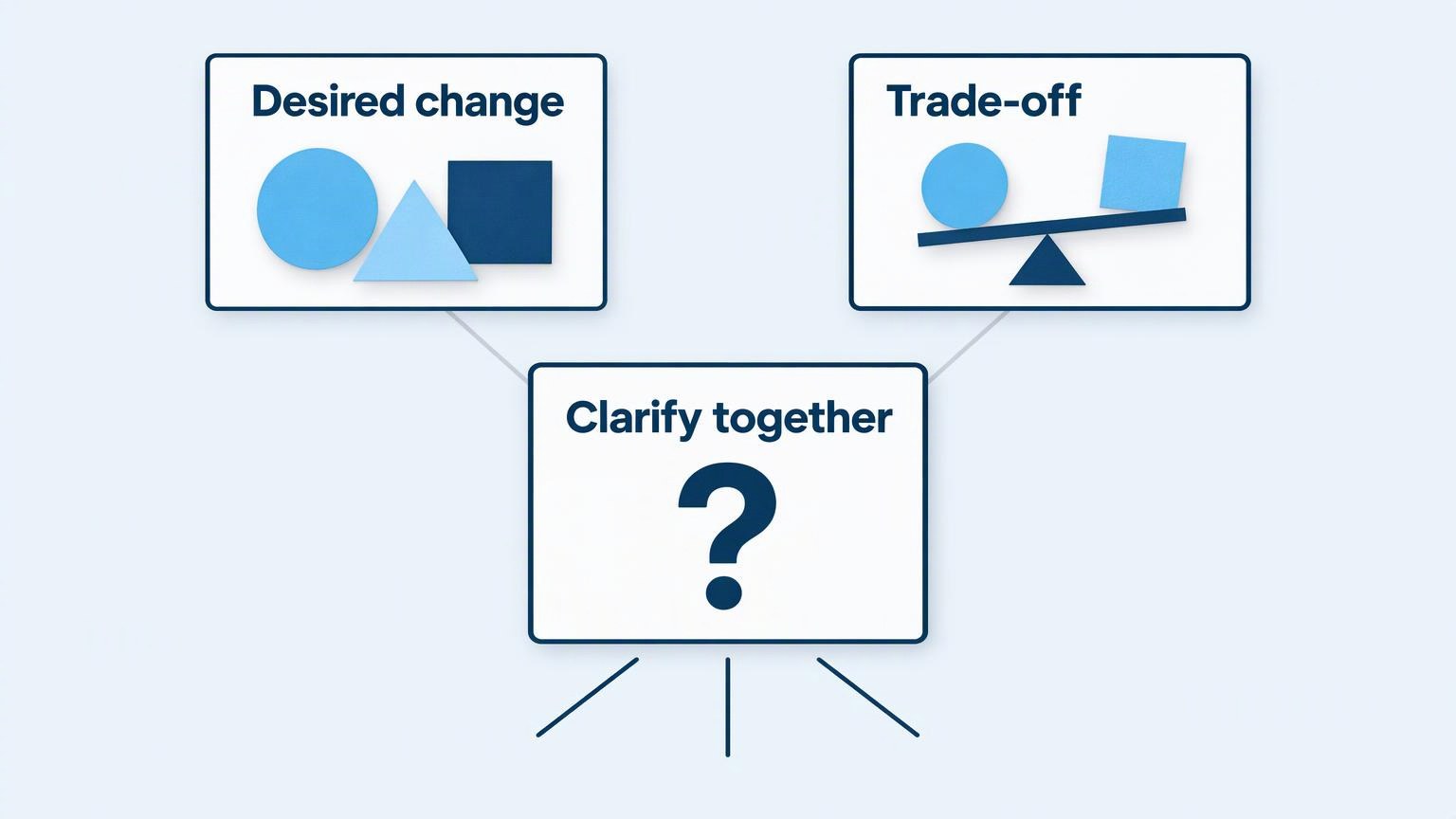
When priorities conflict, the next decision is usually what to clarify, not which procedure to choose. Keep both priorities visible so the clinical discussion addresses the trade-off you actually face.
Say you want a smoother abdominal outline, but you are also reluctant to accept a visible scar. You have read about liposuction and tummy tucks, yet you do not know what is causing the contour that concerns you.
Choosing liposuction from its name alone would not tell you what causes the contour or what change is achievable. Choosing a tummy tuck would also be premature because you have not discussed its proposed extent or scarring. Pausing research until a consultation is another option, especially if the trade-off could determine whether you proceed at all.
The reasoned next step is to ask the clinician to assess the concern and explain which options, if any, could address it alongside your scar preference. The outcome may be a narrower goal, a different option, more assessment or a decision not to pursue treatment. A clear goal remains useful even when it leads away from a procedure.
Look for an explanation that connects the plan to your goal
A useful clinical explanation connects the recommendation to your concern and explains its limits. Repeating your desired result does not establish why a proposed procedure is appropriate.
“This will give you the shape you want” leaves the reasoning unclear. A more useful explanation identifies what the clinician assessed, what the proposed work would address and what it would not address. It also distinguishes a recommendation from a preliminary possibility that still depends on examination or other assessment.
Keep alternatives in the discussion, including not proceeding. Ask how the proposed option relates to your main priority, what risks and trade-offs matter to that choice and which expectations should change. Eligibility, diagnosis and recovery advice belong with the qualified treating clinician, not a travel contact.
Identify who is giving the clinical recommendation. Verify any claimed professional registration or specialty certification with its issuing body; a marketing title is not that verification. Once there is a specific proposal, our care-plan comparison guide addresses the next stage rather than substituting for this explanation.
Prepare private notes about goals and practical limits
Prepare a short private note that separates your treatment questions from your ability to travel. These are materials for later appropriate discussions, not content for an initial general contact form.
- Main concern: what you notice, in ordinary language.
- Desired change: what would make a difference to you.
- Priority or trade-off: what you want explained before deciding.
- Unanswered clinical question: what assessment or explanation you still need.
- Practical limits: work commitments, available help and flexibility you can consider privately.
A fixed return-to-work commitment tells you something about feasibility, not about recovery. If the clinician's eventual follow-up plan cannot fit that commitment, the practical choices may include changing the travel window or postponing. Do not shorten the clinical plan to fit a reservation.
Flight timing and length of stay depend on the clinician and follow-up plan. A published recovery estimate is not individual clearance to fly. When those requirements become clear, our procedure-trip planning guide covers the separate travel-planning task.

Keep the next conversation within the appropriate scope
Use Hospitality Cancun's published travel and consultation-planning guidance for early research, then establish whether your inquiry falls within its current scope. A planning conversation is not a clinical assessment or a promise of an appointment.
Before submitting any information, clarify who will receive it and for what purpose. If either is unclear, do not submit. Once those details are clear, the first submission is limited to name and email, with optional contact-method preference. Your goal statement, travel details and questions do not belong in that first submission.
Ordinary travel details may be discussed later with the confirmed travel contact. Clinical goals and health information should be discussed through the appropriate provider process; diagnoses, scans and medical records belong only in a named treating-provider-confirmed secure channel. Do not put attachments, payment details or insurance identifiers in a general form.
Permission to reply to your requested inquiry, optional marketing and referral to a specifically named provider are separate choices. Agreeing to a reply does not mean agreeing to marketing or a referral.
Frequently Asked Questions
Do I need to decide on a size or measurement target?
You do not need a numerical target to prepare a useful goal. Describe the change you value and why it matters. If a size or measurement is important to you, keep it as a discussion point for the clinician, not as an assumed or guaranteed result.
Can I use a reference photo to explain a preference?
You can keep a reference privately to identify the feature you mean. Treat it as a communication aid, not evidence that the same result is achievable for you. Discuss whether images are useful through the named provider's process; do not attach them to a general first-contact submission.
What if my goal changes after learning more?
Revise your private notes rather than holding onto the original request just because you researched it first. Record what changed and what you still want explained. A revised goal can help the next clinical discussion stay focused and prevent an earlier assumption from being treated as your current preference.
Should a promotional price influence how I describe my goal?
Keep your goal independent of the offer. A price does not tell you whether the advertised scope addresses your concern or whether treatment is suitable. Once a clinician has explained a specific proposal, cost becomes a separate comparison task. Do not expand your request simply to match a promotion.
Can I prepare for a consultation without deciding to proceed?
Yes. Preparation can be limited to understanding your concern, the possible approaches and the trade-offs. You can use the discussion to decide whether further assessment interests you. Writing a goal statement is not a commitment to treatment, travel, a particular provider or a particular procedure.