
Consultation and Record Planning
Build a personal file that distinguishes the implants placed, the operation performed, and the instructions your treating clinician gives you.
A proposal describes intended treatment. Your personal records should help distinguish that plan from what was actually performed. Start record planning during consultation, rather than leaving it until you are packing to return home.
This guide gives you a practical request framework, not a guaranteed document package or a universal legal checklist. The treating provider must explain its record-access process, and the receiving clinician determines what is needed for your care.
Request complementary records, not just an implant card
Request device identification, a record of the completed operation, and written discharge or postoperative instructions. These serve different purposes, so one should not automatically stand in for another.
Ask whether the provider supplies an implant identification card or device labels, an operative report, and a discharge summary. Also ask which document contains your prescriptions, follow-up arrangements, and the treating team's contact instructions. These are suggested requests, not a claim that every facility issues documents under those names.
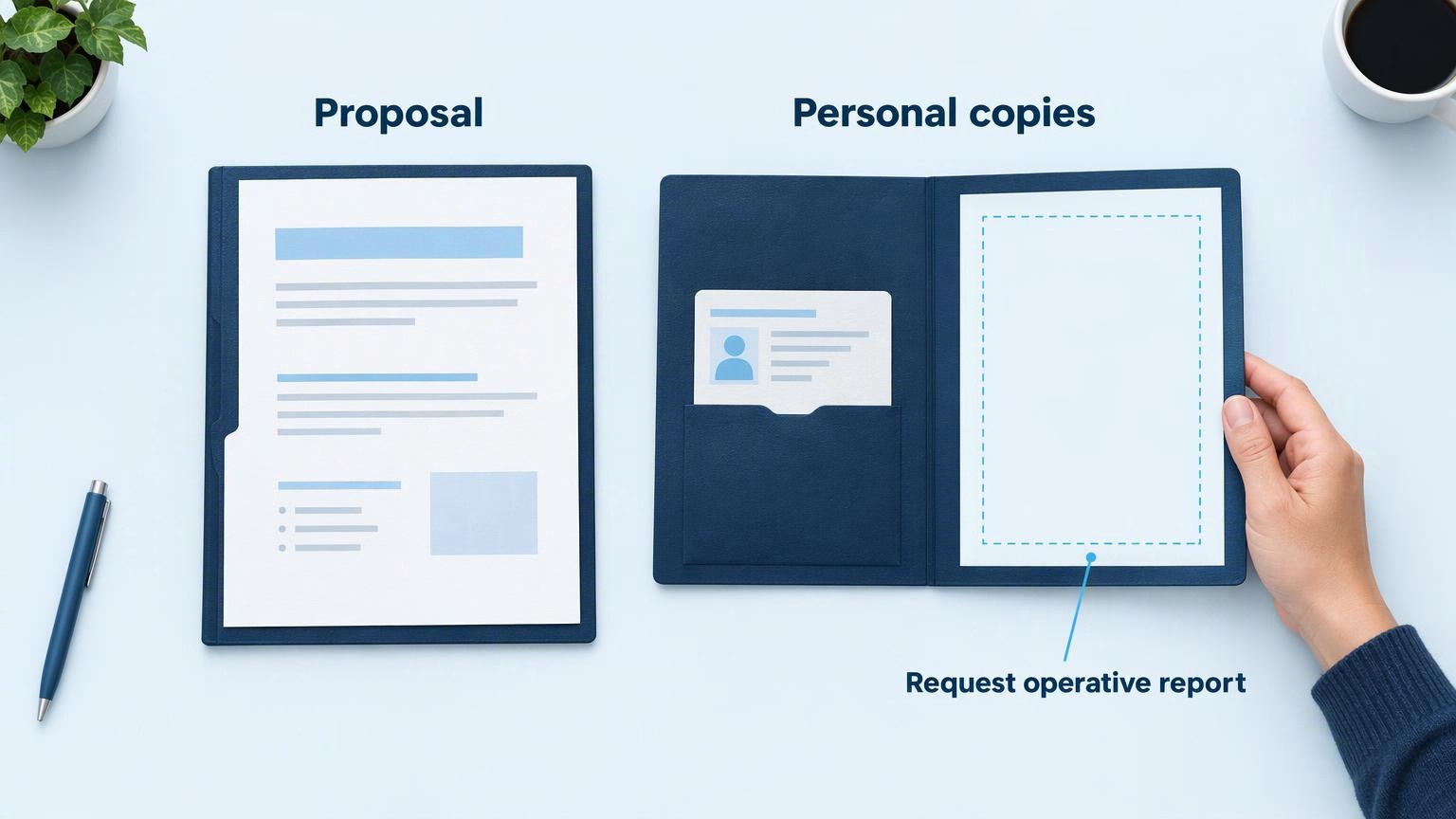
An implant card is the starting point for identifying a device. An operative report is the document to request for the surgeon's account of the operation. Instructions address what your treating team wants you to do afterward. A price quote or consultation proposal belongs in your planning file, but should not be treated as confirmation of the completed procedure.
Use the comparison below to prioritize the missing information in your own file. If a receiving clinician needs additional records, add those to the provider request.
Ask for the implants actually placed on each side
Ask for identification tied to the device actually implanted, with left and right sides clearly distinguished. A brand name in a proposal is not enough to resolve whether the final records identify the devices used.
PlacidWay's breast augmentation planning guide recommends discussing implant brand, model and size, and requesting patient information and device identification details. Its implant comparison guide also recommends requesting the manufacturer and exact model before surgery.
For your copies, ask the provider to identify the manufacturer, model or reference, size, and any serial or lot identifiers recorded for each implant. Have the provider explain unfamiliar labels rather than interpreting an abbreviation yourself. If a field is absent, ask whether it exists elsewhere in the clinical file.
Keep selection and documentation separate. Our guide to discussing implant choices addresses the consultation conversation; your final record request concerns what was placed.
| Your situation | Suitable record request | Reason | Remaining limitation |
|---|---|---|---|
| You only have a consultation proposal | Implant identification and documentation of the completed operation | Separates planned treatment from the devices and procedure actually recorded | The provider must explain availability and release steps |
| You have an implant card but no procedure account | Operative report | Addresses the operation rather than device identity alone | A clinician must interpret the report |
| You have procedure records but unclear follow-up instructions | Written discharge or postoperative instructions | Addresses the treating team's instructions and follow-up plan | These do not establish acceptance by a clinician at home |
| A clinician at home has requested specific documents | The requested records, alongside your personal copies | Matches the handoff to the receiving clinician's needs | Secure delivery and acceptance must be arranged separately |
Agree on a retrieval process with the treating provider
Arrange record access directly with the named treating provider before treatment. Establish how to obtain your own copies and how to retrieve anything that will not be available when you leave.
A useful process identifies the responsible records contact, the requested documents, and the delivery route. It should distinguish a personal-copy request from a transfer to another clinician. Do not assume the same authorization covers both.
Consolidate the variable details into this checklist:
- Which requested documents are available, and which require a separate request?
- Who handles the request, and what authorization does that provider require?
- What delivery method and expected timing apply?
- Are there copying or translation fees, and in which language are copies available?
- How can you request missing records after returning home?
If something will arrive later, retain the request reference and the provider's retrieval instructions. Record availability is an administrative issue; it does not determine your length of stay or clearance to fly. Those decisions remain with the qualified treating clinician and follow-up plan.
Review the copies for gaps before relying on them
Review delivered records against the information you requested, not simply the number of files received. A readable packet can still leave an important question unanswered.
Say you have a consultation proposal naming an implant model and an implant card after surgery. Your clinician at home asks for the operative report before reviewing the completed procedure. You could forward the proposal as though it describes the operation, or request the actual report.
The second choice follows because the proposal records an intention, while the clinician has asked for documentation of what happened. Keep the proposal, but label it separately. Ask the treating provider for the operative report and explain the document gap through its confirmed records process.
When the additional copy arrives, check that it belongs to you, opens correctly, includes all referenced pages, and is legible. Compare device details across the supplied documents. If entries differ or the side assignment is unclear, request provider clarification or a corrected copy. Do not resolve a discrepancy by choosing whichever entry matches your memory.
Arrange the home-provider handoff separately
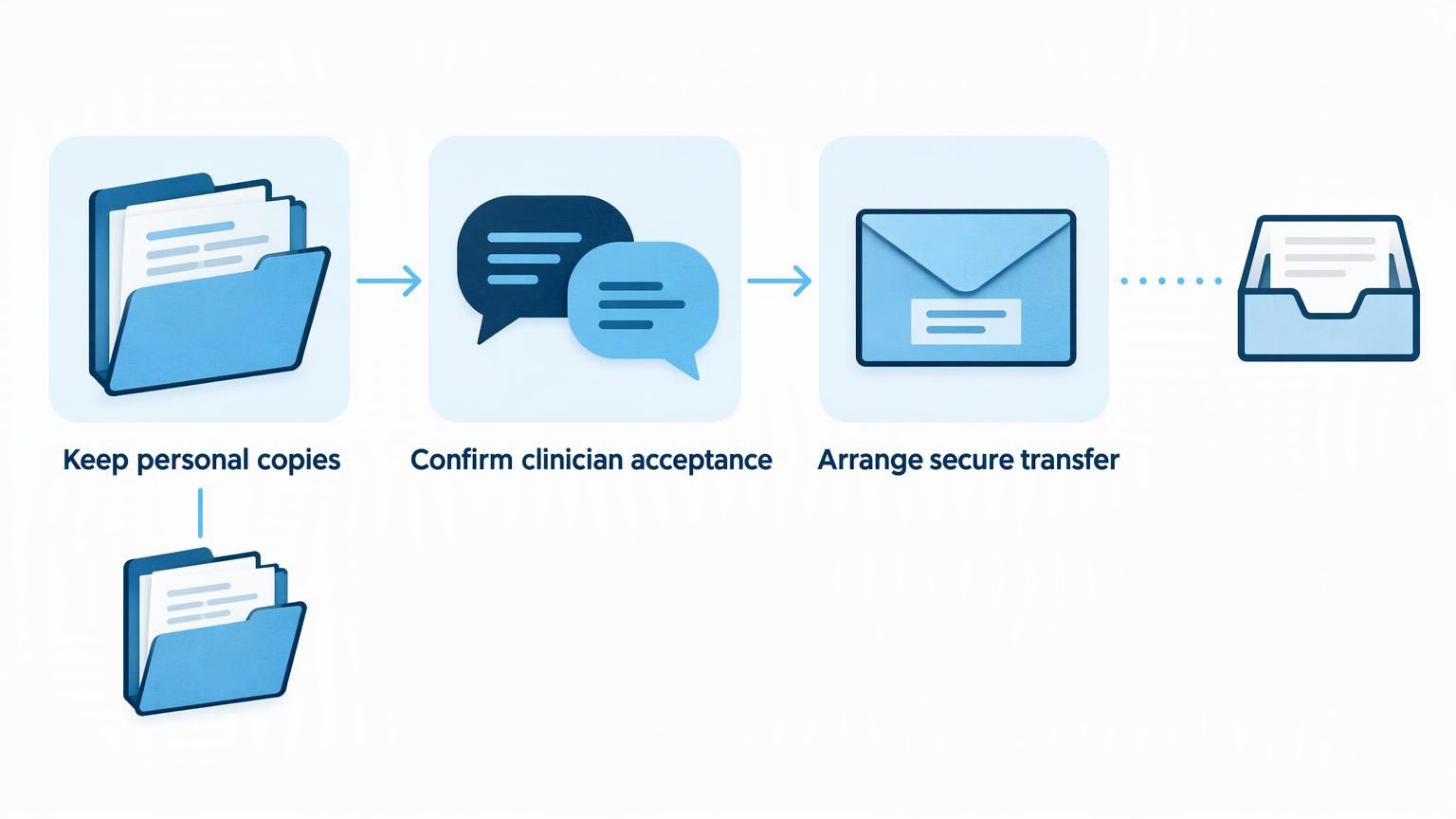
Ask a clinician at home whether they will review your records and provide the follow-up you are seeking. Possessing a complete file does not mean another clinician has accepted responsibility for your care.
Start with that acceptance question, then establish which documents the receiving clinician wants. Their answer changes your request: they may need more than the implant identification you keep for personal reference. Ask about language requirements before paying for translation, and retain the original-language documents alongside any translated copies.
Use the named provider-confirmed secure channel for clinical information. Clarify who receives the transfer, which records are being shared, and whether you or the treating provider will carry out that step. Keep your own accessible copies rather than relying only on a transfer between offices.
Record review is not a substitute for an examination or individual advice. Your clinician must interpret the information and determine appropriate care. For the separate discussion about follow-up responsibilities, see our breast augmentation aftercare questions.
Use destination information without treating it as record access
Review the Costamed destination information presented on Hospitality Cancun's homepage as part of your research. Direct questions about record availability and release to the relevant named provider; a destination page is not a clinical record or authorization to obtain one.
Before submitting any information through a general inquiry, clarify the recipient and purpose. Once those are clear, the first submission is limited to name and email, with an optional contact-method preference. Do not include a record request narrative, trip details, medical records, attachments, payment details, or insurance identifiers.
Ordinary travel details may be discussed later with the confirmed travel contact. Diagnoses, scans, and clinical records belong only in a named treating-provider-confirmed secure channel.
Keep permission to reply to your requested inquiry, optional marketing permission, and permission for referral to a specifically named provider separate. A requested reply does not constitute marketing consent. Opening the contact section does not itself establish a provider relationship or a record-transfer arrangement.
Frequently Asked Questions
Does an implant card establish warranty coverage?
Do not treat an identification card as a statement of warranty benefits. Ask for the applicable manufacturer documents and any enrollment requirements. Keep those separate from the clinical record. Device identity alone does not establish which costs, services, or circumstances a warranty covers.
Should I keep photographs of the documents?
A photograph can be a useful personal backup, but it should not replace a complete readable copy. Check that edges, labels, and every page are captured. Ask the receiving clinician which formats they accept, and retain the provider-issued files or paper copies rather than only cropped images.
What if I already returned home without any implant paperwork?
Contact the treating provider through its confirmed records process and identify the documents you are seeking. Ask how it verifies a request and delivers copies after departure. If you need clinical attention, tell the clinician what is unavailable; do not wait for paperwork before seeking needed care.
Does implant identification prove that a device was authorized for use?
Identification and regulatory authorization are different questions. A manufacturer or model entry tells you what the record identifies; it does not by itself establish authorization in Mexico or the United States. Resolve authorization questions with the relevant regulator and treating provider, rather than inferring approval from a card.
Can my companion request the records for me?
Do not assume that accompanying you gives someone access to your clinical file. Ask the provider what authorization it requires for another person to request or receive copies. Define the documents and recipient through that process, and keep this permission separate from travel coordination or marketing choices.