

Consultation and Travel Planning
Use an appointment-led worksheet to turn open travel questions into decisions about transportation, lodging and your return home.
A useful itinerary distinguishes confirmed appointments from possible travel bookings and clinical questions that could change your plans.
Keep the worksheet below for your own use. It shows what you can decide now, which answers you still need and who can provide them.
Plan around a consultation or an agreed treatment schedule
Plan a consultation-only visit when treatment has not been agreed. Plan a treatment trip when the qualified treating clinician has explained the intended care and follow-up schedule.
For a consultation, record the confirmed appointment but leave any proposed procedure unconfirmed. Assessment may lead to no treatment, a different approach or further evaluation. A hotel reservation should not create an expectation that treatment will happen.
For agreed treatment, record required appointments and in-person follow-up. Flight timing and stay length depend on that plan and the clinician’s advice, not a generic recovery estimate.
Our guide to choosing care before vacation helps establish your trip’s priority. Here, translate planned care into an itinerary.
Build a worksheet that separates facts from assumptions
For each itinerary item, record its status, who can resolve it and which travel decision depends on it. Label entries confirmed, awaiting an answer or optional.
Copy these prompts into a private document:
- Appointments: consultation or agreed treatment, date, time, named clinician, exact location, required follow-up and confirmation reference.
- Transportation: arrival and departure options, appointment journeys, pickup arrangements and assistance specified by the care plan.
- Accommodation: proposed property, room requirements, check-in, checkout, extension options and change terms.
- Open decisions: missing answer, responsible contact, next action and affected reservation.
- Optional activities: ideas kept separate from required appointments and clinical advice.
For example, “follow-up location not confirmed” leads to “obtain the address from the provider before choosing lodging.” When the answer arrives, update the lodging and transport entries rather than merely crossing off the question.
| Approach | Choose when | Reason | Trade-off |
|---|---|---|---|
| Fixed return booking | The provider has resolved the required schedule and the departure fits it. | You can plan around a settled appointment sequence. | Later changes remain subject to the ticket’s terms. |
| Booking with suitable change terms | Another visit remains possible and you can accommodate a later departure. | You retain a route for adjusting the itinerary. | Flexibility may cost more; changes depend on the actual fare terms. |
| Wait to purchase the return | You prefer not to select a departure before the schedule is clearer. | You avoid committing to an unsupported end date. | Later availability and cost remain uncertain. |
Search transportation by address, then compare return options
Start transportation research with confirmed care addresses and proposed lodging addresses. Compare the journeys you need, then choose return-booking terms according to how much follow-up remains undecided.
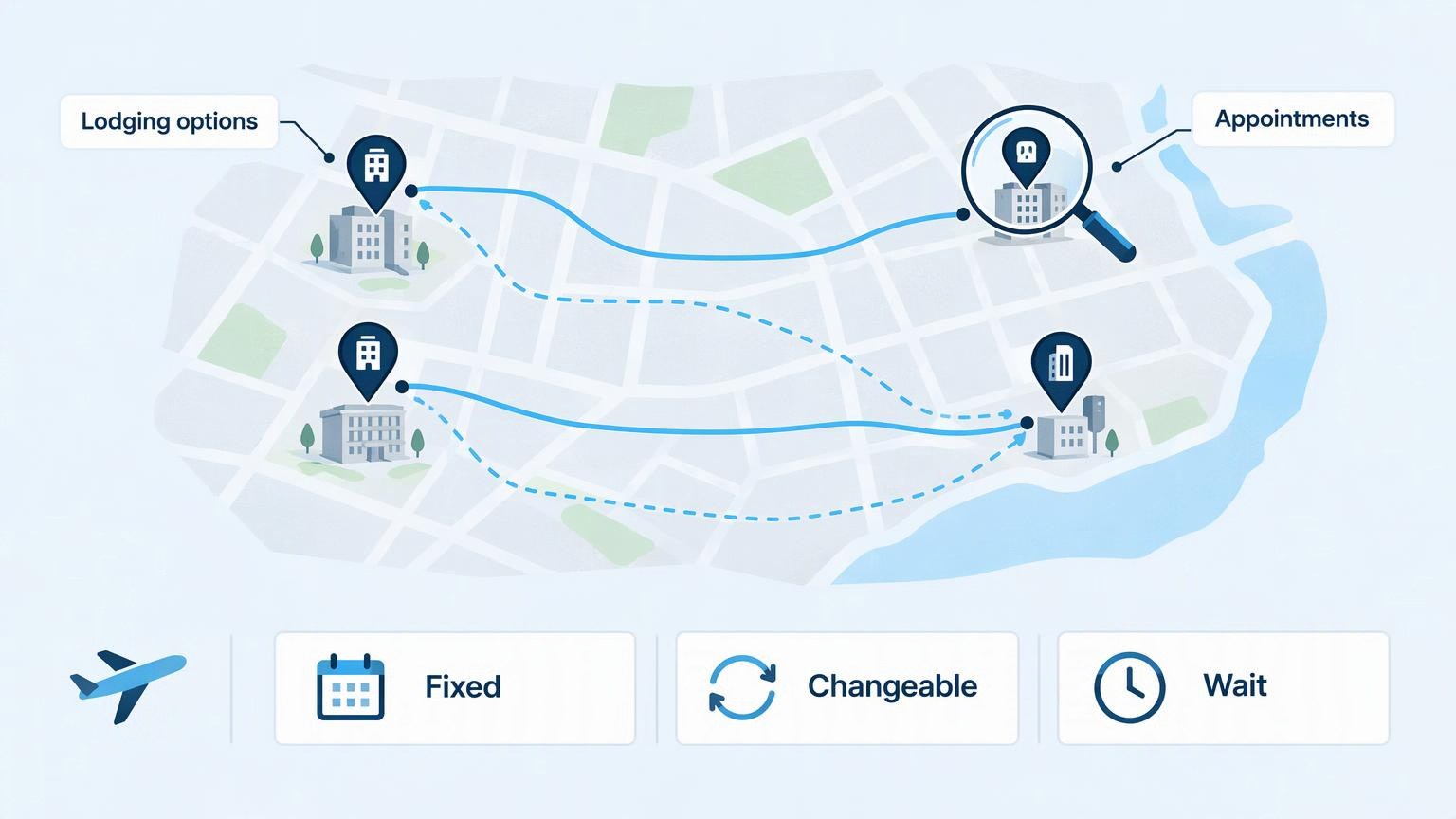
First, locate each appointment rather than assuming every visit uses the same facility. Next, map journeys between those addresses and shortlisted accommodation. Use current route information for the appointment time, not a destination-wide description of convenience.
Compare transport offers by pickup and drop-off locations, service scope and change arrangements. Ordinary transport differs from assistance required by the care plan. A “transfer” label does not establish clinical support.
The table compares return-flight approaches. Flexible terms can accommodate another visit, but are not clearance to fly. Waiting preserves scheduling freedom while leaving availability and cost uncertain.
Once the provider clarifies follow-up timing, update the worksheet and select a departure that fits the schedule and the clinician’s travel advice.
Choose lodging for the stay and its possible changes
Compare lodging by appointment locations, practical room needs and the consequences of changing checkout, not nightly rate alone.
Assess journeys from each property to the care addresses, then compare room access and other features you need. Clinical accommodation or assistance requirements come from the treating clinician; hotel availability is not a clinical recommendation.
Record cancellation, refund and change terms, extension conditions and who handles amendments. An extension could require a new reservation or room move; it is not guaranteed.
A clinician-directed extra night remains a lodging service. The clinical reason establishes neither who pays nor whether it is included. Payment responsibility and applicable hotel terms depend on the written arrangement.
Insurance is separate: supplier terms determine booking consequences, while policy coverage and claim conditions determine whether an eligible expense may be reimbursed. Neither replaces the other.
Work through an open follow-up visit
Suppose your Cancún consultation is confirmed, but the clinician will decide during assessment whether another in-person visit is needed. Your companion has a fixed departure. Record the consultation as confirmed and the additional visit as awaiting assessment.
Ask the provider what can be known about follow-up before travel. Research lodging and appointment transport using the confirmed address, without adding an unagreed procedure.
A fixed return may suit you once the provider clarifies the schedule and the departure fits it. Suitable change terms may be preferable while another visit remains possible. Waiting leaves the later flight purchase uncertain.
If changeable transport and lodging fit your budget, they may let you plan without assuming an end date. If you cannot accommodate a later departure, reconsider visit timing rather than assuming follow-up can be skipped.
Your companion’s departure is a separate logistics decision. If the care plan requires assistance, establish how to meet it. Otherwise, the departure alone creates no need for clinical support; record only resulting transport or lodging changes.

Keep the clinical handoff separate from a planning inquiry
The treating clinician handles suitability, treatment, clinical scheduling, follow-up and travel advice after care. At Hospitality Cancun, we publish travel and consultation-planning guidance; an inquiry does not confirm an appointment.
Identify the named clinician and facility and independently verify relevant credentials before relying on a care schedule. See our guide to evaluating medical-travel options.
Before submitting any information, clarify the recipient and purpose. The first submission then allows only name, email and optional contact-method preference. No trip details, narrative or attachments. Discuss ordinary travel details later with the confirmed travel contact.
Permission to reply, optional marketing and referral to a specifically named provider are separate choices. A reply is not marketing consent. Diagnoses, scans and clinical records belong only in a named provider-confirmed secure channel. Never send payment details or insurance identifiers through a general inquiry.
Frequently Asked Questions
Can a free afternoon automatically become sightseeing time?
No. An empty calendar slot means only that nothing is recorded there. Keep sightseeing optional and follow the clinician’s advice before committing. During consultation-only travel, leaving space lets you accommodate further assessment without having to rearrange a tightly booked leisure schedule.
Should I keep booking references and medical records in the same worksheet?
Keep the worksheet focused on planning status and practical arrangements. Booking references help you locate travel confirmations, but do not bundle diagnoses or scans into a general inquiry. Clinical records belong only in the secure channel confirmed by the specifically named provider.
What if appointment times arrive from different contacts?
Record who supplied each time and whether it is tentative or confirmed. Resolve conflicting appointment details with the treating provider before changing travel bookings. A transport supplier’s pickup confirmation establishes its travel arrangement, not confirmation of the clinical appointment it serves.
Does the word “package” mean all my travel needs are included?
No. Compare written scope, separating care, facility services, lodging and transportation and identifying who delivers each. An included stay does not establish extension terms; an included transfer does not establish required clinical assistance. Mark unspecified items as needing an answer before relying on them.
When should I update the worksheet after making reservations?
Update it whenever an appointment, location, follow-up requirement or booking changes. Replace tentative details with current confirmations and revisit linked decisions. For example, a different follow-up location can change appointment transport even when your flight and hotel reservations stay exactly the same.