
Continuity of Care
Build a record-sharing plan that connects your treating provider with a home clinician who has agreed to the next step.
A useful handoff gives the receiving clinician context without making you reconstruct the visit from memory. It also identifies unfinished work, such as a result expected later. Start while comparing care plans, then update the arrangement to reflect the care actually provided. Here, home care means follow-up with a clinician after your return, not a promise of in-home nursing.
Start with the home clinician's agreed role
Ask the clinician you hope will follow you at home whether they can accept the proposed follow-up task. Do this before treating that part of the plan as arranged. An existing patient relationship does not, by itself, answer whether the clinician will provide the particular care being proposed.
First, have the treating provider describe what is expected after your return. Then discuss that proposed task with your home clinician through their established clinical communication process. Separate reviewing the visit summary from performing an examination, ordering tests or continuing treatment. Agreement to receive a file is narrower than agreement to take responsibility for those activities.
If the home clinician needs more information before deciding, ask what would allow them to assess the request. That answer becomes the starting point for your records request. If they cannot accept the role, return to the treating provider to discuss a different follow-up arrangement rather than assuming a document will resolve the issue.
Request a care summary tailored to the next clinical step
Request a provider-prepared summary of the care actually delivered, along with the documents your receiving clinician identifies as relevant. Use the proposed care plan for advance discussion, but do not mistake it for the final account of your visit.
Bring this compact checklist to the treating provider through the provider's confirmed clinical process:
- Visit summary: reason for the visit, assessment, care provided, dates and responsible clinician.
- Medication information: the provider's current list and written instructions, including any changes they made.
- Follow-up instructions: the proposed next clinical steps and provider-issued guidance for routine questions and urgent concerns.
- Supporting records: relevant reports, test results, images or procedure records requested by the receiving clinician.
- Unfinished work: pending results, expected delivery arrangements and the clinical contact responsible for addressing them.
Ask the receiving office about language and file requirements before the final documents are prepared. For dental care, our guide to dental implant records offers a more focused preparation topic. Let the clinicians decide which details matter to your handoff.
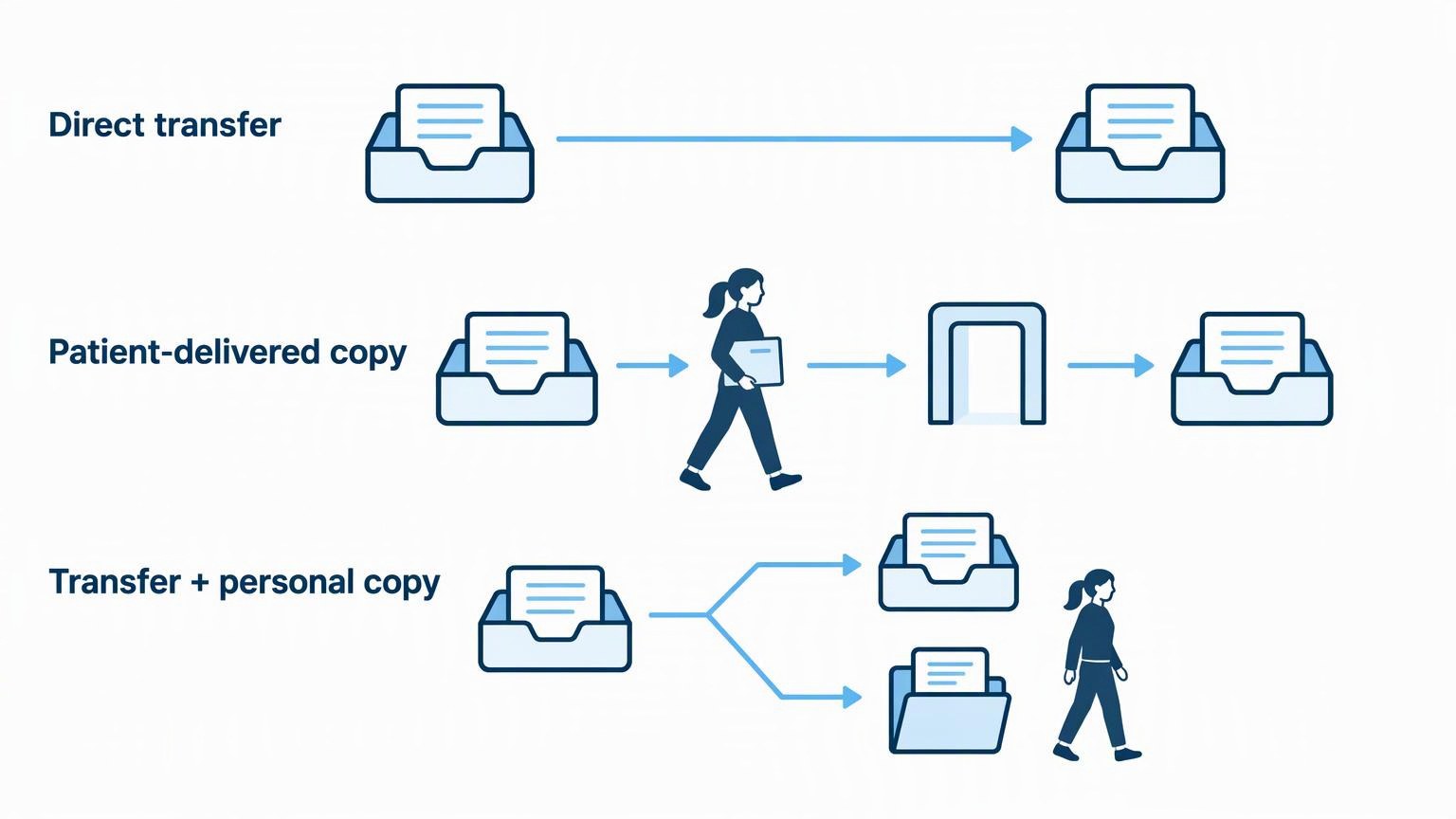
| Route | Suitable When | Reason | Trade-Off |
|---|---|---|---|
| Direct provider transfer | Both offices agree on the sender and receiving channel. | Assigns delivery to the provider offices. | You still need receipt confirmation and your own copy arrangements. |
| Patient-delivered copy | The receiving office accepts your upload through its confirmed secure channel. | Lets you carry out an explicitly assigned delivery step. | You must obtain and deliver the requested files. |
| Direct transfer plus personal copy | Both providers support transfer and you also want a copy. | Separates clinical delivery from your personal access. | Updated documents need clear dates to avoid version confusion. |
Assign the sender, recipient and record-transfer route
Ask the treating provider who handles record preparation and release. Ask the home provider which named recipient and secure channel should receive them. Then establish who will complete the transfer rather than leaving both offices expecting you to act.
The suitable route depends on what both providers can support. Direct transfer may suit an arrangement in which their offices agree to communicate. Patient-delivered copies may suit a receiving office that instructs you to upload records through its confirmed secure channel. A combination can provide a personal copy alongside the clinical transfer, but it creates versions to track.
Clarify any authorization the sending provider requires for the particular release. Do not assume that permission for an introduction authorizes sharing the full clinical file. Diagnoses, scans and clinical records belong only in a named provider-confirmed secure channel, not a general travel inquiry.
Use the comparison below to discuss a route, not to assume a provider offers it. Whichever route you choose, preserve the provider-issued documents rather than rewriting clinical content yourself.
Work through a partly arranged dental-care handoff
When a home clinician's acceptance depends on additional records, resolve that dependency before counting the follow-up as confirmed. A planned appointment and a promised summary may still leave the receiving clinician without what they need.
Say you are considering dental care in Mexico and want your regular dentist to conduct the proposed review after you return. Your dentist says they need the treating dentist's procedure summary and relevant images before deciding whether to accept that role. The proposed arrangement mentions a summary but says nothing about image delivery.
You could plan to collect whatever documents are available at departure, or settle the record requirements in advance. The second route addresses the actual uncertainty: whether the home dentist will have enough information to evaluate the follow-up request.
Ask the treating dentist to identify who supplies the requested documents. Have your home dentist confirm the recipient and usable format. If direct transfer is unavailable, ask whether patient delivery through the receiving office's secure channel is acceptable. Then return to the acceptance question. The outcome is not automatic approval; it is a clearer decision about whether this handoff can support the proposed next step.
Close the loop on receipt and pending results
Count the records step as complete when the receiving office confirms that the intended documents arrived and are usable. Separately confirm that the agreed follow-up arrangement still stands. “Sent” does not establish either outcome.
Keep a private record of the document titles, their dates, the sender and the receiving contact. Use it to resolve a missing report or distinguish an updated summary from an earlier version. Ask the receiving office to identify anything missing rather than interpreting an upload acknowledgment as clinical review.
For a result that will arrive later, establish who will receive it, who will address it clinically and how you will be informed. The first record transfer should not leave that later task ownerless.
Keep provider-issued instructions accessible during the journey. A record-delivery problem and a new medical concern need different responses; do not wait for paperwork to resolve an urgent concern. For the separate travel decision, see our returning-home planning guide. Flight timing remains a question for the treating clinician and follow-up plan.

Keep destination planning separate from clinical handoff
Confirm clinical summaries, record release and follow-up responsibility directly with the relevant care providers. We publish travel and consultation-planning guidance at Hospitality Cancun; that guidance helps you organize decisions but does not establish a receiving clinician's acceptance.
If you use our contact section for planning interest, clarify who receives the inquiry and its purpose before submitting any information. The first submission allows only name, email and optional contact-method preference. Do not include a handoff request, trip details, narrative, attachments, clinical records, payment details or insurance identifiers.
Ordinary travel details may be discussed later with the confirmed travel contact. Clinical information remains in the named provider-confirmed secure channel. Permission to respond to your requested inquiry, optional marketing and referral to a specifically named provider are separate choices. A requested reply is not marketing consent.
Review destination-planning guidance with your handoff requirements in mind, but have the providers settle the clinical arrangements.
Frequently Asked Questions
Is a bill or payment receipt enough for the home clinician?
Do not use a billing document as a substitute for the requested clinical summary. Ask the receiving clinician which care information they need and request it from the treating provider. Keep financial documents separate; including them in a record bundle does not establish an appropriate collection route.
What if my visit is only a consultation?
Ask for a consultation summary reflecting what was discussed, the provider's assessment and any proposed next steps. Tell the receiving clinician that treatment was not performed. They can identify which supporting results are relevant and whether any home follow-up is needed; do not create that role yourself.
Should I translate the records myself?
Ask the receiving office which language it accepts and what translation arrangements it requires. Do not assume your own translation will satisfy its needs. Preserve the original provider-issued records alongside any requested translation, and direct unclear clinical wording to the issuing provider rather than trying to resolve it yourself.
Can a companion receive the records for me?
Ask the provider about its authorization process for that specific person and purpose. Do not assume that accompanying you gives someone permission to receive clinical records. Agree on the permitted role and transfer channel directly with the provider, while keeping the home clinician's receipt and follow-up responsibilities separate.
What if I notice an error in the summary?
Contact the issuing provider through its confirmed clinical process and identify the item you believe needs correction. Ask how an amended document will be supplied and sent to the receiving clinician. Do not edit the provider's original yourself or silently replace a file without identifying the updated version.