

Pre-Travel Decisions
Compare what prospective providers need, who evaluates it and what their response lets you decide before you commit to medical travel.
Screening is worth comparing separately from prices, provider profiles and itineraries. A detailed request for information can still leave you unsure whether anyone has evaluated it. Conversely, a shorter request may be appropriate for a particular consultation. The useful distinction is what the process establishes for your next decision, not how impressive the paperwork looks.
Choose assessment before travel, a consultation visit or a pause
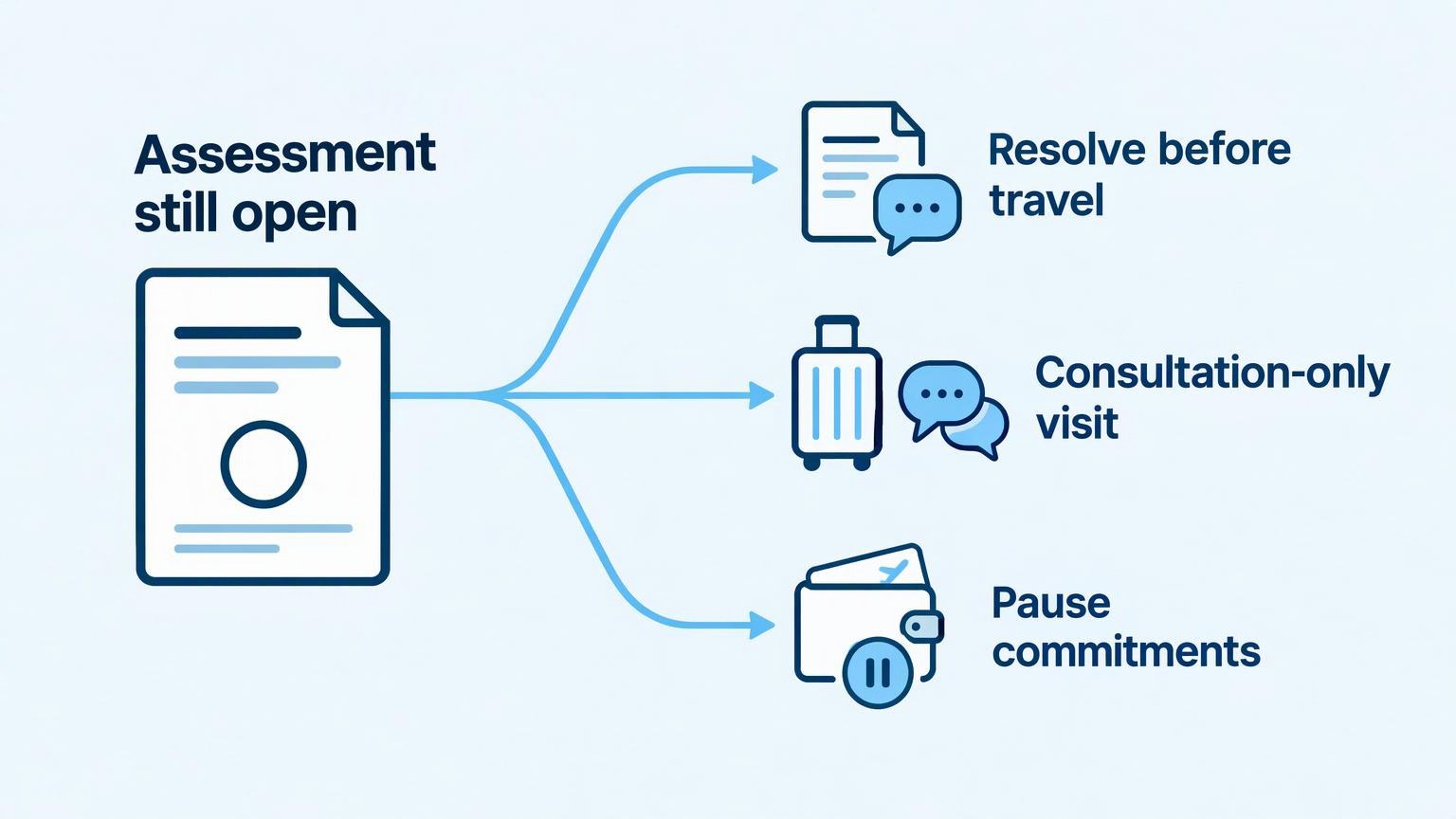
Seek a provider-confirmed assessment before departure when it can answer the questions needed for your next step. If the provider requires an examination in person, evaluate a consultation-only visit on that basis. Pause when the purpose of travel or the outstanding assessment remains unclear.
Start with the prospective provider's own consultation information. Look for how an assessment begins, whether a clinician reviews information before arrival and which decisions require an in-person visit. If the website only describes treatments, it has not answered those screening questions.
Compare the proposed routes without assuming that remote review is definitive or that an in-person consultation commits you to treatment. The key output is a clear explanation of what can be decided now and what cannot.
A consultation-only trip may be a reasonable choice if you are willing to travel for assessment without an expectation of treatment. If treatment during that visit is essential to your plans, wait until the clinician has assessed suitability rather than treating the consultation as approval.
Turn information requests into a usable comparison
Compare the specificity of each provider's requirements, not the number of records or tests requested. There is no test list or record-age cutoff in this guide that establishes your eligibility; obtain those requirements from the prospective treating provider.
Prepare a private worksheet with these columns:
- Requested item: the exact record, medication detail or test the provider specifies.
- Acceptable version: required date range, format and language.
- Purpose: the assessment question it helps the clinician address.
- Dependency: whether review can begin without it or must wait.
A request for “recent results” is not specific enough to arrange testing confidently. Obtain the provider's definition of recent and whether existing results are acceptable before scheduling anything new. Do not infer that another provider will accept the same material.
For dental care, our dental implant records guide is a related planning resource. The provider's own request still determines what is needed for your assessment.
| Situation | Suitable Route | Reason | Trade-Off |
|---|---|---|---|
| The provider offers review before departure | Provider-confirmed remote assessment | Clarifies what can be decided before travel | An examination may still be required |
| The provider needs an in-person examination | Consultation-only visit | Makes assessment the purpose of the trip | Treatment may not follow during that visit |
| Reviewer, requirements or visit purpose remain unclear | Pause and resolve the missing decision | Avoids treating scheduling as clinical approval | Delays travel commitments |
Identify the clinical reviewer and interpret the response
Identify the clinician responsible for assessment and distinguish their conclusions from administrative messages. Establish the clinician's identity and verify relevant credentials with the issuing bodies; a company name or coordinator's signature does not identify the clinical decision-maker.
Read each response for what it actually establishes. “Documents received” acknowledges delivery. “More information needed” leaves the review incomplete. A clinician's recommendation for a consultation identifies a next step, but does not necessarily establish suitability for treatment.
When the provider gives a clinical conclusion, retain its conditions: what was reviewed, what remains to be assessed and whether an examination is still required. Do not turn a conditional response into an unconditional travel decision.
Also distinguish responsiveness from completeness. A prompt acknowledgment is useful administratively, but your comparison should focus on whether the clinical question was answered. If the reviewer or meaning of the result is unclear, mark that information as missing rather than labeling the process complete.

Let an open review change the plan
A clinical review that is still incomplete should change what you commit to, even if a treatment slot is available. Base your choice on what the clinician still needs to assess rather than the appeal of a proposed date.
Say you have limited time away from work and are comparing providers for care in Mexico. One response offers a reserved treatment slot without explaining whether a clinician has reviewed your information. Another identifies the reviewer and says an additional assessment is needed before recommending the next step.
The first response gives scheduling information, but not the missing clinical conclusion. The second is more useful for screening because it tells you why the decision remains open. Neither response yet supports treating the trip as confirmed treatment.
Your next move is to resolve the assessment requirement directly with the provider. If it can be addressed before departure, reassess the plan afterward. If an examination in person is required, consider whether a consultation-only trip meets your goals. If your leave only works when treatment is certain, pause rather than force an incomplete review into that window.
Keep screening current and follow-up separate from reservations
Before advancing the plan, resolve how the provider will handle changed information and what follow-up the proposed care requires. An earlier review should not be treated as answering questions that arose afterward.
Keep a dated private record of the provider's conclusion and its conditions. If your health information or medication details change, use the provider's clinical communication process to determine whether reassessment is needed. Do not decide yourself that the change is irrelevant or alter medication to match an earlier plan.
Follow-up is another clinical dependency: establish who is responsible, how questions after returning home would be handled and what remains to be arranged. Flight timing and length of stay depend on the clinician and follow-up plan, not a generic recovery-day estimate.
Changing a flight or hotel reservation is a separate logistics task, not clinical reassessment. Our guide to keeping care separate from vacation offers a related planning perspective. Keep both decisions visible without allowing an itinerary to answer a medical question.
Send screening questions to the treating provider
Confirm screening requirements, eligibility and clinical next steps directly with the prospective treating provider. A general travel inquiry is not a clinical assessment, and a website contact link does not identify who will evaluate medical information.
Before submitting any information through Hospitality Cancun's contact section, clarify the recipient and purpose. The first submission is limited to name and email, with optional contact-method preference. Do not include a narrative, travel details, diagnoses, records, scans, insurance numbers, payment details or attachments.
Ordinary travel details may be discussed later with the confirmed travel contact after recipient and purpose are clear. Clinical information belongs only in a named treating-provider-confirmed secure channel. Excluding financial or insurance identifiers from a general inquiry does not establish where they should later be sent.
Keep three permissions separate: responding to your requested inquiry, optional marketing and referral to a specifically named provider. Permission for a reply is not permission for marketing or a referral. Use the website for further reading while leaving clinical requirements with the provider responsible for assessment.
Frequently Asked Questions
Does requesting more tests mean a provider's screening is better?
Not by itself. A longer list does not establish a more appropriate assessment. Compare whether the provider explains the requested information and how it supports the review. Leave decisions about which tests are clinically necessary to the qualified clinician rather than ordering extra tests to make an application look complete.
Can I reuse the same records when comparing providers?
You can organize existing records privately, but do not assume every provider accepts the same versions. Requirements may differ in date range, format or language. Have each prospective provider specify what it accepts, then use its confirmed clinical channel rather than distributing a records bundle through general inquiry forms.
Should I arrange translations before a provider reviews my documents?
First establish the provider's language and translation requirements. Avoid paying for a format it has not agreed to accept. If translation is required, obtain its instructions about which documents need translation and what form is acceptable. This guide does not establish a universal translation rule for care in Mexico.
Does a referral mean I have been accepted for treatment?
No. Treat a referral as an introduction, not a clinical conclusion. The named provider still needs to explain its assessment process and the meaning of any response. Separately decide whether you permit that specific referral; agreeing to receive an inquiry reply does not authorize a provider introduction.
Can I decline treatment after traveling for a consultation?
Keep the decision about treatment separate from the decision to attend a consultation. Travel interest is not treatment consent. Obtain the provider's explanation of the proposed care before deciding. Any contractual consequences of changing or canceling purchased services depend on the applicable written terms; this guide does not establish refund rights.