

Travel and Consultation Planning
Turn patient reviews and provider claims into evidence you can use before making travel commitments.
A detailed review can make an unfamiliar provider feel easier to evaluate. But an account of helpful communication or a comfortable hotel answers a different question from whether a surgeon's credentials check out. Your goal is to connect each claim to the evidence that can support it, then decide what travel commitment that evidence justifies.
Read reviews for specific experiences, not clinical proof
Reviews are useful for identifying experiences to investigate. They do not establish your medical suitability, a provider's qualifications or the terms you would purchase. Read the details before giving weight to the rating.
Start by identifying what the reviewer actually describes. Was it rhinoplasty, another procedure or only an inquiry? Does the account name the surgeon and distinguish the operating facility from the hotel? A broad endorsement of a package may leave those distinctions unanswered.
- Timing: Does the review describe an initial consultation, an early postoperative experience or later follow-up?
- Communication: What happened when the person needed an explanation or a response?
- Responsibility: Was the praise about clinical care, a driver, lodging or a planning contact?
- Context: Is a promotional relationship disclosed, and can you distinguish firsthand experience from repeated marketing language?
Turn a specific observation into a direct question. If someone praises follow-up, ask the treating provider what follow-up your proposal includes. If someone describes a refund, consult your own supplier's terms. Neither account transfers automatically to your arrangement.
Verify the person and facility behind credential claims
Begin with the surgeon's full professional name, the exact qualification being claimed and the name of the proposed operating facility. These identifiers let you investigate a claim without confusing a brand, coordinator or hotel with the person delivering care.
Ask the provider for relevant registration or certification identifiers and the organization that issued them. Then seek confirmation from that organization through its own independently located information, rather than treating a badge image or a provider-hosted profile as confirmation.
Compare the name, specialty, credential status and any stated validity conditions. If the information differs from the proposal, resolve the mismatch before paying. A credential attached to someone else does not verify the surgeon named for your operation.
Apply the same discipline to facility claims: identify the actual operating location, the claimed accreditation and its issuing body. A surgeon's qualification and a facility's accreditation are different claims. Neither a review nor a package label supplies the missing connection. This check establishes what a claim refers to, not a guarantee of an individual outcome.
| Information available | Useful next action | What it does not establish |
|---|---|---|
| Detailed review of communication | Use the described experience to frame consultation questions | Qualifications or your treatment suitability |
| Review praising a hotel or transfer | Identify the supplier and compare your travel terms | Clinical care quality or contractual inclusions |
| Provider credential claim | Match the named person or facility with the issuing body's information | An individual outcome guarantee |
| Individual care plan and supplier terms | Compare the clinical schedule with travel commitments | Insurance coverage unless the policy confirms it |

Get clinician answers that make a travel schedule meaningful
A useful travel schedule follows the treating clinician's assessment and follow-up plan. It should not begin with a reviewer's stay length or a flight deal. Eligibility, diagnosis, treatment suitability and recovery advice belong with that clinician.
Prepare a focused agenda for the consultation:
- What can the proposed procedure address, what are its limits, and what alternatives should I consider?
- How will appearance goals and any breathing concerns be evaluated?
- What risks and uncertainties apply to the proposed approach?
- Which assessments and follow-up visits must happen in person?
- Who handles urgent clinical concerns during the stay and after returning home?
- How will readiness for return travel be assessed, and what could change the plan?
The answers should distinguish a preliminary estimate from an agreed schedule and explain what still requires an examination. A suggested departure date is not the same as individual clearance to fly.
For the financial questions that follow a consultation, use our guide to questions before requesting a rhinoplasty quote as a separate planning reference.
Separate care responsibilities from travel promises
Ask each responsible supplier to identify its services and contractual obligations during the appropriate consultation or later planning discussion. Praise for lodging or transport does not verify surgical care, and praise for a surgeon does not establish hotel cancellation rights.
For any bundled offer, distinguish the proposed procedure, facility services, anesthesia, follow-up, lodging and transport. Identify who supplies each item, who receives payment and which written terms apply. An inclusion should describe a service, not merely use a broad package label.
Changes need the same separation. If a clinician advises a longer stay, an extra hotel night remains a travel charge. The clinical reason does not establish who pays, whether the night is included or which hotel change terms apply. Those answers depend on the applicable contracts.
Supplier cancellation, refund and change terms govern the reservation consequences. Insurance coverage is separate and depends on policy conditions; it is not a substitute for those terms. Our care and travel plan comparison guide develops that distinction further.
Let open timing change the booking decision
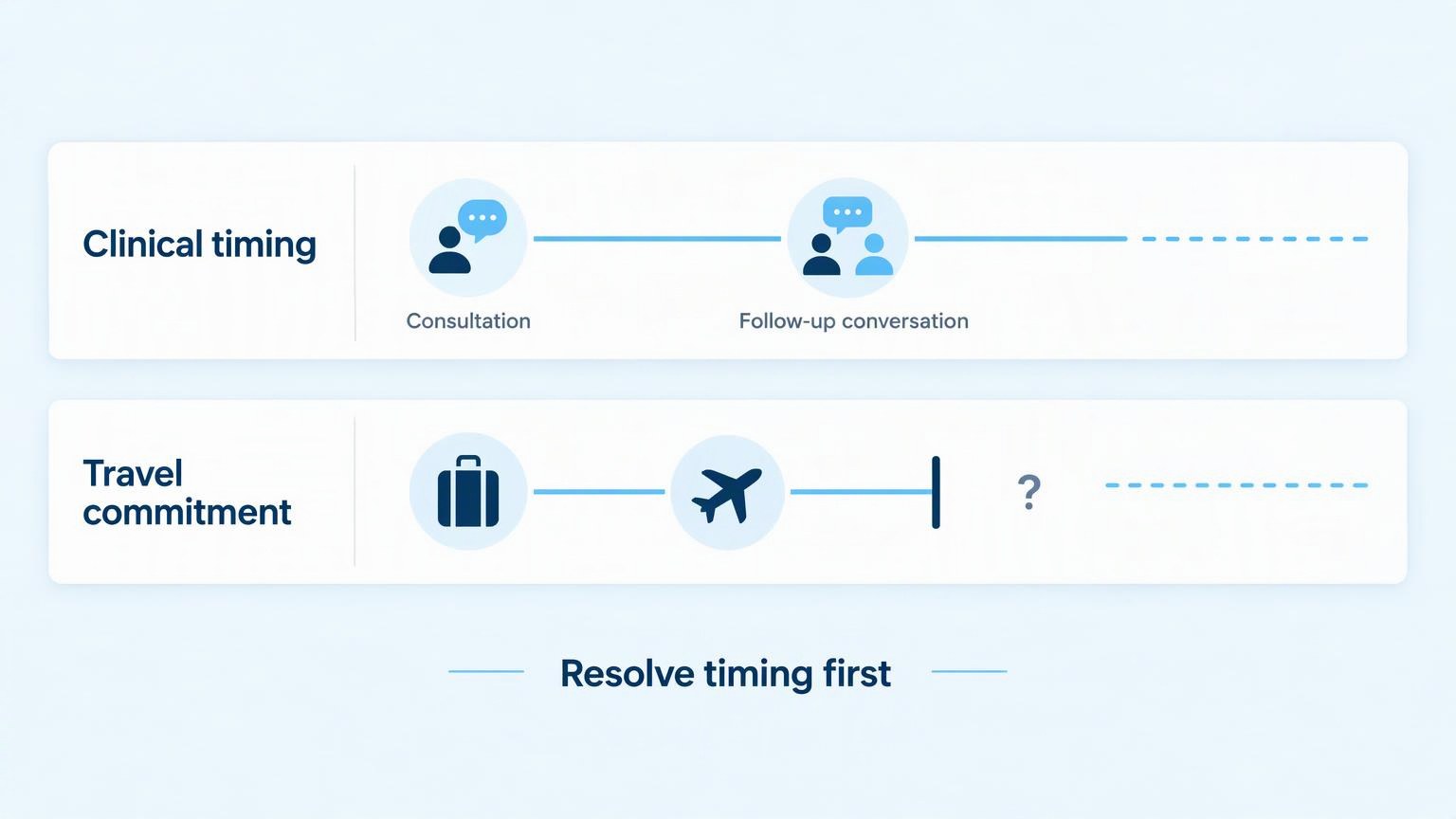
If your return deadline cannot accommodate the proposed follow-up, changing the booking type may not solve the underlying problem. Resolve the clinical schedule first, then compare reservations that fit it.
Say you have found detailed reviews praising a provider's communication. You have also gathered credential identifiers, but the treating clinician has not yet explained which follow-up checks must precede departure. Your work schedule requires you to return on a fixed date.
An inflexible return flight would lock in a date that the care plan has not supported. A changeable reservation might reduce some booking friction, but it would not create more time away from work or establish permission to fly.
The next step is a clinician discussion about follow-up and return assessment. If the expected schedule fits your available time, compare the actual flight and lodging change terms. If it does not fit, postponing travel is more coherent than building a trip around an unsupported departure date. Positive reviews remain useful background, but they do not resolve this timing conflict.
Move the remaining questions to the appropriate contact
Keep clinical questions with the treating provider and ordinary travel questions with a confirmed travel contact. Hospitality Cancun publishes travel and consultation-planning guidance; use it to organize logistics without treating it as clinical advice.
Before submitting any information through the contact section, clarify who will receive it and for what purpose. Once those details are clear, the first submission is limited to name, email and an optional contact-method preference. Do not add dates, destination, companion details, room needs, narrative or attachments.
Ordinary travel details may be discussed later with the confirmed travel contact. Diagnoses, scans and clinical records belong only in a named provider-confirmed secure channel. Do not send insurance numbers or payment details through a general inquiry.
Keep permission to respond to your requested inquiry, optional marketing and referral to a specifically named provider as separate choices. Permission to reply is not marketing consent.
Frequently Asked Questions
Should before-and-after photos decide my shortlist?
Use photos to clarify the appearance goals you want to discuss, not as a prediction of your result. Ask whether the examples show the proposed surgeon's work and when the images were taken. The clinician should explain whether the changes you want are realistic for your individual circumstances.
Does a negative review mean I should rule out a provider?
Not automatically. Identify the specific complaint and whether it concerns clinical care, communication or a separate travel supplier. Use it to seek a direct explanation of the relevant process. A complaint that raises a question the provider has not answered about your own proposed plan matters more than a rating alone.
What if two surgeons recommend different approaches?
Ask each clinician to explain the reasoning, alternatives and limits behind the recommendation. Do not reduce different proposals to a price comparison. An independent clinical opinion may help you understand the disagreement before making travel commitments. A planning contact should not choose the surgical approach on your behalf.
Can I rely on a virtual consultation alone?
Ask the treating clinician what the virtual discussion can establish and what remains subject to an in-person assessment. If the proposal is preliminary, understand how it may change and which commitments would already be binding. A convenient consultation format does not remove the need to resolve those conditions.
What if I do not understand the consent documents?
Request an explanation in language you understand before signing. Compare the documents with the procedure, risks, alternatives and follow-up discussed in consultation. Resolve inconsistencies with the treating provider rather than relying on a reviewer's account or a travel contact's interpretation. Leave yourself time to consider the answers.