
Recovery and Follow-Up Planning
Turn broad package promises into a practical plan for instructions, assistance, clinical reviews, and the return home.
A proposal can include postoperative checkups without explaining everyday assistance or care after returning home. Those are different planning problems. This guide helps you connect the provider's clinical requirements to practical arrangements without treating an advertised recovery period as advice for your own care.
Read recovery inclusions as categories, not a complete care plan
Package wording tells you which service categories are advertised, but it does not by itself establish the recovery arrangements for your proposed operations. Start with the individualized procedure proposal, then match each inclusion to a specific service and responsible provider.
For example, PlacidWay's Cancun listing for Dr. Victor Samano advertises accommodation, airport transfers and local transportation, along with postoperative checkups. It separately excludes airfare and meals outside the hospital. These are that listing's descriptions, not promises about another provider or your eventual agreement.
The distinction matters: accommodation addresses where you stay; checkups address clinical reviews. Neither label specifies hands-on assistance, staff availability, review locations, or care after departure. Meals also require a separate practical arrangement when they are outside the stated inclusion.
Use our guide to comparing mommy-makeover plans if the operations themselves are still unclear. Recovery planning should follow the proposed care, rather than supply assumptions that the proposal never made.
Have the treating provider define instructions and assistance
The treating clinician should define your procedure-specific instructions and required assistance. A companion or travel contact can help with ordinary logistics, but their presence does not establish that clinical tasks are covered.
For your provider discussion, prepare this compact checklist privately:
- Written instructions: the instructions for the actual proposed procedures, including activity, medication, wound or garment care where applicable.
- Assistance tasks: what help is required, who may provide it, and whether any task needs a qualified professional.
- Reviews: which assessments must happen in person and who conducts them.
- Concerns: provider-defined warning signs, whom to contact, and where to seek urgent assessment.
Translate the answers into named responsibilities. Someone arranging meals is performing a different role from someone providing postoperative clinical care. Do not let a phrase such as “recovery support” conceal that difference.
If the proposal names only a coordinator, our care-team verification guide helps you separate the people behind the procedure. Here, the goal is narrower: knowing who carries out the recovery tasks the clinician identifies.
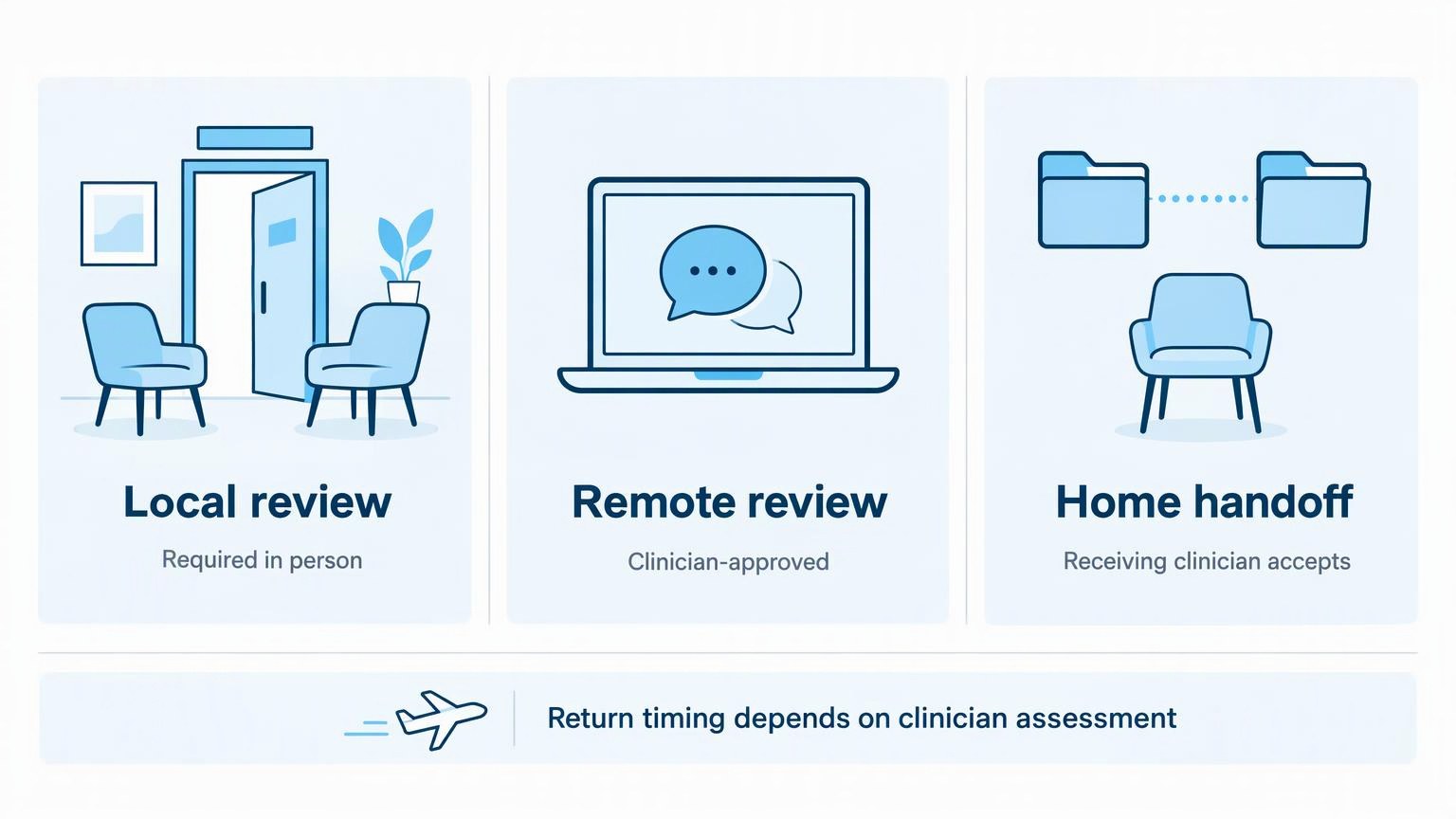
| Route | Suitable When | Reason | Limitation |
|---|---|---|---|
| Local in-person review | The treating clinician requires an examination before departure. | Keeps the required assessment within the local care plan. | Needs an appointment, location and compatible stay. |
| Clinician-approved remote review | The named clinician approves it for the specific task. | Allows that review without assuming another trip. | Does not replace required in-person assessment. |
| Accepted home-clinician handoff | A receiving clinician agrees to continue care. | Creates a defined route after returning home. | Records transfer and appointment acceptance need arrangement. |
Arrange follow-up before planning your return home
Identify the clinician responsible for follow-up during your stay and the accepted route for continued care after returning to the United States. An included checkup is not automatically a complete cross-border follow-up arrangement.
First, establish which reviews must occur locally and their appointment locations. Then determine whether the named clinician offers and approves remote review for any specific follow-up task. A video conversation should not be assumed to replace an examination that the clinician requires in person.
If care will transfer to a clinician at home, arrange that clinician's acceptance and the necessary information transfer before relying on the handoff. Possessing records is not the same as having a receiving clinician or an appointment.
The routes below may be combined when the treating plan calls for it. None independently establishes when you can fly. Base return travel on the treating clinician's assessment and follow-up plan, not on the end of a hotel reservation. Also establish a route for concerns that require in-person assessment after departure.
Work through a companion's fixed departure before booking
A companion's fixed departure should be tested against the provider's required assistance and reviews, not treated as your return deadline. Changing a flight solves transportation; it does not necessarily solve an assistance gap.
Say your companion must return to work, while the treating provider's plan calls for another local review after that departure. Start by having the provider explain what support you would need during the remaining stay.
If the required practical help can be arranged and any clinical assistance is separately covered, staying longer without that companion may be workable. If the plan requires assistance the companion was expected to provide, compare extending their stay with arranging an appropriate replacement. Do not assume hotel staff can fill that role.
If neither arrangement fits your commitments, postponing procedure-related travel or keeping the visit consultation-only is more proportionate than booking around an unsupported early departure.
The order is important: the clinician defines care needs, you resolve the support gap, and then the traveler or confirmed travel contact adjusts lodging and transport. A later flight alone does not create a need for clinical services.

Separate the reason for an extra stay from who pays
A clinician's recommendation to stay longer does not establish who pays for the change. An additional hotel night remains a lodging service, even when a clinical decision causes the extension.
Before committing, distinguish three things: the service being charged, the event that changes the plan, and the party responsible under the agreement. A proposal that says “extra nights if medically necessary” does not tell you whether those nights are included or who pays unless its terms specify both.
Review the relevant supplier's cancellation, refund and change terms separately for lodging, transportation and clinical services. Establish what happens to unused services and any added bookings. The reason for changing a plan does not itself create a refund right or waive a charge.
Insurance is a separate inquiry. Cancellation, medical and evacuation coverage depend on the actual policy, exclusions and claim conditions; do not assume planned surgery or a related extension is covered. Supplier obligations and an insurer's possible payment answer different questions. Keep both sets of terms available when evaluating the financial consequences of a changed stay.
Review the published scope without assuming recovery services
Hospitality Cancun's published Costamed-focused overview does not establish a procedure-specific recovery arrangement for you. Read the website's scope separately from the proposal supplied by a named treating provider.
We publish travel and consultation-planning guidance. Do not treat that role, or the website's broader medical-tourism descriptions, as confirmation that Hospitality Cancun provides postoperative clinical care or that a referral to Costamed has been accepted. In a later discussion with a confirmed contact, clarify whether the published scope relates to your inquiry and which organization would be responsible for any proposed service.
Before submitting any information, establish the recipient and purpose. The first submission permits only name and email, with an optional contact-method preference. Travel details may be discussed later with the confirmed travel contact. Permission to reply, optional marketing, and referral to a specifically named provider are separate choices.
Your research outcome should be a clear division between clinical care, practical support and travel arrangements, not an assumption that one website description covers all three.
Frequently Asked Questions
What should I pack or wear after surgery?
Use the treating provider's instructions for your proposed procedures rather than a general packing list. Ask which clothing or garments are required, whether any are supplied, and how to obtain the correct items. An advertised package does not establish garment type, fit, or instructions for your individual care.
Can I plan sightseeing during the recovery stay?
Do not build activities into the itinerary on the assumption that a recovery stay is a vacation. Have the treating clinician explain activity restrictions and how they affect your plans. Keep optional outings separate from required reviews, practical assistance and the arrangements needed to follow your instructions.
What if I need help understanding the instructions in English?
Resolve language needs with the treating provider before relying on the instructions. Establish how you will receive understandable written guidance and communicate questions during follow-up. Do not assume that a coordinator's English-language messages mean every clinical discussion or urgent-care interaction will have the language support you need.
Should I send medical records through a general inquiry form?
No. Diagnoses, scans and clinical records belong only in a named provider-confirmed secure channel. Do not send them, attachments, insurance numbers or payment details through a general form. This does not establish a later route for financial information. Keep clinical-record transfer separate from ordinary travel discussion.
Does a routine follow-up appointment replace an urgent-care plan?
No. A scheduled review addresses a planned assessment, while an urgent-care route addresses concerns that cannot wait for that appointment. Have the treating provider define the warning signs and response instructions for your care. Keep the relevant contacts accessible, without assuming a travel contact can provide clinical triage.