

Provider Selection
Separate advertised offerings from individualized recommendations before deciding which providers deserve a consultation.
Your first shortlist is a list of candidates for assessment, not a decision to undergo surgery. Keep public-page facts separate from questions that require consultation. This prevents an attractive package, destination description or quick response from becoming a substitute for an individualized plan.
Choose Shortlist Candidates by Scope, Not Package Size
Advance providers that describe relevant services and identify a route to assessment by the treating clinician. Retain an otherwise relevant but incomplete offering for clarification. Set aside an offering that does not address your interests or requires accepting additions you do not want.
A broad menu is not automatically a better fit. It may contain services you have no interest in, while a narrower offering may support a useful consultation. Nor does a provider's willingness to discuss a procedure mean that it is suitable for you.
Use the comparison below to decide your next step, not to rank clinical quality. Your shortlist should distinguish relevance from readiness for comparison: a relevant provider can still lack information needed for an informed decision.
A named clinician and care location also give you something concrete to verify. For that separate task, use our guide to verifying the care team in Cancun. Do not treat a package seller's identity as the identity of the treating provider.
Search for Candidates, Then Follow Through to the Provider
Start with searches that combine Mexico, your procedure interests and consultation information. Then search each candidate's exact provider or clinician name. This moves you from broad discovery toward information attributable to the people who would assess and treat you.
Read directories as discovery tools. Bookimed's Guadalajara listing says its ranking considers factors including patient demand, reviews, response speed and certifications. Those inputs are not an individualized assessment of your suitability.
Similarly, PlacidWay's Monterrey package page presents package and center information. Distinguish the listing platform, named center and treating clinician instead of assuming they are interchangeable.
For each candidate, save the page address and separate what the provider states from what an intermediary states. If you cannot identify who would conduct the clinical assessment, keep the candidate pending. If the provider's own information describes a relevant scope and clear consultation route, move to consultation preparation rather than collecting more rankings.
| What You Find | Suitable Next Step | Reason | Trade-Off |
|---|---|---|---|
| Relevant scope, named clinician and identifiable assessment process | Prepare for an individualized consultation | There is a concrete route to resolving clinical fit | Public information still does not establish suitability |
| Relevant package label, but unclear components or treating provider | Keep pending clarification | Missing identity or scope prevents meaningful comparison | You may need more information before advancing |
| Offering outside your interests or dependent on unwanted additions | Set aside unless a relevant alternative is available | Package size does not resolve a mismatch | A smaller advertised menu may better match your priorities |
Compare What Each Consultation Actually Establishes
A useful consultation connects your interests to a clinician's assessment and explains what remains undecided. A response that repeats a package description does not yet establish an individualized plan.
Prepare your priorities privately. During a later consultation through the provider's confirmed process, distinguish your preferences from procedures the clinician recommends. You can ask for the reasoning without deciding in advance that every advertised component belongs in your plan.
Keep a compact comparison record for each provider:
- Scope: What is proposed, excluded or still subject to assessment?
- Reasoning: How does the recommendation address your priorities, and what alternatives were discussed?
- Assessment: What must the clinician evaluate before confirming suitability?
- Responsibilities: Who provides treatment, follow-up and clinical support?
- Continuity: What happens locally and after you return home?
An unanswered question is not necessarily a reason to reject a provider. What matters is whether the provider explains how and when it will be answered before you commit. Keep eligibility, risks, treatment suitability and recovery advice with the qualified treating clinician, not a travel contact.
Test the Plan Against Your Time Away
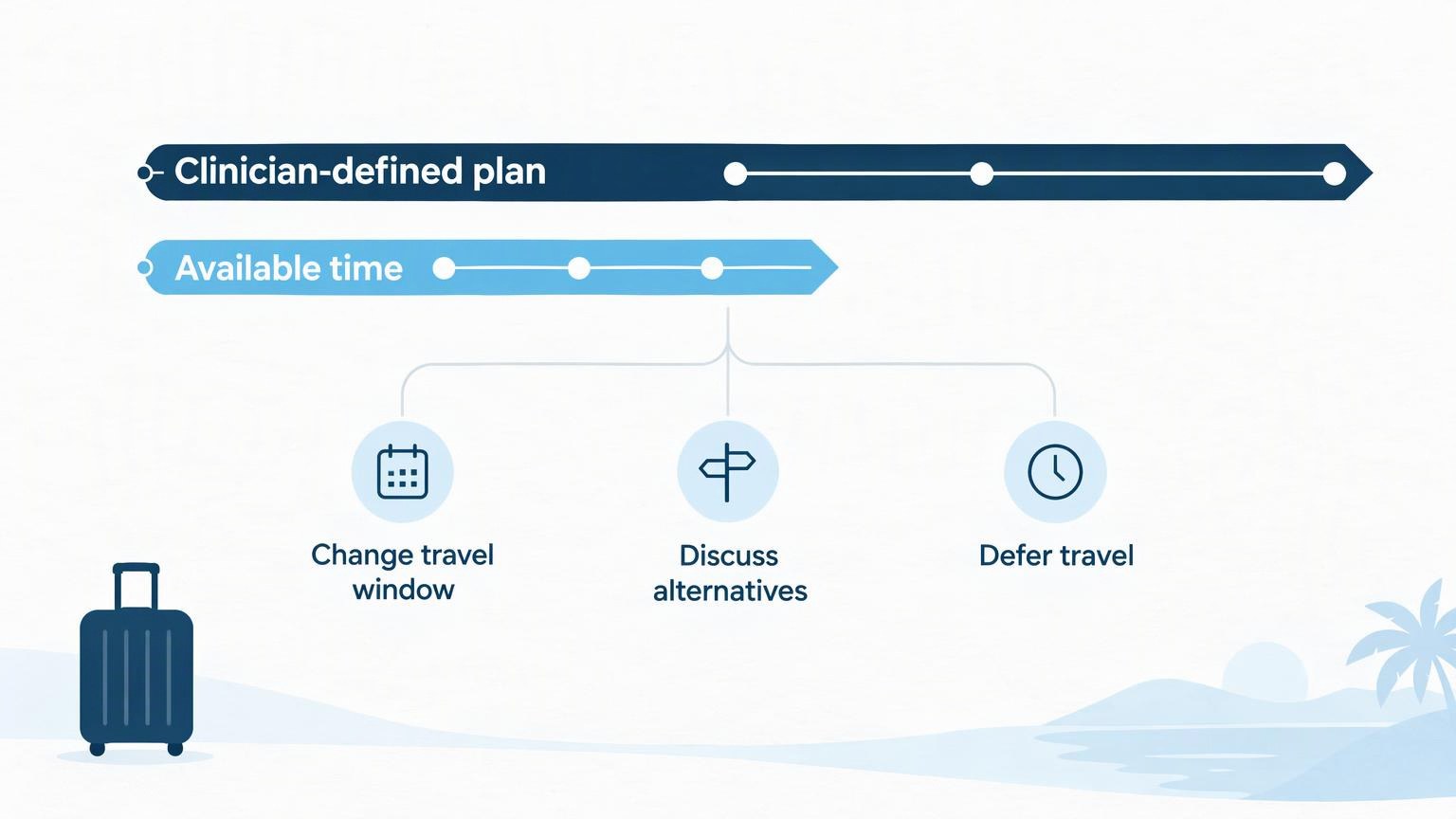
Your available time is a planning boundary, not a reason to compress clinical follow-up. Length of stay and flight timing depend on the clinician's assessment and follow-up plan; a package schedule is not individual clearance to fly.
Say you have a firm return obligation and are comparing an advertised combined offering with a provider that leaves scope open until assessment. The first looks easier to schedule because it presents a ready-made itinerary. The second initially feels less certain.
The deciding issue is whether either clinician-defined plan fits your actual availability. If the advertised itinerary has not been assessed for you, its apparent certainty does not solve the problem. Continue assessment with the provider that explains the timing decision, then compare that plan with your return obligation.
If the necessary plan does not fit, alternatives include changing your travel window, discussing whether a different approach is clinically appropriate or deferring travel. Do not choose the shortest advertised stay merely to preserve your calendar. Separately, discuss ordinary booking flexibility with a travel contact; it cannot determine clinical readiness.
Compare Proposals Only After Aligning Their Scope
Provider totals become meaningful only when you understand which services each proposal purchases. Different procedure scope or follow-up arrangements make headline prices poor substitutes for comparison.
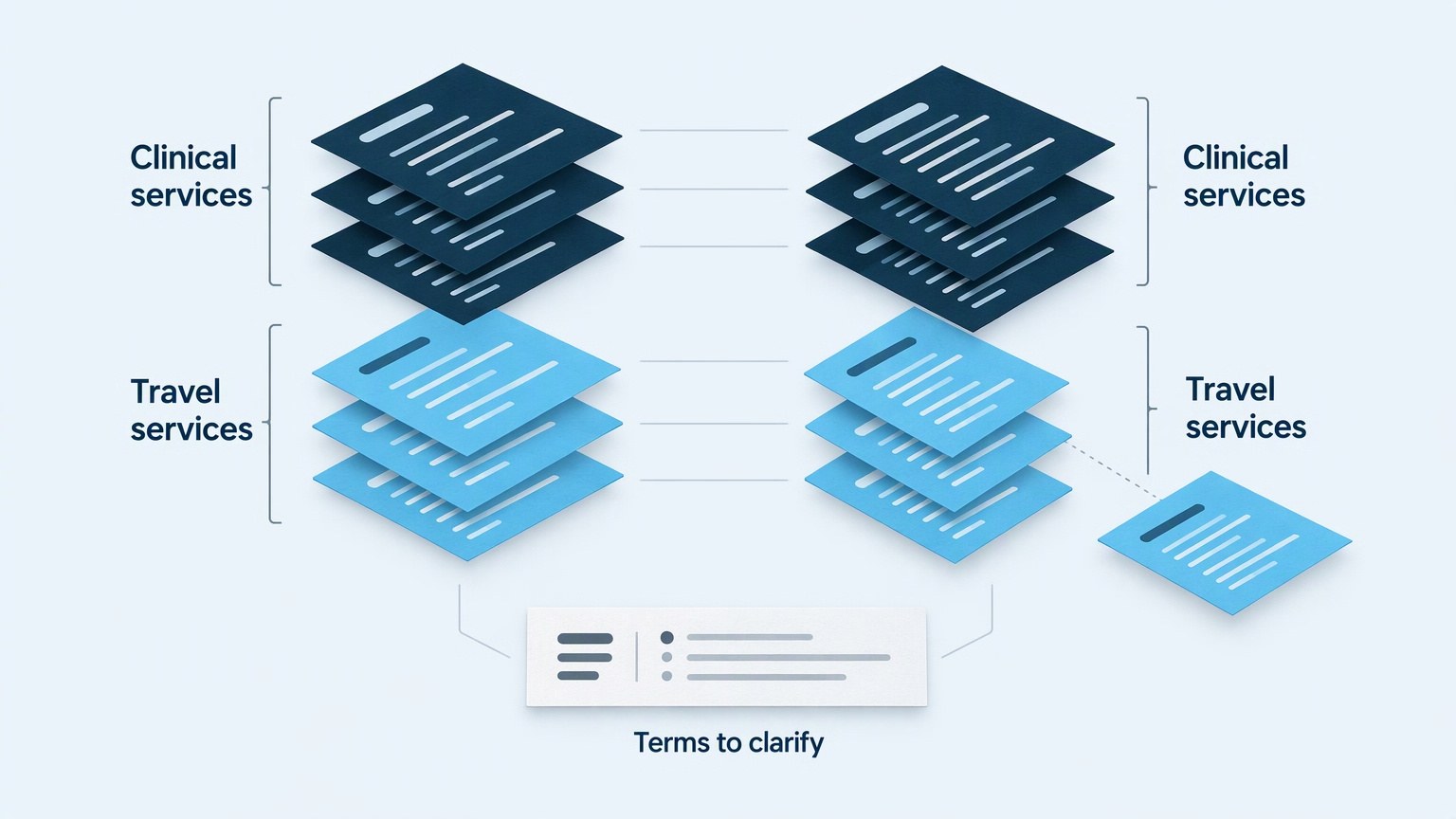
Separate clinical services from travel services. Identify what is included, excluded and conditional, and which business supplies each component. A package label does not establish lodging, transport or follow-up inclusions. Our guide to comparing mommy makeover costs in Mexico develops that financial comparison.
Also distinguish a change's cause from its contract consequences. If a clinician directs an extra stay, an additional hotel night remains a travel service. That direction does not establish who pays, whether the night is included or which hotel terms apply.
Supplier cancellation, refund and change terms determine the contractual consequences. Insurance is separate: coverage and claim conditions must be assessed under the actual policy, not inferred from the reason for cancellation. A provider can remain on your shortlist while you clarify material terms, but its proposal is not ready for commitment until you understand those terms.
Keep Travel Planning and Clinical Consultation Separate
Use Hospitality Cancun's published travel and consultation-planning guidance to organize your next decision. Clinical assessment belongs with the qualified treating provider. Our content does not establish that we offer a particular procedure, arrange an appointment or have a relationship with a provider you find.
Before submitting any information, clarify who receives it and for what purpose. If either is unclear, wait.
The first contact submission is limited to name and email, with optional contact-method preference. Travel dates, destination, companion arrangements and room needs may be discussed later with the confirmed travel contact after recipient and purpose are clear.
Permission to reply to your requested inquiry, optional marketing and referral to a specifically named provider are separate choices. A requested reply is not marketing consent. Diagnoses, scans and clinical records belong only in a named provider-confirmed secure channel. Do not place payment details, insurance identifiers or attachments in a general inquiry.
Frequently Asked Questions
How many providers should I put on my shortlist?
Use a manageable list rather than an arbitrary target. Include enough candidates to compare relevant scope and consultation approaches, but stop expanding once additional listings add no useful alternative. A longer list does not improve the decision if most entries leave the same essential questions unanswered.
Can before-and-after photographs establish that a provider is right for me?
No. Photographs can help you identify topics to discuss, but they do not establish your suitability, the full care arrangement or what outcome you should expect. Keep them separate from evidence about the named clinician and facility, and let the treating clinician explain their relevance to your assessment.
What if providers recommend different procedure combinations?
Compare the reasoning before comparing the number of procedures. Ask each clinician which priorities the recommendation addresses, what alternatives were considered and what remains subject to assessment. You do not need to select the larger plan. If explanations remain difficult to reconcile, consider an independent clinical opinion before committing.
Does a fast response make a provider a stronger candidate?
Responsiveness can make communication easier, but it does not establish credentials or individualized suitability. Judge whether the response answers the relevant question and comes from the appropriate person. A prompt package message and a clinician's assessment perform different jobs; keep both their source and substance visible in your notes.
Should I remove a provider that cannot confirm everything before assessment?
Not automatically. Some decisions properly remain open until the clinician evaluates you. Distinguish that from unexplained uncertainty about who provides care or what a proposal purchases. A useful response identifies what still needs to be decided and how the assessment will address it, rather than presenting an unassessed plan as settled.