

Procedure Comparison
Put competing procedure lists on equal terms before deciding which proposed care plan deserves further consideration.
A polished proposal can still leave you comparing unlike things. One list may name each operation, while another uses broad wording such as breast surgery or body contouring. Your first task is not to choose the longer list. It is to identify what each proposal actually recommends, what remains undecided and which differences require clinical explanation.
Put Both Procedure Lists Into the Same Format
Start with the actual proposal text and organize both lists by anatomical area. Preserve the original wording beside your notes so that a broad term does not quietly become a specific operation.
The Bookimed mommy makeover listings describe differing combinations under the same label, including a tummy tuck with a breast lift and another offer described as breast augmentation or lift with additional procedures. These are descriptions of advertised offers, not proof of what a clinician would recommend for you.
On your private comparison sheet, give each named operation its own line. Beside it, record the anatomical area, any stated technique or component, whether it is proposed or optional, and whether it is planned together with other operations or separately.
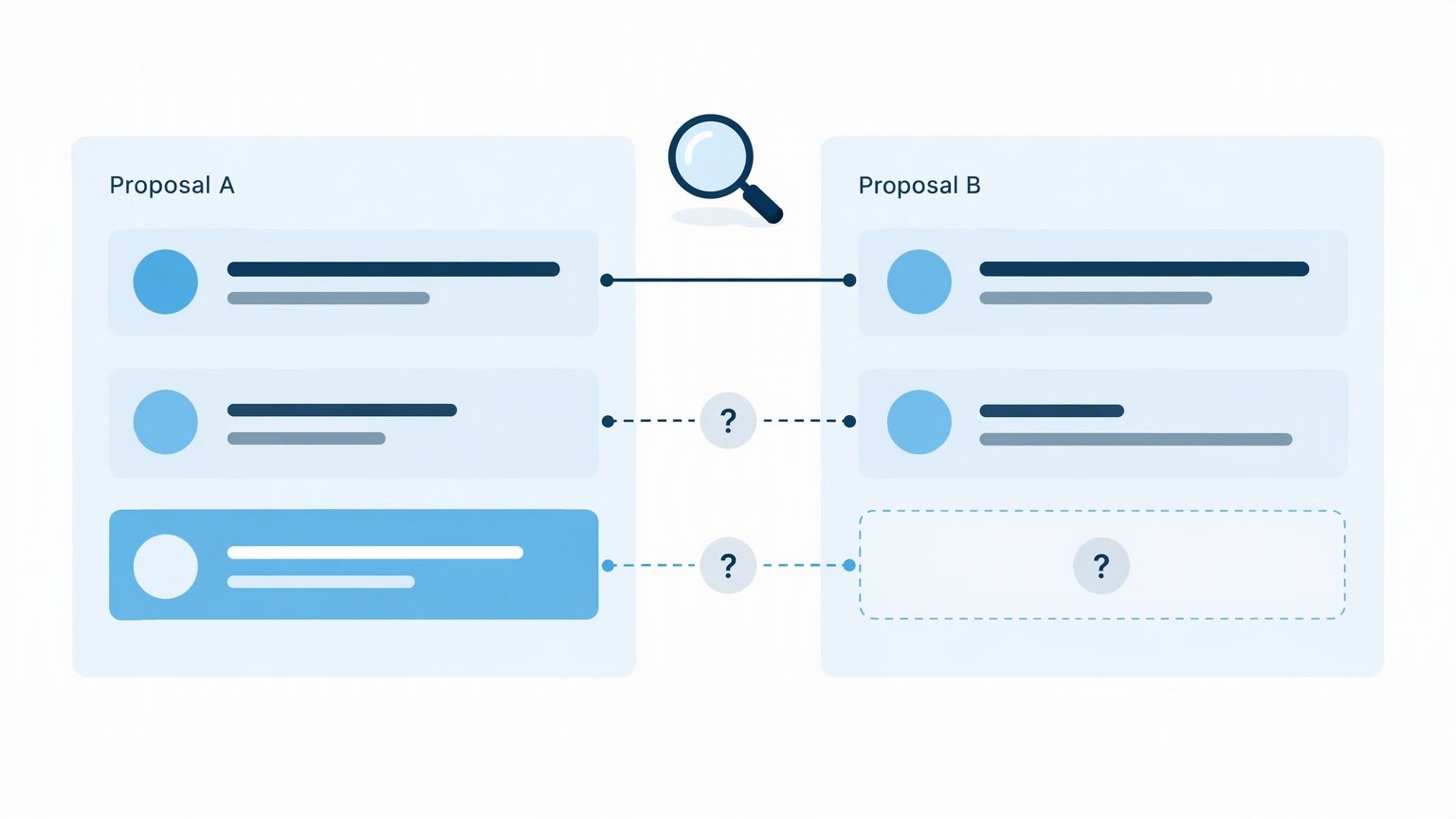
Then classify the differences: matching wording, different wording requiring explanation, an additional procedure, or an unspecified item. If one proposal names liposuction areas and another does not, you have a scope gap. You do not yet have evidence that the second proposal covers fewer areas. This classification tells you exactly where the consultation needs to begin.
Distinguish Alternatives From Additions
A different procedure name is not necessarily an extra benefit, and an extra line is not necessarily a better plan. Ask the clinician whether the difference represents an alternative recommendation, an additional operation or simply incomplete wording.
Breast procedures: If one proposal says lift and another says augmentation, do not place them in a single interchangeable category. Ask what each recommendation is intended to change, what it would leave unchanged, and whether the clinician is proposing one procedure instead of the other or a combination. If implants are proposed, have the clinician explain their role in that recommendation.
Abdominal procedures: If muscle repair is explicitly listed in one tummy tuck proposal but absent from the other, ask whether it is proposed, not proposed or undecided pending assessment. Silence is not enough to establish the intended scope.
Liposuction: Compare the named anatomical areas rather than a headline area count. Ask the clinician to identify the intended boundaries when descriptions differ.
Use the comparison below to decide what kind of clarification you need. It is a guide to reading proposals, not a way to determine which operation is suitable for your body.
| Proposal Difference | Useful Next Step | Why It Matters |
|---|---|---|
| Matching operations and named areas | Compare the clinician's rationale and proposed sequence | Matching scope enables further comparison but does not establish suitability. |
| Lift in one list, augmentation in another | Discuss them as alternative recommendations unless a combination is explicitly proposed | Different names should not be treated as interchangeable inclusions. |
| Muscle repair stated in only one list | Clarify the other proposal's intended abdominal scope | An omitted detail needs clarification; it does not prove exclusion. |
| Named liposuction areas versus a broad description | Have the clinician identify the intended areas and boundaries | A headline count cannot establish equivalent coverage. |
Work Through an Uneven Pair of Proposals
When proposals differ in several places, resolve the differences in order rather than selecting the one that appears more complete.
Say you receive a proposal naming a tummy tuck with muscle repair and a breast lift. Another names a tummy tuck, breast augmentation and liposuction, but does not identify the liposuction areas. You want to understand the proposed breast change and abdominal scope before committing to a plan.
First, align the shared tummy tuck wording. The second clinician needs to explain whether muscle repair forms part of that proposal or remains undecided. Next, address the breast recommendation: lift and augmentation are different entries, so ask each clinician to explain the recommendation rather than assuming the proposals pursue the same change. Finally, establish the purpose and areas of the added liposuction.
The reasoned outcome is to pause the ranking. The second proposal's longer list does not establish a closer match, and the first proposal's more explicit abdominal wording does not establish clinical superiority. If the explanations reveal different intended changes, compare those choices on their merits. If they reveal matching scope, you can move on to provider verification and the separate financial comparison.
Compare Combined and Staged Plans on Clinical Rationale
Have the qualified treating clinician explain the proposed sequence for you. A preference for one trip does not establish that procedures should be combined, and a staged proposal is not automatically a weaker offer.
For a combined recommendation, ask why the listed operations are being proposed together and what patient-specific assessment supports that recommendation. For a staged recommendation, ask which operation comes first, why that order matters and what would determine whether to proceed with a later stage. The clinician should assess eligibility, suitability and recovery requirements rather than leaving those decisions to a package comparison.
Keep your clinical and practical decisions separate. You can assess whether repeated travel, time away and household arrangements are workable. You cannot use those preferences as medical clearance to combine procedures.
If a staged plan fits the clinician's recommendation but repeated travel is not workable for you, the next discussion is whether to narrow or defer the proposed care, not simply compress it into one visit. Likewise, flight timing and length of stay must follow the clinician's assessment and follow-up plan. An advertised stay length is not individual clearance to fly.

Close the Scope Comparison Before the Planning Handoff
Your procedure comparison is ready for the next step when you can explain what is proposed, what remains conditional and why the meaningful differences exist. That does not mean you have independently established medical suitability.
Keep a short private scope record:
- The current proposal date and named clinician.
- Each proposed operation and anatomical area.
- Optional items, assessment-dependent decisions and sequencing.
- The clinician's explanation of the differences between proposals.
Use that agreed scope for the separate mommy makeover cost comparison. A clear procedure list also does not replace care-team verification.
Before submitting any information through a general inquiry, clarify the recipient and purpose. The first submission is limited to name and email, with optional contact-method preference. Do not include proposal text, health or travel narratives, records, attachments, payment details or insurance identifiers. Ordinary travel details may be discussed later with the confirmed travel contact; clinical information belongs only in a named provider-confirmed secure channel.
Permission to answer your requested inquiry, optional marketing and referral to a specifically named provider are separate choices. A requested reply is not marketing consent.
Frequently Asked Questions
Can before-and-after photos settle a difference between procedure lists?
No. A photograph does not identify the exact operations proposed for you or establish that the same plan would be appropriate. Use images to help explain a preference during consultation, then return to the written scope and the clinician's explanation. Do not use visual similarity as a substitute for comparing named procedures.
How should I handle procedure names given in Spanish and English?
Keep both versions and ask the clinician to confirm the intended operation in language you understand. Do not resolve an unfamiliar term by selecting a similar-looking English name yourself. Once clarified, use the confirmed wording consistently across your comparison sheet, consultation notes and the current proposal so that translation does not create a false match.
What if I do not want an optional procedure?
Tell the clinician that you do not want to include it and ask for the recommendation to be explained without that addition. Clarify whether removing it changes the proposed approach or sequence. Do not assume that an optional label establishes clinical independence, and do not accept an addition merely to make a package seem complete.
Can a lower price decide between otherwise similar lists?
Price can inform your decision after the scope is understood, but matching procedure names alone do not establish equivalent care. Keep the clinical comparison separate from the financial one. Compare the written charges and inclusions against the same proposed scope rather than interpreting a lower total as evidence of either better value or missing procedures.
What should I do if the procedure list changes after consultation?
Replace the old comparison with the revised proposal and identify exactly what changed. Ask the clinician to explain the new recommendation and which earlier assumptions no longer apply. Keep the previous version for reference, but do not compare another provider's current proposal against an outdated list or carry old planning assumptions forward without review.