

Care Communication
Learn to distinguish friendly, fast replies from accounts that explain how questions reached the appropriate person and received a useful answer.
When reading plastic surgery reviews from Tijuana, “great communication” can mean very different things. The writer might describe an easy booking exchange, an understandable consultation, or help obtaining clarification afterward. Those experiences should not be treated as interchangeable.
This guide focuses on the content of communication accounts. It does not rank Tijuana surgeons or clinics. Your goal is to find a useful observation, understand its limits, and decide what information you still need.
Favor reviews that describe an exchange, not just satisfaction
A useful communication review describes an interaction you can examine: who was involved, what needed explaining, and what happened next. Positive and negative accounts deserve attention on that basis, rather than tone alone.
For example, “the staff were wonderful” expresses satisfaction. An account explaining that a clinician clarified an instruction after the patient raised a question identifies both the role and the purpose of the exchange. It is more useful for researching explanations, although it remains that writer’s account.
Do not reject a brief review as false simply because it lacks detail. Keep it in the overall-impression category instead of letting it answer a question it never addresses. Likewise, a lengthy review may discuss friendliness without showing whether a care question was answered.
The comparison below separates common kinds of communication content. For a broader framework covering other review subjects, read our guide to reading beyond star ratings.
Search for the interaction you need to understand
Start with the provider’s full name and Tijuana, then add the communication stage relevant to your concern. Searching only for general reviews can mix clinic hospitality, scheduling, and clinical explanations.
- Identify the provider. If an account names only a clinic, do not assign its communication comments to an individual surgeon.
- Narrow the subject. Add consultation, instructions, or follow-up to your search. Choose the term that matches your unanswered question.
- Read the full account. Look for the person contacted, the question raised, and any later update explaining the result.
- Separate unmatched results. A booking exchange belongs in a scheduling comparison, even if your main concern is postoperative clarification.
If the role remains unclear, your next task is to identify who handled that exchange, not search for more praise about the whole clinic. Keep repeated copies of the same account together. Multiple appearances do not make it multiple independent experiences.
| Review content | Useful for | Limit or next decision |
|---|---|---|
| “Everyone was helpful” | Understanding overall satisfaction | Does not identify the exchange or explain what help involved. |
| Prompt replies about scheduling | Assessing the reported booking interaction | Does not answer how clinical questions were handled. |
| A named role clarified an instruction | Investigating how explanations reached the patient | Does not establish current arrangements or clinical quality. |
| A question was forwarded but no outcome is described | Identifying an incomplete handoff account | Seek an update; do not assume either resolution or refusal. |
| Independent accounts describe the same unanswered question | Identifying a specific issue to investigate | Does not establish its frequency across all patients. |
Judge understanding separately from reply speed
A quick reply demonstrates responsiveness in the interaction described. It does not necessarily show that the question received an understandable or clinically appropriate explanation.
Read for the difference between acknowledgment and resolution. “They replied to my message” leaves the content unknown. An account saying the reply explained a previously unclear instruction tells you more about what the exchange achieved. Neither establishes how every future question will be handled.
Also distinguish administrative answers from clinical discussion. Scheduling staff can explain an appointment arrangement without that exchange demonstrating a clinician’s explanation of treatment. If a reviewer says “everything was explained,” look for the subject and the person doing the explaining.
For English-speaking readers, language detail can be relevant. An account identifying how questions were discussed is more informative than a broad claim that communication was easy. Still, another person’s ability to understand an exchange does not establish what language assistance will be available to you. That requires a current, provider-specific answer.
Trace a handoff all the way to the answer
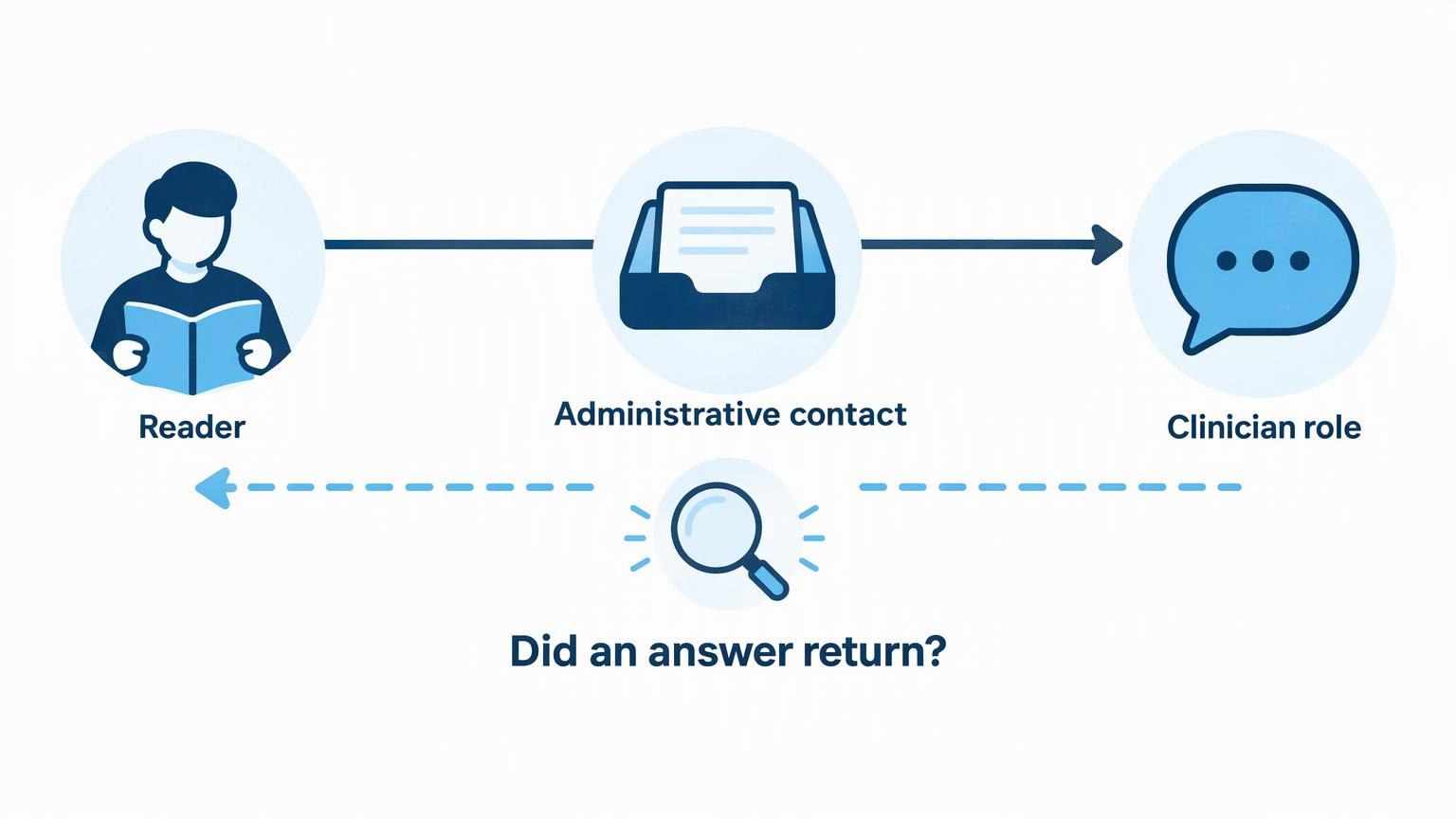
A completed handoff shows more than a message being forwarded. The useful detail is whether the question reached the appropriate person and whether an answer returned to the patient.
Say you are concerned about obtaining clarification of care instructions after leaving the facility. You find an enthusiastic review describing prompt appointment messages. Another account explains that scheduling staff received an instructions question, passed it to a clinician, and relayed the clinician’s clarification.
You could choose the more enthusiastic account, treat any forwarding as poor communication, or compare the exchanges by purpose. The last approach is more useful. The appointment account supports a scheduling observation; the second provides a clearer lead about handling an instructions question.
If the second account ends at “they forwarded my message,” the handoff’s outcome remains unknown. Look for an update rather than filling in a successful resolution. The planning consequence is specific: establish who is responsible for clinical clarification and how that responsibility operates before relying on a follow-up arrangement.
Read complaints by issue and outcome
Repeated complaints matter most when they independently describe the same communication problem. Conflicting ratings are less informative until you compare the interactions behind them.
Separate a message receiving no acknowledgment from a reply that did not answer the question. Also separate both from a question repeatedly passed between people without a clear owner. These are different issues and lead to different follow-up inquiries.
Read later updates for resolution. An initially confusing exchange followed by a clear explanation differs from an account that ends without an answer to the question. Preserve both the difficulty and the eventual outcome instead of reducing the story to its final rating.
A provider response offers the provider’s position; it does not independently establish what happened. Nor does a set of reviews let you calculate how frequently a communication failure occurs across all patients. Use a specific pattern to identify an issue worth investigating, without converting it into a claim about everyone’s experience. Our review source-checking guide covers tracing an account’s origin.
Turn review observations into current planning decisions
Carry forward the concrete communication issue, not the reviewer’s overall verdict. Reviews describe reported experiences; the provider must explain the arrangements that would apply to your consultation and care.
Keep a short private note for each useful account:
- Reported event: who handled which question and what happened.
- Limit: what the account does not establish.
- Current decision: which responsibility needs a provider-specific explanation.
A helpful answer identifies responsibility rather than relying on “someone will assist.” Clinical suitability, treatment explanations, recovery advice, and any clearance to fly belong with the qualified treating clinician. Another reviewer’s departure schedule does not settle your travel timing.
We publish travel and consultation-planning guidance at Hospitality Cancun. Use that guidance for planning context, not clinical confirmation. Keep Tijuana review observations attached to the people and locations they describe when reading destination information on our website. A communication account from one destination does not establish arrangements at another, and website guidance does not establish a treating-provider relationship.

Frequently Asked Questions
Can before-and-after photos help me assess communication?
Photos do not show how questions were answered, who explained instructions, or whether a patient could obtain clarification. An accompanying account may describe those interactions, but evaluate that text separately. Satisfaction with appearance and satisfaction with communication answer different questions; neither should silently stand in for the other.
Is a review mentioning a messaging app especially useful?
The channel alone adds little. What matters is who used it, what the exchange concerned, and whether the question was resolved. An app name does not establish a current contact arrangement, continuous availability, or a suitable route for clinical records. Keep the reported interaction separate from assumptions about the technology.
Should I disregard a review written by a companion?
No. A companion may describe explanations or exchanges they personally witnessed, making the account useful for that limited purpose. Distinguish those observations from statements about conversations they did not attend. Their account cannot substitute for the patient’s own understanding or establish the clinical appropriateness of an answer.
Does silence about communication mean there were no problems?
No. A review may focus on appearance, hospitality, or another subject and omit communication entirely. Treat that absence as no information on your question, rather than a positive or negative finding. You do not need to discard the whole review, but it cannot resolve a concern it never discusses.
Do several detailed reviews justify a provider recommendation?
They can identify promising research leads, but detail does not independently verify authenticity, credentials, clinical quality, or suitability for you. Use the accounts to make your next comparison more precise. A recommendation about treatment requires more than communication testimony, including provider-specific evidence and discussion with the qualified treating clinician.