

Review Research
Learn which personal accounts deserve further attention by tracing when care happened, what the reviewer experienced and what still needs independent verification.
A rating compresses an experience into a single judgment. Your research needs the sequence behind it: consultation, treatment, follow-up and any later update. Reading in that order helps you distinguish a useful observation from praise or criticism that leaves the important context unstated.
Read the visit timeline, not just the posting date
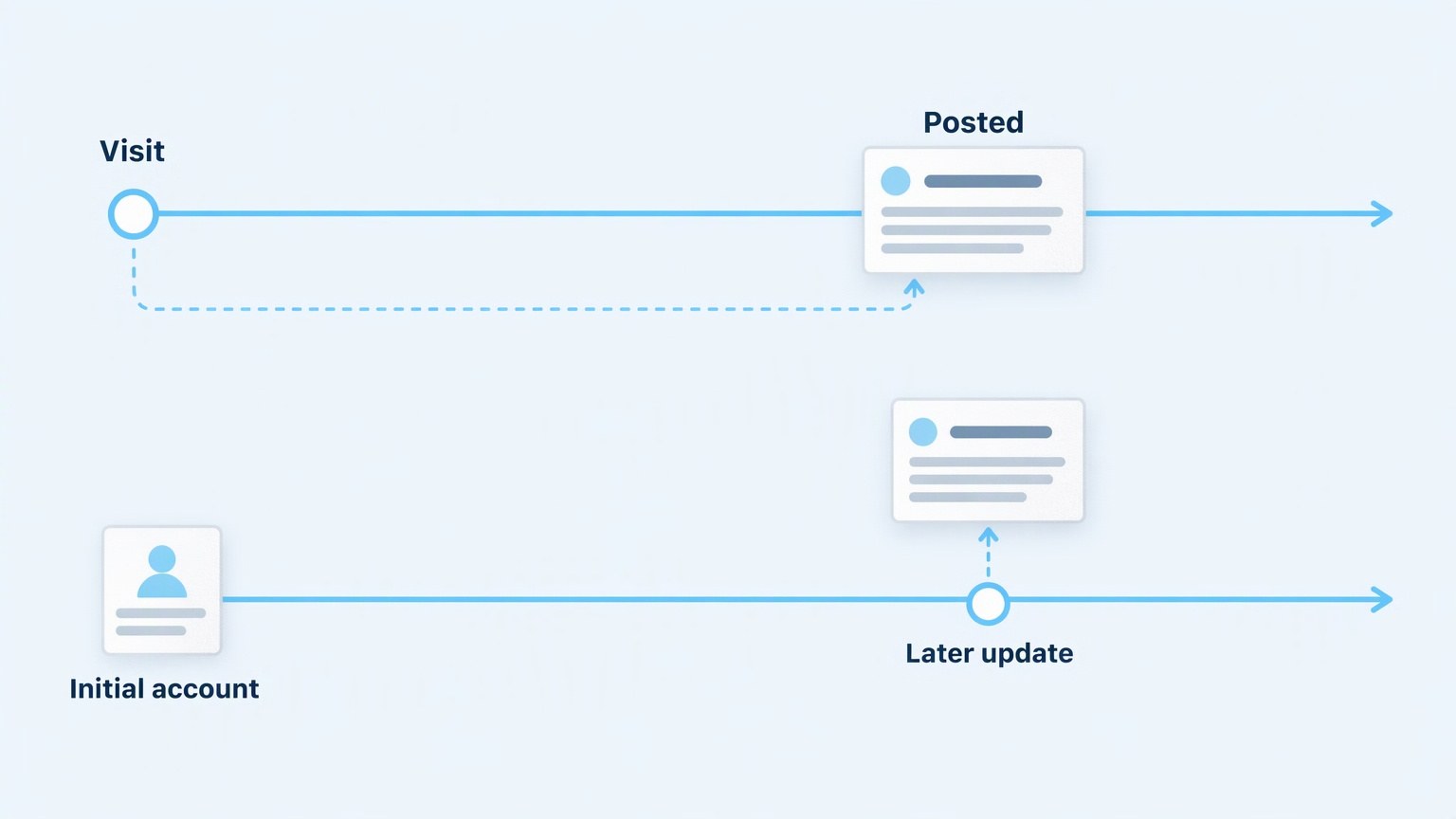
The date of the experience matters more than how recently the review appeared. A newly posted account can describe an older visit, while an updated account may contain both early impressions and later follow-up.
Separate the publication date, the stated visit date and the point at which the reviewer last reported their experience. If the visit date is absent, you cannot tell how recent the care was from the posting date alone.
A consultation review answers a different question from an account written after treatment. Likewise, an early expression of satisfaction does not tell you what happened later. Preserve that distinction even when both accounts carry the same rating.
There is no useful universal expiration date for a review. An older account can reveal a historical concern worth investigating; a recent account can help describe a current interaction. Neither establishes that the surgeon, facility or follow-up arrangements are unchanged. Give each account a role based on its timeline, not its age alone.
Search for the missing context in a useful order
Start with the provider's full name and Tijuana, then narrow the search to the procedure or stage of care you need to understand. This is more useful than repeatedly searching for the highest-rated surgeon.
- Open the original review page rather than relying on a search preview. Read the dates and surrounding text.
- Use a newest-first option where available, but retain older detailed accounts for comparison.
- Add a specific term such as consultation, follow-up or communication when those details are missing.
- Compare results from independently operated sources with testimonials selected for a provider's own website.
If the newest results describe consultations only, your next search should target later experiences, not more consultation praise. If results name different facilities, separate them before drawing a pattern.
Keep a link to the original account so you can revisit its wording. Our guide to checking sources behind Tijuana plastic-surgery reviews offers a related reading step.
| Account | Useful role | Limit |
|---|---|---|
| Recent post with no visit date | Identify a question to investigate | Does not establish when the experience happened |
| Older account with a clear care timeline | Understand a historical experience | Does not establish current arrangements |
| Recent consultation-only account | Compare consultation communication | Does not describe postoperative follow-up |
| Dated account with a later update | Trace how that person's experience developed | Does not predict your outcome or recovery |
Compare the same part of the experience
A review becomes useful for comparison when it identifies the person or organization involved, the stage of care and a concrete event. Length alone does not make an account informative.
For example, “communication was excellent” leaves the scope unclear. An account explaining whether questions were answered before the consultation or after departure gives you something more precise to investigate. It still describes that person's experience, not a promised service.
Separate comments about the surgeon from comments about scheduling staff, the facility or lodging. Otherwise, satisfaction with hospitality can be mistaken for evidence about clinical care, or a booking complaint can be attributed to the wrong party.
Also distinguish an observation from an interpretation. “My message received a reply” describes an event; “they will always be available” extends beyond it. The comparison below shows how different accounts can contribute without being treated as interchangeable evidence. For another angle, read beyond the star ratings.
Resolve conflicting reviews by identifying what they actually address
Conflicting opinions do not always describe conflicting facts. First identify whether the accounts concern the same provider, facility, period and stage of care.
Say you find a recent positive review describing a friendly consultation and an older negative review describing difficulty getting replies after returning home. You are considering that provider and want to understand follow-up communication.
The recent account offers relevant information about the consultation, but it does not answer the older concern. Rejecting the complaint solely because it is older would leave your actual question unanswered. Treating it as proof of today's arrangements would also go too far.
The useful next step is to look for later follow-up accounts and obtain the provider's current explanation of who handles postoperative questions and how contact works. If the older account concerns a different facility or provider, remove it from that direct comparison.
The outcome is a focused research question, not a winner chosen by rating or publication date.
Keep personal accounts separate from provider verification
Reviews can describe communication and personal experience. They cannot establish a clinician's credentials, your treatment suitability or the current arrangements for your care.
When an account calls a surgeon “certified,” identify the exact credential being claimed and check it with the issuing organization using the clinician's full name. A general compliment is not a substitute for a matching record. If you cannot establish a match, do not repeat the credential claim as fact.
Current facility and follow-up arrangements require separate provider-specific confirmation. A reviewer naming a hospital does not establish where your proposed treatment would take place or who would be responsible afterward.
Keep the clinical handoff equally clear. Eligibility, diagnosis, treatment suitability and recovery advice belong with the qualified treating clinician. Someone else's return journey does not determine your flight timing or length of stay; those depend on your clinician and follow-up plan. Use reviews to identify the issue you need explained, not to supply the clinical answer.

Turn your assessment into the next research step
Continue researching a provider when relevant accounts supply enough context to identify concrete questions. If the evidence is vague or mismatched, leave the comparison undecided rather than filling the gaps with an overall score.
Keep a short private note with the original link, posting and visit dates, named provider and facility, stage of care, useful observation and any claim you still need to verify. End with the next source you need. This turns reading into a directed search rather than an accumulating collection of testimonials.
We publish travel and consultation-planning guidance for adults considering care in Cancun or the Mexican Caribbean. Review our website for its listed destination information; this Tijuana review guide is not an offer of Tijuana clinical services or a provider introduction.
For Tijuana, continue with independent review sources and verification specific to the clinician and facility you are considering. A destination website, appealing travel plan or contact link should not decide whether the provider information is sufficient.
Frequently Asked Questions
Does a verified-purchase or verified-patient label settle the question?
Do not treat the label as clinical verification. Read the platform's explanation of what it checks. Whatever the label establishes, it does not by itself authenticate a credential, confirm today's facility arrangements or make that person's treatment experience applicable to you. Keep those questions separate.
How should I treat the same review appearing on several websites?
Count the underlying experience once unless you can establish that the accounts are different. Match the wording, author information and visit details, then retain the clearest original version. Repeated publication gives you more places to find an account, not additional independent experiences supporting the same conclusion.
Is a provider's reply to a complaint useful?
Yes, as the provider's response to that account. Look for whether it addresses the specific issue rather than offering a general reassurance. A reply can help identify what needs clarification, but it does not independently prove either side's description or establish how a future concern will be handled.
Should I disregard an anonymous review?
Not automatically. You can assess its dates, named provider, stage of care and concrete observations without demanding that the writer disclose private information. However, if the identity or experience cannot be established, retain that uncertainty. Do not elevate a detailed anonymous account into a verified clinical record.
Do before-and-after photographs make a review more reliable?
Photographs do not resolve missing dates, provider identity or follow-up context. Look for how the images are connected to the written account and when they were taken. Do not use another person's images to infer your likely result, treatment suitability or recovery timeline; those require discussion with your treating clinician.