

Consultation Planning
Use a career transition to organize your research, not to set a deadline for surgery.
A new role brings practical questions: when you must attend, what the work involves, and whether you can step away for follow-up. Those questions deserve attention without turning a career milestone into pressure to change your appearance. The useful goal is a better-informed decision, including the option not to proceed.
Choose a planning stage, not a surgery deadline
Keep researching now if your work arrangements or clinical plan are unclear. Pursue a consultation if you want individual answers, but leave travel undecided. Consider a trip only when the care plan and your actual work commitments can fit together without relying on an assumed return date.
These are different levels of commitment. Reading and organizing questions can be useful during a busy transition. A consultation is an opportunity to understand suitability, alternatives and timing; it is not an obligation to undergo surgery. Travel reservations create separate commitments that deserve their own review.
The comparison below helps you choose a stage. An open calendar alone does not establish that a trip fits. Conversely, starting a job does not mean you must abandon research. You can continue learning while waiting for clearer information about leave, duties and follow-up.
Keep your reasons for considering rhinoplasty separate from the job offer. A personal goal can be discussed on its own merits, without assuming a changed appearance is necessary for professional success.
Map the work commitments that could limit your options
The most useful work information is what you must do and when, not just your first day. A start date may be fixed while later attendance is negotiable, or the reverse. Treat an arrangement as available only after the appropriate employer contact has agreed to it.
Prepare this short list privately before a clinical consultation:
- Fixed attendance: orientation, training, required meetings and work travel.
- Actual duties: desk work, public-facing tasks, physical activity, protective equipment or other job-specific demands.
- Time-away arrangements: approved leave, any remote-work agreement and who can authorize changes.
- Follow-up access: whether your schedule can accommodate appointments after returning home.
Use the list to distinguish a calendar problem from a clinical question. An employer can clarify attendance expectations. The treating clinician must assess how your duties relate to the proposed care and individual recovery plan.
Remote work should not be treated as automatic leave or medical clearance. If your plan depends on working remotely, establish both the employer's agreement and the clinician's guidance before relying on that arrangement.
| Situation | Suitable Next Step | Reason | Trade-Off |
|---|---|---|---|
| Job duties or leave arrangements are unclear | Research without booking travel | You can prepare without relying on unknown work flexibility | Individual clinical questions remain unanswered |
| You want individual guidance but have a fixed start date | Pursue a consultation with travel undecided | Clinical advice can inform whether any window is workable | A consultation may lead to waiting or not proceeding |
| Onboarding conflicts with the proposed care plan | Reconsider travel after work arrangements become clearer | The known obligation cannot support the current plan | Research continues, but the trip is deferred |
Research a consultation that can answer your work questions
Start by identifying the treating clinician and care location, then investigate qualifications and the consultation process. Searching only for a convenient date or a bundled offer does not tell you who will assess you or how your questions will be answered.
Use a broad search such as “rhinoplasty consultation in Cancun,” then narrow it to the named clinician. Look for credential details that can be checked with the issuing authority, rather than treating a profile badge as proof. Establish where the consultation and any proposed procedure would take place. This gives you an identifiable option to evaluate, not an endorsement.
Next, establish how an English-language clinical discussion would work. Bring your work-duty list to that consultation and ask the clinician to distinguish returning to particular tasks, attending follow-up, and flying home. Do not substitute a general website timeline for those individual answers.
For preparation, our rhinoplasty questions before requesting a quote guide offers related reading. Keep track of questions that still need answers; a provider's available date does not answer them.

An open gap between jobs may still be too constrained
If your return must happen before mandatory orientation, but you do not yet have individual guidance on travel timing, the gap is not yet a dependable treatment window. The practical choice is to obtain clinical advice without committing the trip to that deadline.
Say you have accepted a new role with required in-person orientation. You are interested in rhinoplasty in Cancun and see an apparent opening before work begins. You have not yet discussed the necessary stay, follow-up or clearance to fly with a treating clinician.
Booking immediately would make the trip depend on an answer you do not have. Consulting first could help you understand whether a workable plan exists while preserving the option to wait. Deferring travel until after onboarding could be preferable if orientation cannot move and later leave is still unknown.
The reason to wait is not simply that several reservations are involved. It is that a hard work obligation would conflict with any plan requiring a later return. If the eventual clinical plan and approved work flexibility resolve that conflict, you can reassess rather than force the original window.
Judge flexibility by the terms that apply when dates change
Compare the actual cancellation, refund and change terms before making financial commitments. A label such as “flexible” is less useful than knowing which reservation can change, what the change costs, and what money remains at risk.
Review each proposed service separately: clinical appointments or treatment, accommodation, flights and transport. Identify the seller, the charged service, payment deadlines and the applicable change terms. A combined total does not establish that every component follows the same rules.
For example, if a clinician directs a longer stay, an extra hotel night remains a travel charge. The clinical reason does not establish who pays, whether the night is included, or which hotel terms apply. You cannot determine those details without answers in the relevant proposal and contract.
Insurance is a separate question. Supplier terms determine contractual consequences; insurance coverage depends on the policy and claim conditions. Do not assume a medical reason automatically makes a supplier payment refundable or an insurance claim payable. If a date change would make the plan financially unworkable, resolve that exposure before booking.
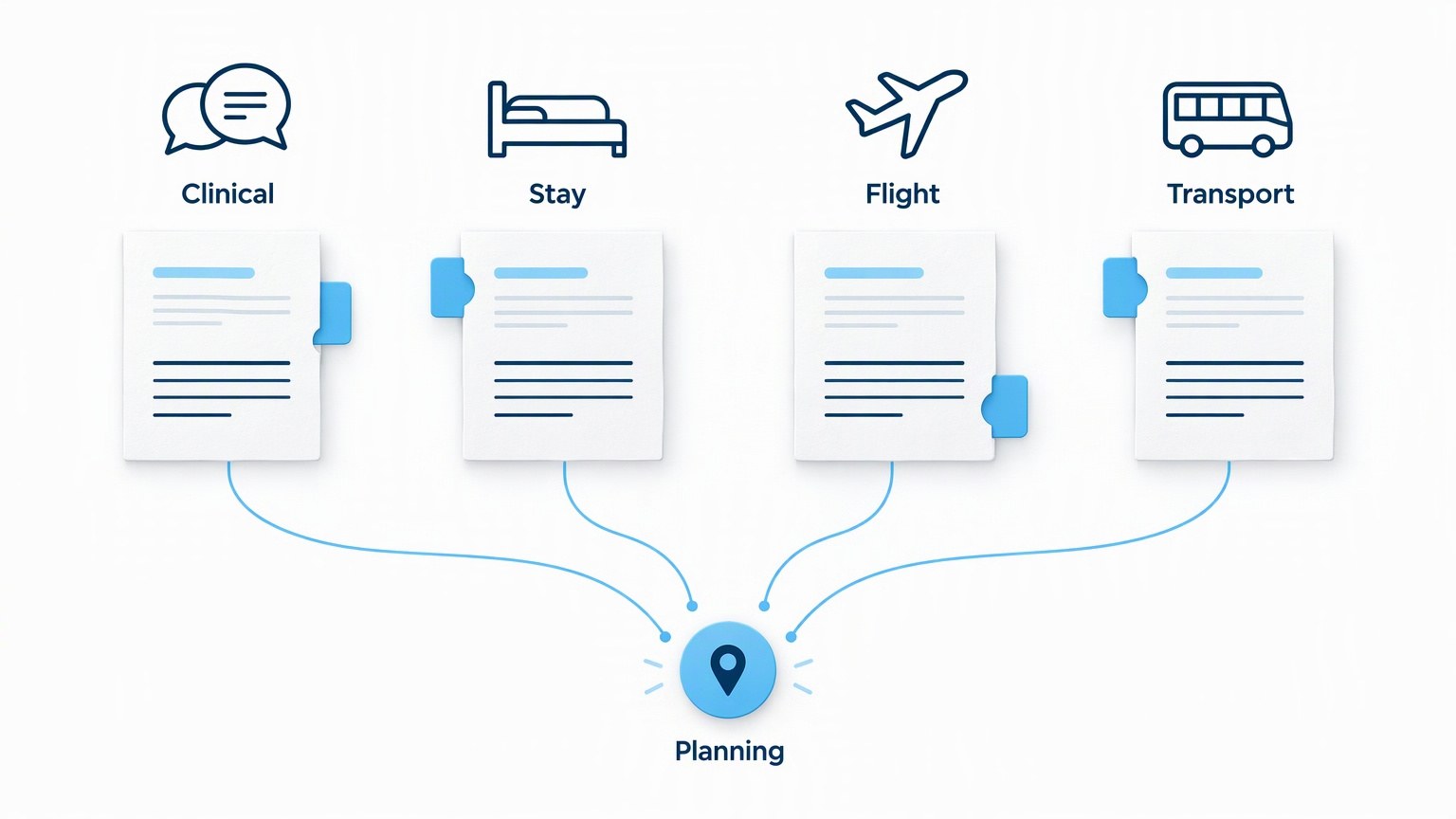
Use Hospitality Cancun's guidance for the planning handoff
Hospitality Cancun publishes travel and consultation-planning guidance. Use it to organize the nonclinical side of your research, while leaving suitability, treatment and individual recovery advice with the qualified treating clinician.
Read our Cancun medical-tourism buyer guide for broader preparation. In a later conversation with a confirmed contact, ask whether your particular planning inquiry falls within our current scope. Do not treat an inquiry as a confirmed appointment or accepted referral.
Before submitting any information, clarify who will receive it and for what purpose. The first submission is limited to name and email, with an optional contact-method preference. Travel details may be discussed later with the confirmed travel contact. Do not put records, attachments, payment details or insurance identifiers in a general inquiry.
Permission to answer your inquiry, optional marketing, and referral to a specifically named provider are separate choices. A requested reply is not marketing consent. Diagnoses, scans and clinical records belong only in a named provider-confirmed secure channel.
Frequently Asked Questions
Should I tell my new manager that I am researching rhinoplasty?
You can separate an administrative discussion about attendance or leave from a discussion of personal treatment goals. Ask the appropriate employer contact what information its process requires before deciding what to disclose. This guide does not establish your employer's policy or any legal entitlement to leave.
Can I use before-and-after photos to decide whether to proceed?
Photos can help you express preferences, but they cannot establish suitability or predict your individual result. Take your goals to a qualified clinician for assessment. Avoid turning a desired image into a requirement to look different by orientation, a staff photo, or your first public-facing assignment.
Does a companion's availability make the trip workable?
A companion's available dates solve only part of the planning problem. Any support requirements must come from the actual care plan. Compare those requirements with the companion's ability to remain available, and keep their travel arrangements separate from assumptions about when you can fly or resume work.
Should I combine the visit with sightseeing?
Keep sightseeing optional rather than making it part of the reason the care trip must happen. Any activities need to fit the treating clinician's individual guidance and follow-up plan. A tourism itinerary should not determine treatment timing or turn a necessary appointment into a scheduling inconvenience.
What if I decide against rhinoplasty after a consultation?
You can decide not to proceed. Learning that the plan does not fit your goals or work commitments is a useful outcome of research. If you have already paid for any service, its applicable cancellation or refund terms determine the financial consequences; the consultation itself does not establish refund rights.