

Care and Travel Planning
Choose an arrangement by tracing who confirms care, communicates changes and handles the practical steps around your visit.
A polished proposal can describe the procedure and lodging while leaving the work between them unclear. Your comparison should reveal who acts, what confirmation you receive and what happens when the original plan no longer fits. The goal is an arrangement you can carry out, not merely a reassuring description.
Compare direct communication with a defined coordination role
Choose direct provider communication and separate travel bookings when the care provider gives clear instructions and you can manage the practical arrangements. Consider a coordination role when it accepts specific tasks you would otherwise need to perform, such as passing an appointment change to the lodging contact.
The meaningful difference is responsibility, not convenience language. A coordinator who forwards messages but cannot confirm a reservation change offers something different from a contact assigned to complete that change. Neither role should replace the treating clinician's decisions about suitability, aftercare or travel readiness.
Compare proposed arrangements against the same tasks. You may prefer keeping control of flexible reservations while delegating appointment-related logistics. Conversely, a bundled description may still leave you responsible for contacting each supplier. Select based on the work actually assigned, including what remains yours.
The comparison below describes arrangements to evaluate, not services assumed to be offered by any particular organization.
Turn published provider information into a procedure-specific comparison
Published organization information is a starting point, not a complete answer about who will coordinate your tummy tuck. When reviewing the Costamed information on Hospitality Cancun's website, distinguish the organization described from the actual clinician, facility and contacts proposed for your care.
Start with the treating clinician's full identity and the proposed facility. Then verify the claimed professional credentials with the relevant issuing body, matching the individual rather than relying on a brand description. Establish separately whether a travel organizer has any role in the proposed arrangement.
Next, compare the provider's procedure-specific answers: who conducts the consultation, who decides whether to proceed and who issues preoperative and follow-up instructions. A general description of services does not assign these responsibilities for you.
Keep clinical selection separate from travel support. An efficient planning contact does not establish a clinician's qualifications, and a qualified clinician's involvement does not establish included lodging or transportation. For the broader selection, see comparing tummy tuck options in Cancun.
| Arrangement | Choose When | Reason | Trade-off |
|---|---|---|---|
| Direct provider contact plus reader-managed travel | You can manage reservations and receive clear provider instructions. | You control practical decisions and communicate directly about care. | You must carry confirmed schedule changes into your bookings. |
| Defined coordination role plus direct clinical access | You want specific practical handoffs delegated. | An identified contact takes responsibility for agreed tasks. | Scope and authority need to be explicit; clinical decisions remain with the provider. |
| Proposal with unclear responsibilities | Do not choose yet. | A coordination label does not identify who completes each task. | Resolve the unassigned work before comparing it with clearer arrangements. |

Map each communication handoff before committing to travel
A usable handoff identifies the sender, the recipient and the confirmation that allows the next step to proceed. Compare this sequence rather than accepting a promise that someone will keep everything organized.
During the later planning stage, use a short responsibility checklist:
- Preoperative documents: the named provider identifies what is needed and confirms its secure submission channel.
- Consultation outcome: the clinician explains the proposed care and what remains undecided.
- Appointment timing: the care provider confirms the schedule before it becomes the basis for travel arrangements.
- Travel action: you or an agreed travel contact handles the relevant reservation.
- Language: establish how you will receive understandable clinical explanations and written instructions in English.
For example, “documents sent” is not the same as “documents received and reviewed.” If an assessment is still pending, the next decision is whether to delay committing to travel, not whether to assume the procedure will proceed.
Keep appointment confirmations and supplier confirmations distinct. Each answers a different question, and neither substitutes for the other.
Test the arrangement with a changed follow-up appointment
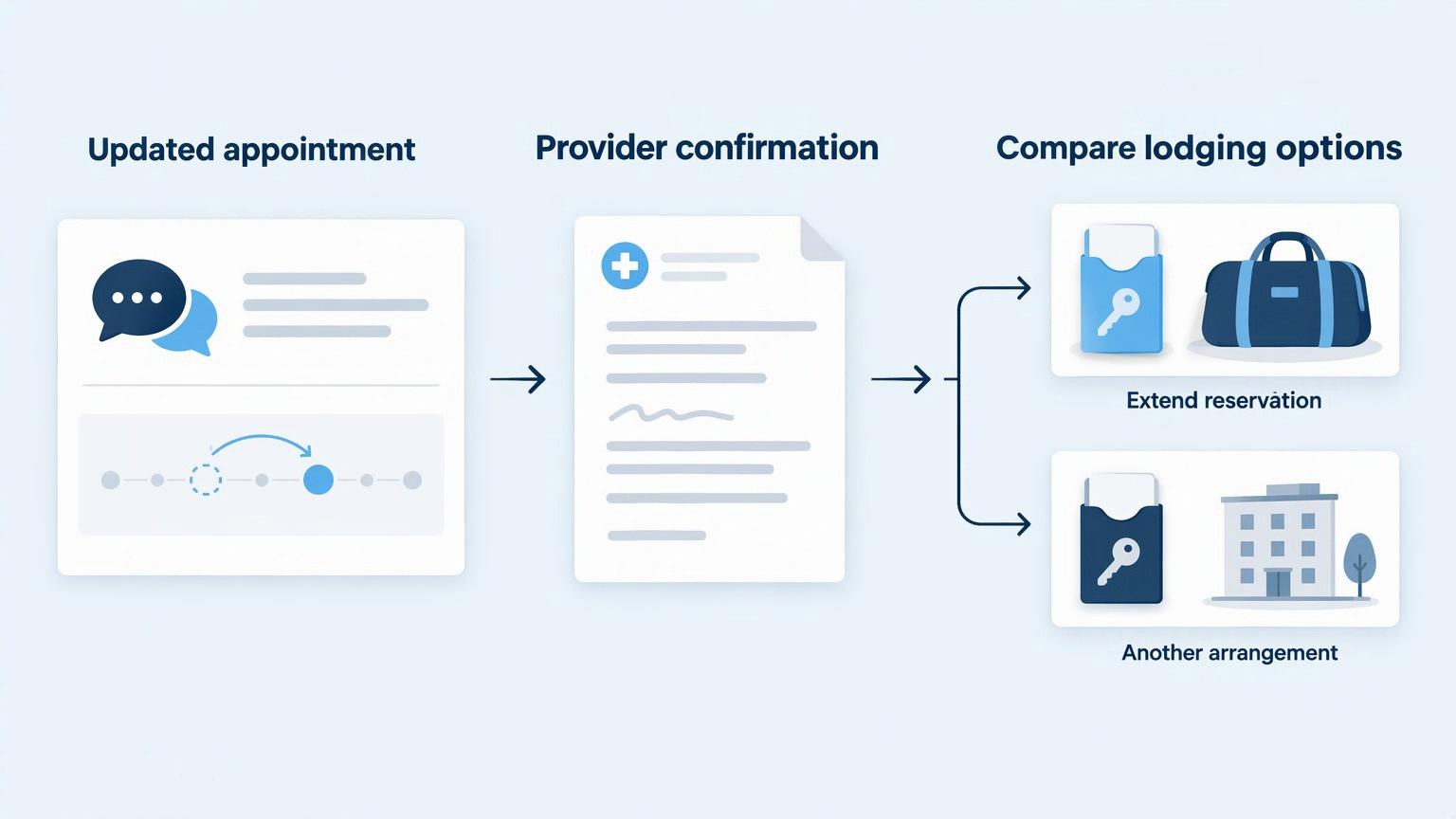
A changed follow-up appointment tests whether responsibilities are usable when the schedule moves. The clinical contact confirms the care requirement; the person assigned to travel arrangements handles the reservation consequences.
Say your clinician schedules a further review after your planned hotel checkout. You have a lodging reservation, but you do not yet know its extension terms. First, obtain the provider's updated appointment confirmation. Then compare extending that reservation with making another lodging arrangement, using the clinician's actual requirements and the suppliers' terms.
If you manage bookings directly, you handle that comparison. If an agreed coordination role includes reservation changes, that contact performs the task within its stated authority. Prefer the latter only if the delegated work is useful to you and clearly assigned. A schedule change alone does not establish a need for additional clinical support.
An extra hotel night remains a travel charge even when a clinical decision causes it. You cannot determine who pays, whether it is included or which change or cancellation terms apply unless the applicable written agreement answers those questions. Insurance coverage and claim conditions are separate from supplier obligations. See comparing the full trip cost.
Require a clinical escalation plan that continues after the trip
Clinical concerns need a provider-defined route, not just a travel contact. Compare arrangements by whether the treating provider explains routine postoperative contact, after-hours escalation and follow-up after you return to the United States.
Distinguish a scheduling question from a concern requiring clinical assessment. A travel organizer may handle an appointment-related reservation task if agreed, but that does not make the organizer responsible for interpreting symptoms or deciding treatment. Obtain the clinician's instructions for when and how to seek urgent help rather than relying on a general message inbox.
For the return home, establish what follow-up the treating provider proposes, what records you will receive and how another clinician can contact that provider. Do not assume a clinician at home has agreed to accept postoperative care merely because records will be available.
Flight timing and length of stay depend on the clinician and follow-up plan. A convenient departure date, a package duration or a flexible ticket does not establish individual clearance to fly. Assess whether you can carry out the proposed follow-up before finalizing the travel commitment.
Keep the first contact separate from later planning
Before submitting any information, clarify who will receive it and the purpose of collection. Once those details are clear, the first inquiry is limited to name and email, with optional contact-method preference. That limit does not expand after confirmation.
Travel dates, destination, companions and room needs may be discussed later with the confirmed travel contact. Diagnoses, scans and clinical records belong only in a named provider-confirmed secure channel. Do not send clinical records, insurance numbers, payment details or attachments through a general inquiry form.
Keep permission to answer your requested inquiry separate from optional marketing and from referral to a specifically named provider. Agreeing to a planning conversation is not agreement to the other purposes.
Prepare your comparison privately: the proposed clinical contacts, delegated travel tasks and responsibilities still to be assigned. Those notes help you evaluate a later conversation; they are not additional first-form fields.
Frequently Asked Questions
Can my companion be my coordinator?
A companion can handle practical tasks you agree on, such as keeping reservation confirmations accessible or helping with scheduling. That does not make them a clinical contact. Any assistance required by the care plan must be defined by the treating clinician, rather than inferred from a companion's presence.
Does an English-language email mean the whole consultation will be in English?
No. An English-language planning exchange establishes only how that exchange was handled. Establish separately how clinical discussions, consent explanations and written instructions will be communicated. If interpretation is proposed, identify its role and availability rather than assuming the travel contact will interpret medical information.
Does clear coordination establish that a provider is qualified?
No. Coordination describes how work and communication are organized; professional qualifications are a separate verification task. Match credential claims to the named clinician and relevant issuing body. A clear responsibility map can make an arrangement easier to evaluate, but it is not evidence of treatment suitability or outcomes.
Should I seek another clinical opinion before choosing the travel arrangement?
A separate qualified clinical opinion can help you evaluate the proposed care when you remain uncertain about its scope or suitability. Keep that assessment separate from comparing travel convenience. If the clinical plan changes, revisit the logistics based on the revised plan rather than preserving bookings as the deciding factor.
Can I assume my usual clinician will handle follow-up at home?
No. Contact that clinician separately to establish whether they can take the proposed follow-up role and what information they need. The treating provider's plan to supply records does not establish another clinician's acceptance. Resolve this before relying on local follow-up as part of your chosen arrangement.