

Care Contact Planning
Build a contact map that tells you who can answer, who can relay a question, and who handles the practical arrangements.
A saved number is not yet a care-contact plan. Know whose office it reaches, what that person can answer, and where questions outside their role go.
This guide maps those connections, rather than recovery activities or follow-up schedules. The result should be a small, usable contact map, not a long list of names with unclear responsibilities.
Match the question to the person who can answer it
Ask for the treating clinician’s name, a clinical administration contact, and whoever handles your travel arrangements. These are distinct roles, not a promise that every arrangement includes separate staff.
The clinician answers individual questions about suitability, care instructions, and clearance to travel. An administrative contact may arrange communication with that clinician or clarify appointment details. A travel contact handles nonclinical arrangements within their agreed responsibilities.
A coordinator can help when their role is clear. Distinguish between answering within their authority and passing a question along. For clinical judgment, identify who makes the decision and how their answer reaches you.
One person may handle several administrative tasks without being your clinician. Several contacts are not necessarily better if nobody owns the next step. Use the comparison below to assign questions by substance rather than title.
A Hospitality Cancun inquiry is not an appointment confirmation
No. Hospitality Cancun’s inquiry notice states, “This form does not confirm a clinical appointment.” Separate an inquiry acknowledgment from confirmation by the provider responsible for your consultation.
Our homepage names Riviera Maya and Cozumel Island in its destination information. Those descriptions are not your consultation address or proof of a provider relationship. A Cancun search does not identify the office that would see you.
Seek appointment confirmation from the relevant provider identifying the clinician or service, location, and appointment details. An inquiry acknowledgment does not establish provider acceptance or scheduling.
The website contact section is not a medical-advice or emergency channel. Hospitality Cancun publishes travel and consultation-planning guidance. Use our guide to comparing care plans to organize your comparison; obtain individual clinical answers from the treating provider.
| Question or Situation | Suitable Contact | Reason | Limit |
|---|---|---|---|
| Is the proposed treatment suitable for me? | Qualified treating clinician | Requires an individual clinical assessment | An inquiry handler cannot establish suitability |
| Which appointment has been confirmed? | Provider’s clinical administration contact | Identifies the actual scheduled consultation | Scheduling authority is not clinical judgment |
| Can my reservation be changed? | Relevant supplier or agreed travel contact | Concerns a travel arrangement | Cannot give clearance to fly |
| I need a clinical answer but only know a coordinator | Coordinator for routing to the named clinical contact | Can establish who receives and answers the question | Relaying a message is not answering it |
Verify the contact’s identity and authority
Establish who the person is and what they are authorized to do. A familiar logo or friendly reply does not establish either.
Start with the clinician’s full name and practice or facility. Check claimed qualifications against the relevant credential issuer’s own records, matching the identity carefully. One professional’s credential does not establish another person’s responsibilities or a facility’s status.
Confirm administrative contacts through the provider’s independently established communication route. Determine whether they handle scheduling, relay clinical questions, or perform another defined task. Save that role beside their details to distinguish administrative replies from clinical advice.
For travel arrangements, identify the supplier or planning contact responsible for each reservation. Changing lodging or transportation does not confer authority over care. If a contact cannot identify who would answer your medical question, mark that role as still needing confirmation rather than assigning it to whoever replies fastest.

Keep inquiry details, medical records, and permissions separate
Medical records belong only in a named treating-provider-confirmed secure channel. Before submitting any information through Hospitality Cancun’s contact section, clarify the recipient and purpose. If either is unclear, wait.
The first submission allows only name, email, and an optional contact-method preference, even after recipient confirmation. Do not add dates, destination, companion or room details, narrative, proposal text, or attachments.
Ordinary travel details may be discussed later with the confirmed travel contact. Diagnoses, scans, and clinical records require the separate provider-confirmed channel. Payment details and insurance identifiers are not clinical records and do not belong in the general inquiry; do not assume the clinical channel is their destination.
Separate permission to reply to your inquiry, optional marketing, and referral to a specifically named provider. A requested reply is not marketing consent. Before permitting an introduction, identify the provider and purpose.
Split a mixed care-and-travel question into separate actions
Separate clinical judgment from logistics before choosing a contact. A booking change alone does not establish a need for clinical input.
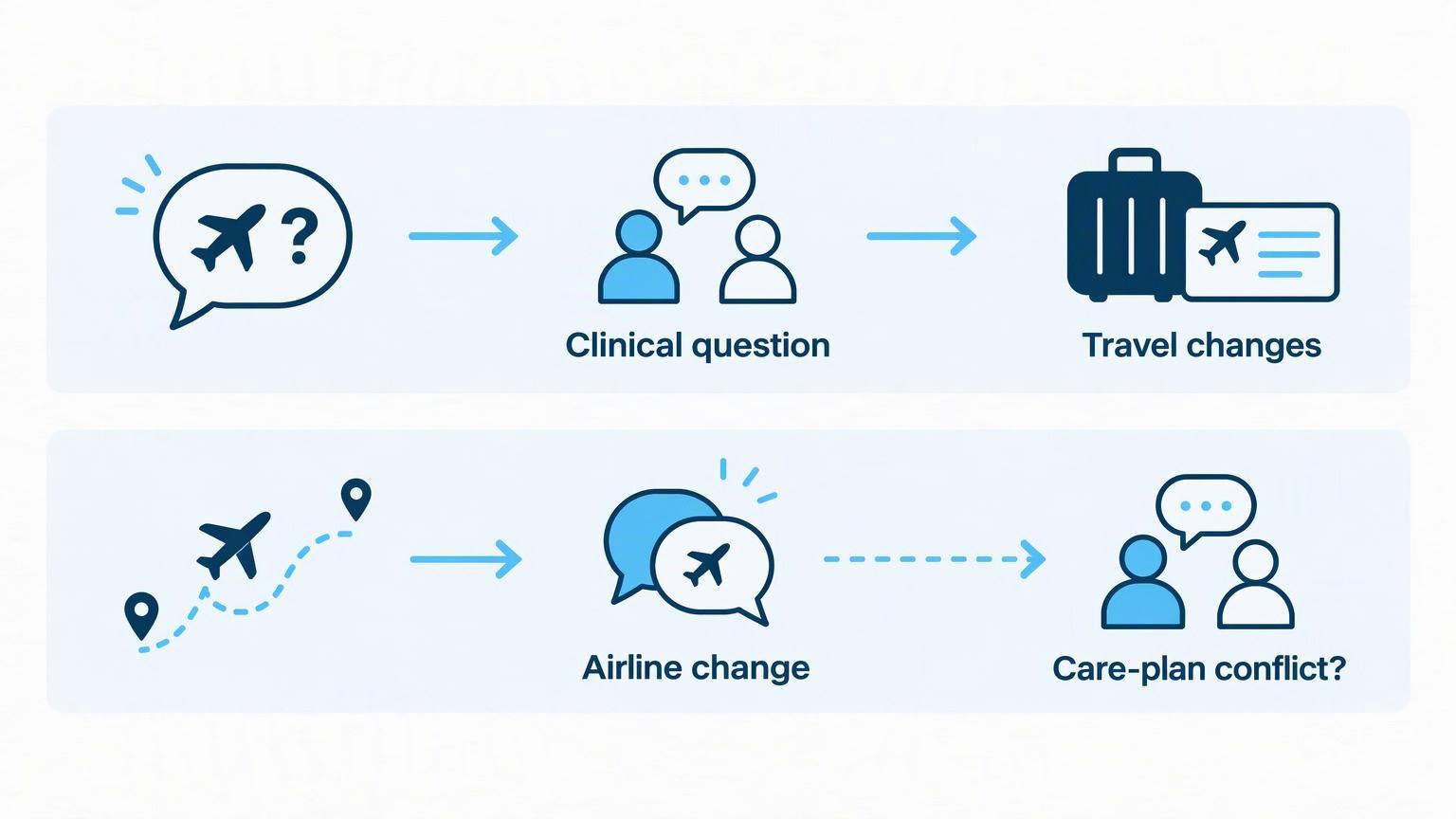
For example, suppose you have a return flight booked and want to know whether you can leave as planned. If the question is whether your condition and care plan permit flying, ask the treating clinician through the confirmed clinical route. A travel contact cannot give individual clearance.
After receiving clinical direction, discuss any reservation changes with the airline or agreed travel contact. Share the scheduling information needed, not medical records in a general travel conversation. Clinical direction does not determine who pays a change charge or whether a supplier waives it; those consequences depend on the applicable written terms.
If instead the airline moves your flight and you need another departure option, start with the airline or travel contact. Clinical input becomes relevant if an alternative conflicts with your care plan. The starting constraint determines which contact acts first.
Make the contact map usable when the usual person is unavailable
Add provider-directed backup and urgent-contact instructions to your map. Do not assume the appointment contact monitors clinical concerns after hours.
Keep a private contact card covering:
- Each person or office, organization, and role.
- The routine clinical-question route and who answers.
- The provider’s urgent and after-hours instructions.
- The backup when the routine contact is unavailable.
- The travel contact’s separate responsibilities.
- The contact for care questions after returning home.
Record actual provider instructions, not an invented waiting period. Urgent or emergency concerns should follow the appropriate emergency-care route, not wait for a travel-planning reply.
Keep the card accessible to you. If a companion helps communicate, establish what they may receive; their presence does not automatically grant access. Our guide to traveling with a companion addresses that separate planning decision.
Frequently Asked Questions
Can I use a group chat for all communication?
A group chat shows participants, but does not establish their authority or suitability to receive clinical records. Identify everyone involved and the chat’s purpose. Send medical records only through the named provider-confirmed secure channel, keeping them out of general planning conversations.
What if I prefer to communicate in English?
Establish English-language arrangements with the actual provider. Determine whether you will speak directly with the clinician or through an interpreter, and who clarifies anything you do not understand. An English-language website or administrative reply does not establish how your clinical consultation will work.
Is a first name enough for my contact list?
No. Record the full name where available, organization, role, and confirmed contact route. A first name alone makes affiliation checks and finding a replacement harder. When responsibilities rotate, an identifiable office contact can help you reach whoever currently handles the task.
Should my companion be the main contact?
That depends on the help you want and what the provider permits. Distinguish help with travel messages, permission to receive specified updates, and assistance with communication. Keep your own access to the map so your companion is not your only connection to the provider.
How should I update the map if the clinician changes?
Confirm the new clinician’s identity, clinical contact route, and administrative responsibilities. Establish whether existing messages or records reached the new provider through the appropriate channel. Label previous contact details as superseded so you do not accidentally send a new question to the former contact.