
Consultation Planning
A useful records-sharing plan explains how information reaches the clinician abroad and how you retrieve it for care at home.
Records sharing is a practical part of consultation planning, not just an upload step. A document can reach an office without being usable for the intended review. Work through access, permission, format, and responsibility separately so you know what each answer allows you to do next.
How will you get access to your records?
Start with the office that holds your existing records and the clinician who would receive them. Establish how you can obtain a copy, then ask the receiving clinician which records are relevant to the proposed consultation. This avoids gathering a large archive without knowing what is needed.
Ask the record-holding office how requests are made, how identity is checked, what copies are available, and whether any processing time or charge applies. These are questions about that office's process, not assumptions about a universal rule. Viewing information in an account is different from having a copy you can transfer.
Plan the reverse direction too. Before care abroad, establish how you would request records created during the visit, whether copies can be obtained after departure, and whom to contact if access fails. Keep clinical document selection with the clinician. For a dental-focused companion guide, see records to request for dental implant care in Mexico.
What exactly are you permitting when records are shared?
A useful permission discussion identifies the recipient, the purpose, and the information involved. Ask the sending office what release or authorization process applies to the proposed transfer. Do not treat a general planning conversation as permission to circulate your clinical file.
Keep three choices separate: permission to respond to your requested inquiry, optional marketing, and referral to a specifically named provider. A requested reply is not marketing consent. Permission for an introduction also does not explain the provider's process for obtaining clinical records.
For the clinical transfer, establish which provider or office will receive the records, why they are requested, whether anyone else will receive them, and how additional recipients would be handled. Ask how you can change your instructions and what that change would mean for information already sent.
The useful result is a defined disclosure you understand, not simply a checked box. If the recipient is unnamed or the purpose remains broad, resolve that ambiguity before authorizing the transfer.
| Arrangement | Suitable When | Reason | Trade-Off |
|---|---|---|---|
| Provider-to-provider transfer | Both offices support an agreed secure route. | You do not have to relay the files yourself. | You still need receipt confirmation and a way to obtain your own copy. |
| Patient-mediated secure upload | You can obtain the accepted files and the named provider confirms its secure channel. | You can retain copies and track what you submit. | You must manage file completeness and compatibility. |
| Copies presented at the consultation | The clinician accepts review during the visit. | It may suit a consultation that does not require advance records review. | It does not meet a requirement for review before arrival. |
Which format and transfer route will the clinician accept?
Choose the route around the receiving clinician's requirements and the sending office's available options. Do not assume that offices in different countries share a system, or that a file you can open is sufficient for clinical review.
Ask whether the recipient needs a written report, underlying images, or both. Also establish the accepted file type, any viewing requirements, and the language needed for review. A screenshot, a report, and a complete imaging file should not be treated as interchangeable without the clinician's agreement.
The comparison below describes possible arrangements, not services every provider offers. Provider-to-provider transfer may avoid having you relay files, while a patient-mediated upload may give you a copy to retain. Either route still needs an identified recipient and a named treating-provider-confirmed secure channel.
Timing matters when the clinician wants records before the consultation. Presenting copies during the visit is an option only if the receiving clinician accepts that timing. It does not replace an advance-review requirement.
What if the available file is not the requested record?
Resolve the mismatch with the receiving clinician rather than choosing the easiest file to send. The next action depends on whether the available document meets the stated review requirement.
Say you are considering a consultation in Mexico and have a PDF report from a previous scan. The receiving clinician asks for the images as well. You could upload only the report, ask the original imaging office about transferring the images directly, or obtain the image files for an accepted secure upload.
Sending the PDF alone does not satisfy the request unless the clinician agrees it is enough for the intended review. The better next step is to establish which image format the receiving office accepts, then ask the original office which matching export or transfer it can provide.
If neither route works, return to the receiving clinician for an alternative. Do not decide yourself that another scan is necessary. This resolves a document problem without turning it into a clinical decision or assuming that a travel contact can interpret the record.

Who confirms receipt, review, and the handoff home?
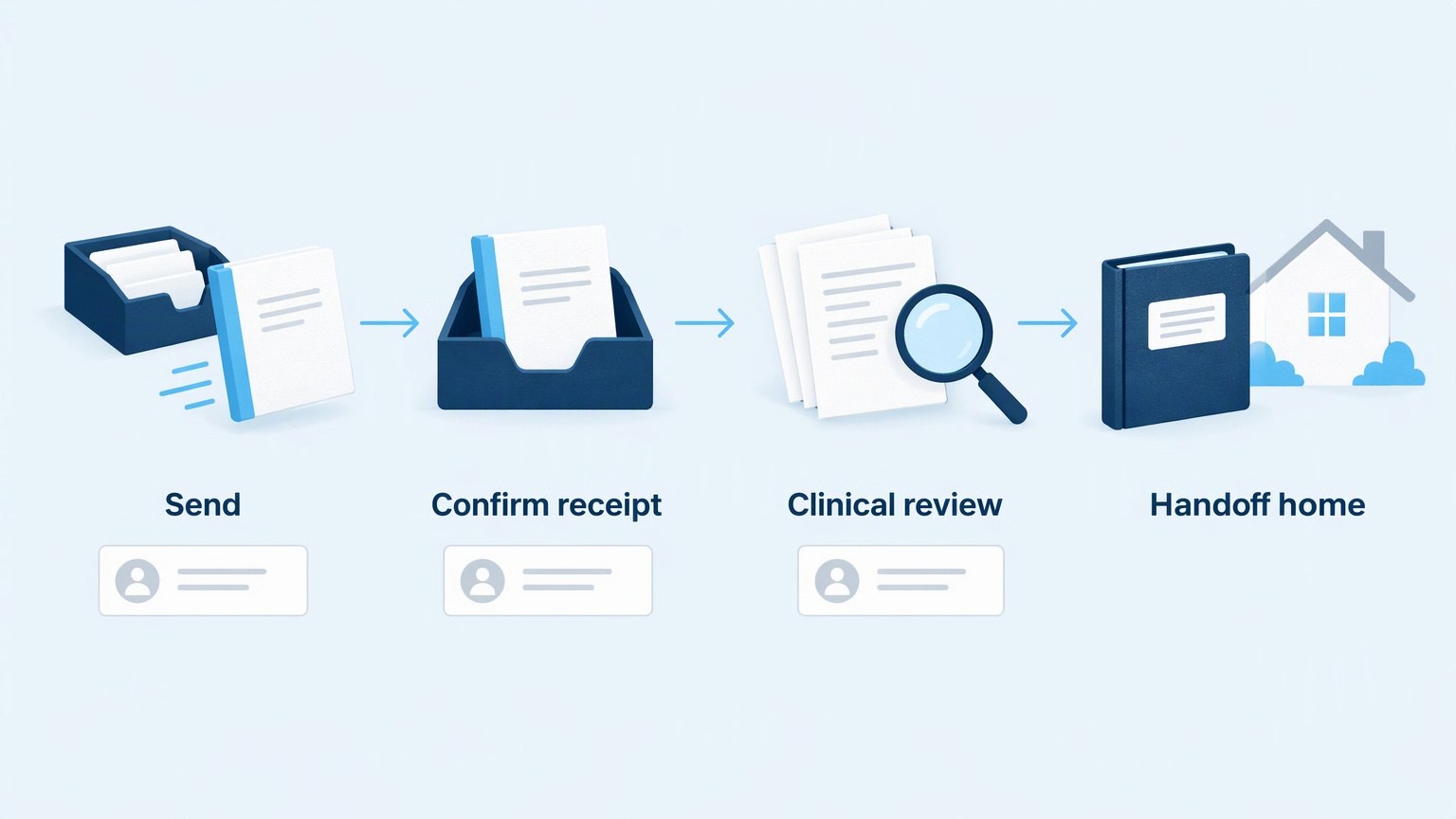
Identify responsibility for each milestone: sending the files, confirming receipt, reviewing them, and supplying records after the visit. An upload confirmation does not tell you whether the clinician has reviewed the contents.
Ask the sending office whom to contact about an incomplete export. Ask the receiving office who handles unreadable files or missing documents. The treating clinician determines whether the information supports the intended review and answers clinical questions about its contents.
For the return handoff, establish with your home clinician what information they need and how they will receive it. Do not assume that sending records means the home clinician has accepted a follow-up role. Our guide to comparing Cancun care plans addresses the broader care-plan decision.
Keep a short handoff checklist privately:
- Sending and receiving office contacts.
- Documents requested and transfer method agreed.
- Receipt status and any missing items.
- Clinical-review status.
- Process for obtaining visit records and arranging the handoff home.
What belongs in a travel-planning inquiry?
A first Hospitality Cancun contact submission is limited to your name and email, with an optional contact-method preference. Before submitting any information, clarify who will receive it and the purpose. If either is unknown, wait; sending fewer details does not resolve unknown routing.
Do not add travel dates, destination, companion or room details, a planning narrative, or attachments to that first submission. Ordinary travel details may be discussed later with the confirmed travel contact after recipient and purpose are clear.
Diagnoses, scans, and medical records belong only in a named treating-provider-confirmed secure channel, not a general inquiry form. Payment details, financial records, and insurance identifiers also do not belong in a general inquiry. They are not clinical records, and this guide does not establish a later collection route for them.
We publish travel and consultation-planning guidance at Hospitality Cancun. Reading that guidance or opening the contact section does not arrange a clinical records transfer. Use it to inform planning while keeping clinical sharing with the identified provider.
Frequently Asked Questions
Does a privacy-law label prove that a transfer is appropriate?
Do not use a label alone to decide. Ask the organization to explain the recipient, purpose, information requested, and transfer process. Legal protections and obligations depend on the organization and applicable rules. If you need a legal determination, seek qualified advice rather than relying on a marketing statement.
Can a companion help manage my records?
Ask each provider how it handles access or communication involving a companion. Traveling together does not establish the companion's authority to receive clinical information. Clarify the role you want them to have and the provider's process for recognizing it, rather than handing over your account credentials.
What should I do if I notice an error in a record?
Contact the office that created the record and ask about its correction or amendment process. Identify the disputed entry clearly through that office's appropriate channel. Do not silently edit the original file before sharing it. Ask how any correction would be communicated to recipients who already received a copy.
Should I translate records myself?
Ask the receiving clinician what language is acceptable and whether a translation is needed. If it is, establish the type of translation they accept and who will arrange it. Keep the original available alongside the translation, and do not substitute your own interpretation for the clinical wording.
What if someone asks for my entire medical history?
Ask the requesting clinician which information is needed for the intended consultation and why. Do not independently omit information the clinician says is relevant, but do not assume a broad request defines its own scope. Establish the requested records and recipient before using the provider-confirmed secure channel.