

Consultation Preparation
Turn a care document into focused questions, a provider-confirmed explanation and a clear reference you can consult later.
A document can look complete while leaving you uncertain about a particular sentence. Your job is not to rewrite the care plan or decide which clinical advice sounds more convincing. It is to identify where your understanding stops and bring that exact point to the treating provider.
This review method helps you prepare questions. It does not prescribe rhinoplasty care, determine treatment suitability or supply recovery instructions.
Start With the Document Your Provider Intends You to Use
Start by identifying which document the treating provider intends as your care reference. A package page, consultation summary and personal notebook serve different purposes; none should automatically stand in for individualized instructions.
For example, the PlacidWay listing for Dr. Victor Samano's rhinoplasty package describes follow-up visits and postoperative instructions. That description tells you instructions are part of the advertised process. It does not provide your instructions or establish which document applies to you.
When you receive a document, look for its source, any date or version identifier, and the stage of care it addresses. If those details are absent, prepare a focused question: “Is this the current reference you want me to use, and does it apply to my care?” A newer-looking file is not, by itself, proof that it replaces another one.
Keep promotional information outside the instruction set. That makes the next step a review of the provider's intended advice, not a comparison of advertising language.
Mark the Exact Wording You Cannot Explain
Mark the smallest passage that leaves you unsure, then name what is missing. A precise question is easier to answer than “Can you explain all of this?”
Read each relevant sentence for its action, timing and conditions. You are checking whether you understand those elements, not deciding whether the instruction is medically appropriate. Words such as “later” or “as directed” may refer to information elsewhere; note where you cannot find that reference.
- Action: What does the instruction mean for you to do?
- Timing: Is its start, end or sequence understandable?
- Conditions: Does it explain when it applies?
- Reference: Can you identify any other instruction it relies on?
In a separate question list, copy the wording and add the gap: “This sentence refers to another direction, but I cannot identify it. Which direction does it mean?” Do not fill the blank yourself.
This is a reading checklist, not a required clinical contents list. The treating provider determines what belongs in your individual instructions.
| What You Find | Next Step | Why |
|---|---|---|
| A package page mentions aftercare | Identify the actual provider-confirmed instructions | A service description is not your care reference |
| A sentence lacks a clear reference or condition | Quote it and identify the missing meaning | A focused question avoids guessing |
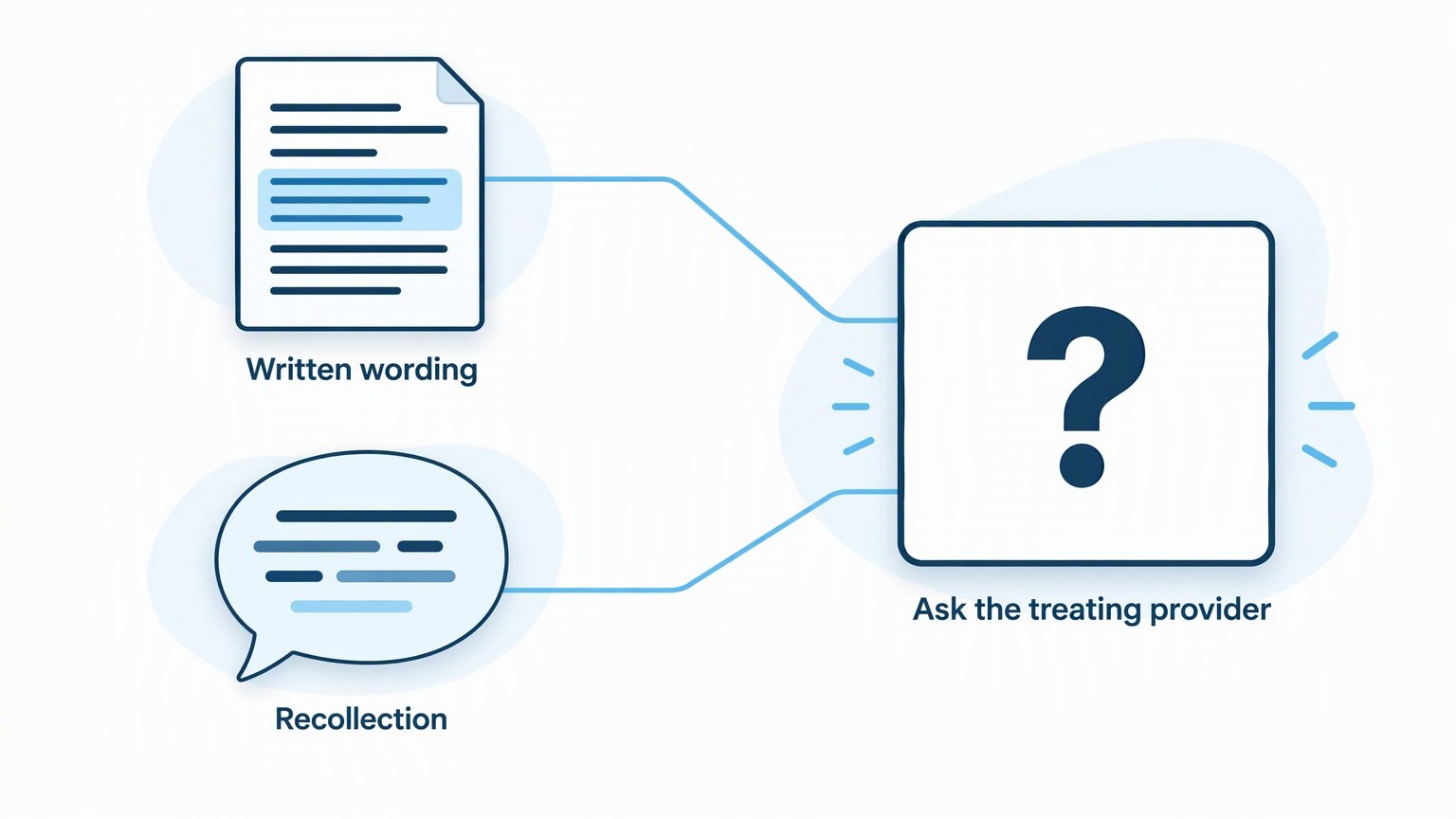
| Written wording differs from remembered advice | Ask the treating provider to reconcile both | Neither memory nor appearance settles the discrepancy |
| The provider clarifies or corrects wording | Identify the written reference to use afterward | An explanation should not leave competing versions |
Take Conflicting Instructions Back to the Treating Provider
The treating provider should clarify a clinical discrepancy before you act on the unclear instruction. Do not settle it by choosing the printed version, your memory or whichever translation seems easier to follow.
Say you remember being told that an action depends on a later review, but the written sentence appears to give an unconditional direction. You could follow the sentence as you read it, rely on your memory or ask the provider to reconcile them. The first two options each assume one account is correct. Requesting clarification addresses the uncertainty itself.
Bring the exact sentence and describe your recollection as a recollection, not a competing instruction: “I remember this depending on a review. Does this sentence include that condition, or have I misunderstood?”
The useful outcome is an explanation of what applies to you and a clear written reference. You do not need to prove that someone made an error. You need the provider to resolve the meaning. If a decision is time-sensitive, use the clinical contact route established by your provider rather than waiting on a travel-planning inquiry.
Review the Instructions Together, Not Just on Your Own
Yes, ask for an opportunity to review the instructions with the treating provider. Receiving a document does not replace being able to ask questions about it.
Use your marked passages to organize the discussion. After an explanation, describe your understanding in your own words: “My understanding is that this instruction applies under the condition you just explained. Have I understood correctly?” Let the provider correct your interpretation rather than treating your paraphrase as a new instruction.
Work through unanswered points before moving on to formatting or travel arrangements. A readable document and an understood document are not necessarily the same thing.
If language is the obstacle, establish how the provider will confirm that a translated version reflects the intended advice. Our language-planning guide for rhinoplasty care explains that distinction. Translation can help you access the wording; the treating provider still resolves its clinical meaning.
Before ending the discussion, identify both the reference to use and the route for any questions that remain.
Keep the Clarified Reference Separate From Your Notes
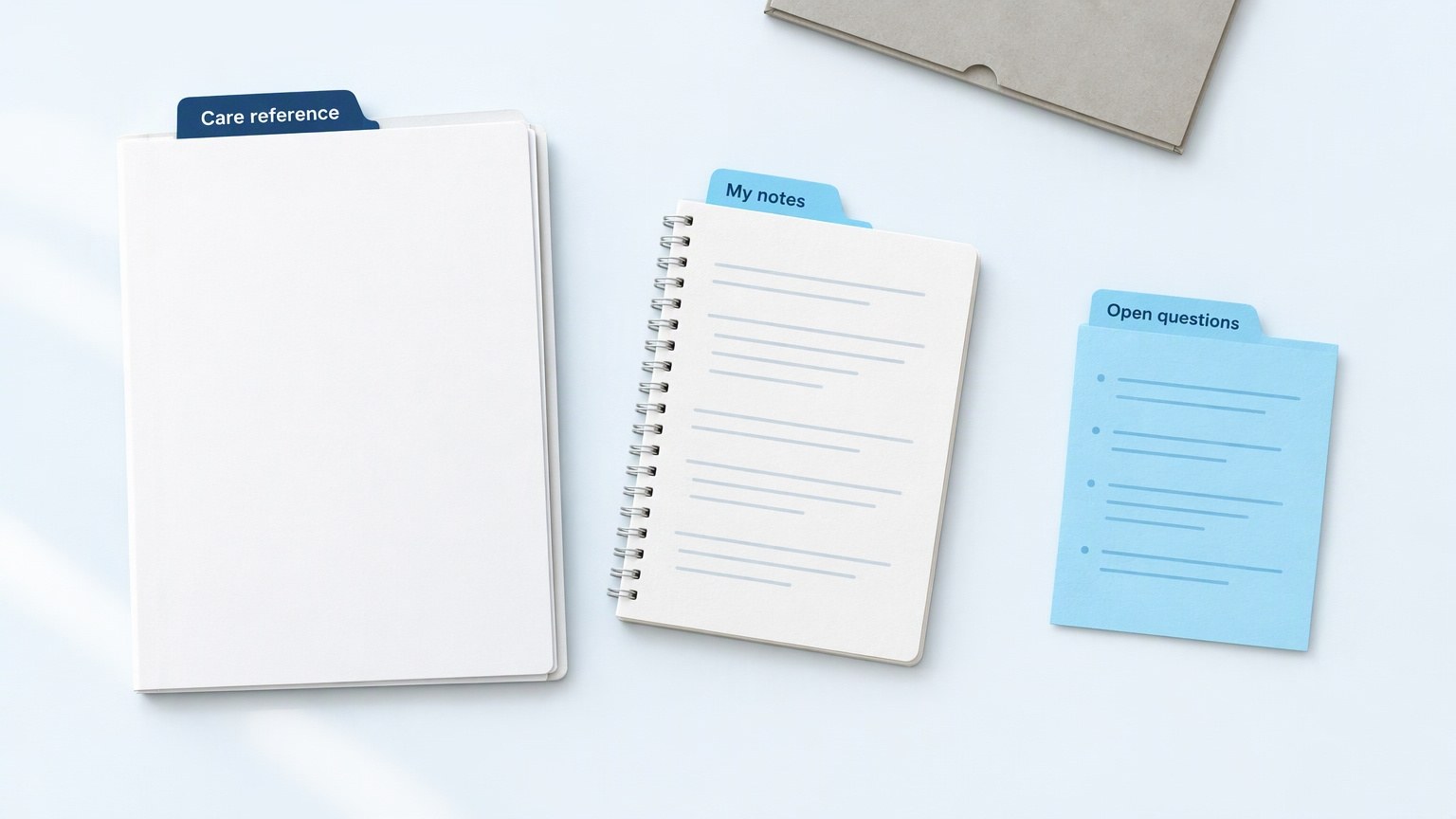
Keep the provider-confirmed instructions easy to identify, with personal reminders and older versions stored separately. A helpful note should not become mistaken for clinical advice.
When clarification changes the meaning of a sentence, ask the provider to make that correction clear in the written reference. Avoid editing the clinical wording yourself and presenting the result as the provider's document.
Use a simple private review record: the passage discussed, the question answered, the reference the provider identified and any questions that still need answers. This records the discussion without creating a replacement care plan.
If you retain an earlier copy, label it separately so you do not accidentally consult it as the current reference. Do not delete an unanswered question merely because the conversation has ended. Leave it marked until the provider addresses it.
The practical test is whether you can later distinguish three things at a glance: the provider's instructions, your own reminders and questions awaiting an answer. Clear organization preserves that distinction when several messages or files accumulate.
Use Clinical Clarification to Inform, Not Replace, Travel Planning
Clarify care instructions with the treating provider first, then address their established travel implications separately. A flight reservation or lodging plan cannot determine what a clinical instruction means.
For rhinoplasty in Cancun Mexico, flight timing and length of stay depend on the clinician and follow-up plan. A general statement about recovery is not individual clearance to fly. Keep broader arrangements separate with the rhinoplasty visit-planning guide.
Before submitting any information through a general inquiry, clarify the recipient and purpose. The first submission allows only name, email and optional contact-method preference. Ordinary travel details may be discussed later with the confirmed travel contact. Do not upload your instructions or clinical records through a general form; clinical information belongs in a named provider-confirmed secure channel.
Permission to answer your inquiry, optional marketing and referral to a specifically named provider are separate choices. A requested reply is not marketing consent. Keep the document-review conversation with the treating provider, even when a separate planning conversation helps organize your visit.
Frequently Asked Questions
Can an app help me prepare a question about a sentence?
An app may suggest wording for a question, but do not use its output to settle a clinical discrepancy or change an instruction. Keep the original sentence available and bring the uncertain meaning to the treating provider. Any translated explanation still needs provider confirmation.
What if the document is difficult to read on my phone?
Ask whether a more readable copy is available, such as a version that preserves the full text without cropped pages. Make sure it is the same provider-confirmed reference. Improving the display can help you review it, but it does not resolve unclear meaning or conflicting wording.
Should I make my own shortened care sheet?
Keep personal reminders separate from the provider's instructions rather than turning a shortened summary into a replacement. Condensing a sentence can remove a condition or reference that matters. If you want a simpler written explanation, ask the treating provider to confirm it before relying on it.
What if my question seems too small to raise?
If it changes your understanding of what an instruction means, it is worth identifying precisely. You do not need a long explanation: quote the passage and say which part you cannot interpret. The provider can address the meaning without you having to propose a clinical answer.
Does a clear instruction document establish a provider's credentials?
No. Understanding written instructions and verifying provider credentials are separate tasks. A polished document does not establish a clinician's qualifications, a facility's accreditation or a relationship with a travel-planning business. Review those matters independently rather than using clear communication as a substitute for credential verification.