

Consultation Preparation
Prepare to understand a surgeon's recommendation by connecting your priorities to the proposed approach, alternatives, and limits.
A useful consultation should leave you understanding the reasoning, not merely remembering a surgical label. Your job is to explain your priorities and understand the choices. The surgeon's job is to assess you and explain what is suitable. This guide helps you prepare that conversation without trying to make the clinical decision yourself.
Start with your goals, not a technique request
Prepare a short private note describing your priorities before discussing surgical methods. Begin with what bothers you, what you hope to change, and what you do not want changed. That gives the surgeon something more useful to assess than a request for a particular approach.
For example, “I want to discuss my profile, but I want to preserve the features I recognize from the front” expresses both a goal and a boundary. It does not prescribe an operation. If you have breathing concerns or previous nasal surgery, identify those as matters for clinical discussion rather than deciding what technique they require.
Rank your priorities if they compete. Is the appearance change more important to you than avoiding an external incision, or would that trade-off make you reconsider surgery? You can express a preference without assuming it is clinically achievable.
Keep this preparation for your conversation with the clinician. The useful result is a clear starting point: which wishes the surgeon can assess, which need clarification, and which may not be compatible with the proposed plan.
Compare open and closed approaches through the surgeon's rationale
Discuss open and closed rhinoplasty side by side, but do not choose between them solely from the incision description. Ask how each approach relates to the work the surgeon proposes for you.
PlacidWay's rhinoplasty overview describes closed rhinoplasty as using incisions inside the nostrils and open rhinoplasty as including an incision across the columella, the tissue between the nostrils. These descriptions explain the terminology; they do not establish which approach is suitable for you.
If the surgeon proposes open rhinoplasty, discuss why that access is useful for the intended work and how the external incision will be addressed. If closed rhinoplasty is proposed, discuss how the intended work will be performed through that approach and what limitations matter in your case.
Avoid treating “closed” as a promise of an easier experience or “open” as proof of a better result. Ask the surgeon to distinguish the incision approach from the actual changes planned. Those are related parts of the explanation, not interchangeable descriptions of the whole procedure.
| Discussion route | When it is useful | What to resolve |
|---|---|---|
| Discuss open rhinoplasty | The surgeon proposes an approach with a columellar incision. | Why that access is proposed and how the incision affects your priorities. |
| Discuss closed rhinoplasty | The surgeon proposes incisions inside the nostrils. | How the intended work fits that approach and what limitations apply. |
| Keep the choice open | The assessment or explanation is incomplete. | What must be clarified before evaluating the trade-off. |
Work through a preference that conflicts with the proposal
When a proposed approach conflicts with something important to you, resolve the conflict through the surgeon's explanation rather than accepting or rejecting the label immediately.
Say you want to discuss a profile change, want to preserve the appearance of other features, and strongly prefer to avoid an external incision. You have read about closed rhinoplasty and arrive expecting it. The surgeon instead proposes an open approach.
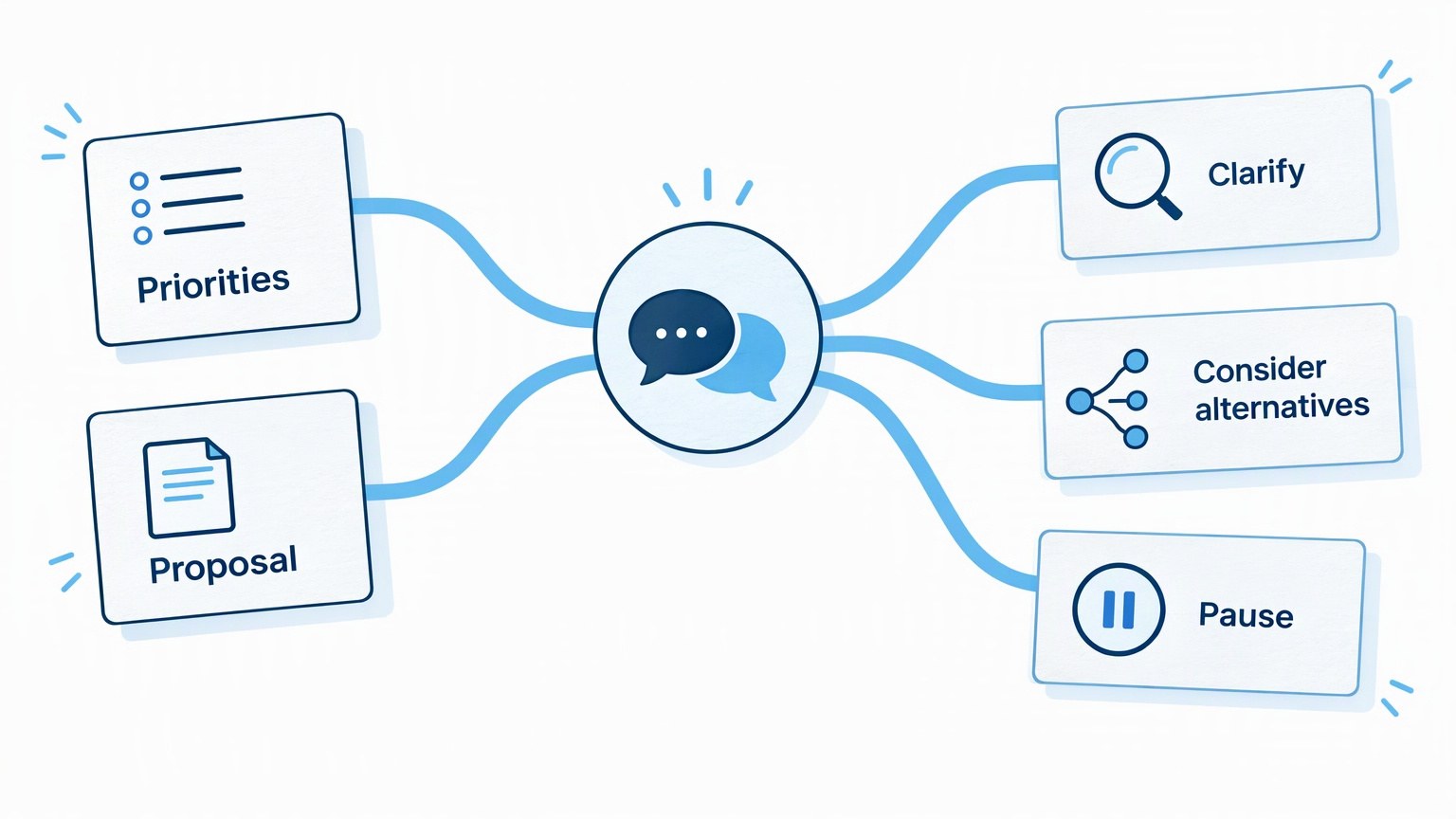
First, restate your priorities. Next, ask which intended changes led to that recommendation and whether a closed approach is an alternative for the same goals. Then ask what would differ if the plan changed: the work proposed, its limitations, or the expectations you would need to revise.
If the explanation connects the recommendation to your assessment and addresses your concern, you have a basis for considering the trade-off. If avoiding an external incision remains a firm boundary, discuss whether a different plan or no surgery is the better decision for you.
If the answer is only “this is the best technique,” pause. You still need the reasoning that connects your priorities, the assessment, and the proposed work. The outcome of this conversation can be further clarification rather than a commitment.
Evaluate the explanation, not just the recommendation
A sufficiently explained recommendation lets you describe why the surgeon proposes that approach, what it is intended to address, and what remains uncertain. You do not need to become a surgical expert, but you should not have to guess at those connections.
Use this compact checklist during the clinician conversation:
- Rationale: What findings support the proposed approach?
- Scope: Which planned changes address each of your priorities?
- Alternatives: What other approaches or decisions deserve consideration?
- Trade-offs: What risks and limitations apply to the proposed work?
- Uncertainty: What cannot be determined or promised at this stage?
Identify the clinician responsible for assessing you and explaining the plan. Verify claimed qualifications with the relevant issuing organization rather than treating a directory listing or promotional title as sufficient proof.
If surgeons recommend different approaches, compare their assessments and intended work before comparing labels. A difference is not automatically evidence that one is wrong. An additional opinion can help when the explanations remain incompatible or unclear.
Keep the financial discussion separate from this reasoning. Our guide to questions before requesting a rhinoplasty quote covers a related next task; a price does not explain technique suitability.

Use Hospitality Cancun's website for your information next step
Check Hospitality Cancun's homepage for current medical-tourism information, then determine whether the available information addresses your rhinoplasty-related questions. Keep the decision about technique with a qualified surgeon; website information is not an individual clinical assessment.
Identify your next information need in your private preparation: perhaps understanding a term, identifying who would explain a recommendation, or distinguishing general information from a clinician's advice. Use that distinction when reviewing the website. A general explanation may help you follow the consultation, but the surgeon still needs to connect the proposed approach to your own assessment and goals.
If the website does not answer your question, use its contact section to find out whether rhinoplasty-specific information is available. Do not assume that a general contact invitation confirms access to a particular procedure or technique.
For broader selection questions, the guide to comparing rhinoplasty options in Cancun is separate reading from this technique-preparation task.
Frequently Asked Questions
Do I need to know every surgical term before a consultation?
No. Prepare your priorities in ordinary language and ask the surgeon to explain unfamiliar terms in relation to the proposed work. Understanding why something is recommended is more useful than memorizing vocabulary. If you cannot explain a term back in your own words, request a clearer explanation.
Can reference photos replace a description of my goals?
Use reference photos as conversation aids, not instructions to reproduce another person's nose. Explain which specific feature interests you and which features of your own appearance you want preserved. Ask the clinician how the reference relates to your assessment rather than assuming the pictured appearance is achievable.
What if I forget an important question during the appointment?
Keep a private written list and mark questions as they are answered. Before the conversation ends, point out any questions that still need answers and ask the clinician how clarification should happen. Do not fill the gap with a general online description or assume that silence means a concern has been addressed.
What should I do if language makes the explanation unclear?
Ask how language support will work before relying on the discussion. During the consultation, restate the proposed plan and your understanding of its trade-offs so the clinician can correct misunderstandings. You should be able to express your priorities and understand the explanation, not merely recognize the technique name.
Should I decide immediately after hearing the proposed technique?
You can take time to consider whether the explanation addresses your priorities. Ask what decisions are actually needed at that stage and which questions still need answers. Do not let a technique label create a sense that the whole plan is settled when you still have questions about its purpose or limitations.