
Conference and Consultation Planning
Use your work agenda to make consultation questions more specific, not to turn an existing business trip into a procedure deadline.
An existing conference booking can make the idea of researching care feel more practical. You already have a reason to travel, but a work itinerary answers different questions from a care plan. The useful starting point is to separate what your employer requires, what you can change personally and what a qualified clinician must assess.
Choose the conference's role before arranging care
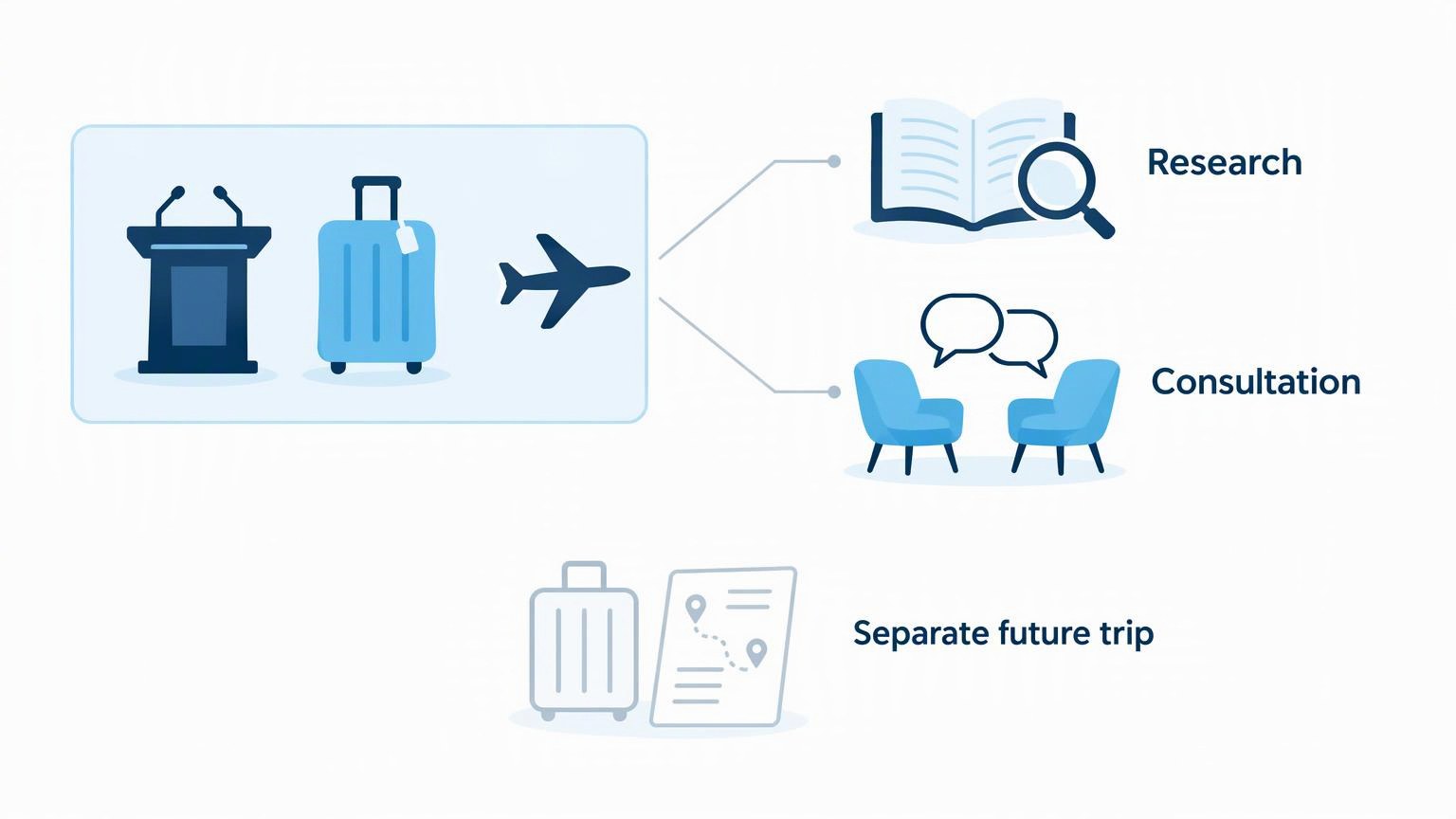
If your work attendance and return journey are nonnegotiable, use the conference as a research occasion rather than a procedure target. A consultation during the trip is another possibility only when the provider confirms it and your work schedule allows it. Neither choice commits you to treatment.
The alternatives below differ in what you must know before proceeding. Research can begin without an appointment. A consultation requires its own confirmation. A future procedure trip requires an individualized clinical plan, not merely an open slot after the conference closes.
This distinction also prevents a false choice between doing everything during the work trip and abandoning your search. You can learn about providers now, discuss your goals through an appropriate consultation channel and decide later whether traveling for care makes sense. The conference supplies context and a deadline for work, not a deadline for your medical decision.
Search for identifiable providers, not a date-fitting package
Start with a broad search for tummy tuck care in Cancun, then move from listings to the named clinician and proposed facility. Do not make availability around your conference the first filter: a convenient date cannot establish credentials or suitability.
Read result labels carefully. A body-lift listing and a tummy tuck listing do not necessarily describe the same proposed procedure. A package headline is also not an individualized recommendation. Record the clinician's full name, the facility name and the exact procedure described, then look for direct provider information and a way to verify claimed qualifications with the relevant issuing authority.
Ranking position needs interpretation. Bookimed describes its clinic ranking as considering patient demand, reviews, update frequency, response speed and certifications. Those platform factors do not answer whether a particular clinician's plan fits you.
Use our Cancun medical-tourism buyer guide for the broader planning framework. The result of this search stage should be candidates to assess, not a booking selected because it fits between conference sessions.
| Situation | Suitable Approach | Reason | Trade-off |
|---|---|---|---|
| Work attendance and return travel are fixed | Research without adding care appointments | Preserves the work itinerary while you assess candidates | No in-person consultation on this trip |
| A free period exists and a provider confirms a consultation | Consider a consultation only | Allows discussion without assuming treatment will follow | The consultation needs its own scheduling and terms |
| You want to pursue treatment after an individualized assessment | Evaluate a separate care trip | Travel can be considered against the actual care and follow-up plan | Requires separate time and expense planning |

Turn conference duties into useful clinical questions
Prepare a private summary of what you must actually do at the conference. An event date alone leaves out the demands that make your question meaningful. Use this compact checklist for your own preparation, not as a first-contact form submission:
- Required presentations, sessions and evening work events.
- Standing, walking, sitting or luggage-handling responsibilities.
- Work obligations immediately after returning home.
- Which commitments and travel reservations can change.
In a consultation, ask the qualified clinician how those duties affect the proposed care plan, what follow-up would be needed and how departure would be assessed. A general recovery estimate does not answer whether you can deliver a presentation or take your particular flight.
Keep the logistical questions separate. An employer decides whether you may miss a session; an airline handles a reservation change; the clinician addresses medical suitability and travel timing. Our tummy tuck aftercare questions guide can help you prepare the follow-up discussion without treating conference attendance as evidence of readiness.
An immovable return date changes the planning outcome
When your return date cannot move, the practical outcome is to avoid making a procedure depend on that deadline. Adding unspecified free time after the event does not resolve an unknown clinical plan.
Say you are presenting at the conference and must be back at work immediately afterward. You are interested in a tummy tuck but have not had an individualized assessment. You could continue researching before travel, arrange a consultation during a genuinely free period if the provider confirms it, or plan a separate care trip later.
Research before travel preserves all your work commitments. A confirmed consultation may let you discuss your goals in person, but it still needs room in the agenda and does not establish treatment timing. A separate future trip lets you evaluate the clinician's proposed follow-up and departure plan before choosing travel arrangements.
For this person, research or consultation is the reasoned choice for the conference visit. Moving a hotel checkout or buying a different flight would solve a reservation problem, not establish medical readiness.
An existing work trip does not establish personal savings
Count only expenses that genuinely disappear from your personal plan. An employer-funded flight or conference room does not establish permission to use it for care, cover an extended stay or pay for a changed return journey.
Compare the work-only itinerary with the proposed care itinerary. Identify the clinical services charged separately from lodging, transportation and changed travel bookings. Then apply the actual supplier terms to the reservations affected. Conference arrangements may have different payment responsibilities from reservations you make personally.
If a clinician directs a longer stay, an additional hotel night is still a travel charge. The clinical reason does not identify who pays, prove the night is included or determine the hotel's cancellation terms. You need the applicable proposal and contract to determine those points.
Supplier cancellation, change and refund terms govern the booking consequences. Insurance is a separate question: coverage and claim conditions depend on the policy, not on a supplier's refund rules. If the supposed savings require an unchanged return date, keep them out of your comparison until the care plan supports that assumption.
Use Hospitality Cancun for a scope conversation, not medical clearance
Hospitality Cancun publishes travel and consultation-planning guidance. Review the medical-tourism overview, then use a later planning conversation to ask whether your specific inquiry is within our current scope. Reading procedure content does not establish that we offer that procedure, book consultations or represent a treating provider.
Before submitting any information, clarify who receives the inquiry and its purpose. If either is unclear, do not submit. The first submission is limited to name and email, with optional contact-method preference. It does not include conference dates, trip details, a planning narrative or attachments. Ordinary travel details may be discussed later with the confirmed travel contact.
Permission to answer your requested inquiry, optional marketing and referral to a specifically named provider are separate choices. A requested reply is not marketing consent. Diagnoses, scans and clinical records belong only in a named provider-confirmed secure channel; payment details and insurance identifiers do not belong in a general inquiry.
The next useful distinction is responsibility: take travel-planning scope questions to the confirmed planning contact and suitability, recovery and flight-clearance questions to the treating clinician.
Frequently Asked Questions
Does a colleague's positive experience make a provider suitable for me?
No. A colleague's experience can give you a name to research, but it does not verify current credentials or establish your suitability for a procedure. Separate what they personally experienced from what the provider proposes for you, and assess the named clinician, facility and individualized plan.
Can I request a remote consultation before the conference?
You can ask a provider whether it offers one, but do not assume remote consultations are available or included. If offered, clarify who conducts it, its purpose and any charges before agreeing. The provider should identify the appropriate channel for clinical information rather than directing records to a general inquiry.
Should I reserve a conference hotel for a possible care stay?
Do not treat a conference hotel reservation as proof that it suits a future care plan. Keep the work booking distinct while the clinical requirements are unknown. If you later consider extending it, evaluate the clinician's accommodation requirements alongside the hotel's actual availability, payment and change terms.
Is a coworker automatically a suitable support person?
No. Sharing a business trip does not mean a coworker has agreed to provide personal support or is available outside conference duties. If a proposed care plan calls for support, clarify the clinician's requirements and the person's willingness and availability separately. Do not assume conference companionship fulfills that role.
What if an advertised package says it fits my available time?
Treat that statement as an offer description, not an individualized assessment. Ask the treating provider to explain the proposed care and follow-up plan through its appropriate consultation process. Included lodging, if actually specified, is a contractual item; it does not itself establish readiness to fly or return to work.